
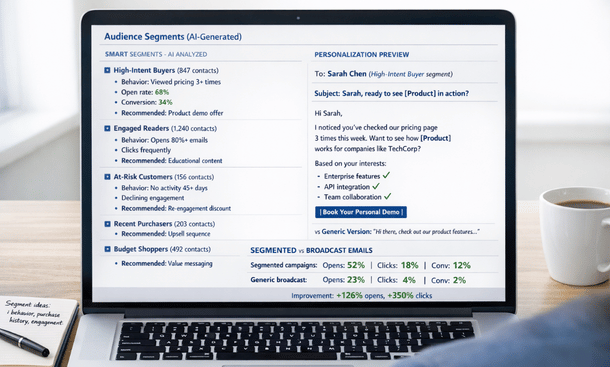
Generic email blasts to your entire list generate terrible results because different subscribers need different messages at different times. Someone who just joined your list needs nurturing content while a long-time subscriber ready to buy needs product information. Manually segmenting your list based on basic demographics barely improves performance because it misses behavioral signals that indicate real intent. AI segmentation analyzes hundreds of data points including email engagement, website behavior, purchase history, and interaction patterns to create dynamic segments that evolve as subscriber behavior changes. This level of targeting was previously only accessible to enterprises with dedicated data science teams, but AI tools now make it available to businesses of any size. To understand how segmentation fits into your complete email automation strategy, our guide on automating email marketing with AI provides the full framework.
Why basic segmentation fails most businesses
Most email marketers understand that segmentation improves results, but they implement it in ways that provide minimal benefit. The typical approach involves creating static segments based on obvious characteristics like location, industry, or how someone joined your list. These segments capture surface-level differences but miss the behavioral patterns that actually predict engagement and purchases.
Static segments become outdated quickly because they don’t adapt as subscriber behavior changes. Someone categorized as a “cold lead” when they first subscribed might have visited your pricing page five times last week, signaling hot buying intent. But if your segments don’t update based on behavior, you keep sending them educational content instead of sales messages, missing the optimal conversion window.
Manual segmentation hits scaling limits rapidly. Creating segments requires deciding on criteria, building the logic, and maintaining accuracy as your list grows. Most entrepreneurs create 3 to 5 basic segments and stop there because managing more becomes overwhelming. This limited segmentation barely scratches the surface of personalization potential.
The data lives in silos across different platforms. Email engagement data sits in your email tool, website behavior lives in analytics, purchase history exists in your e-commerce platform, and CRM data captures sales interactions. Connecting these data sources manually to create meaningful segments requires technical skills most small businesses don’t have.
How AI segmentation actually works
AI segmentation uses machine learning to analyze vast amounts of data across multiple sources and identify patterns that predict subscriber behavior. The technology handles complexity that would be impossible manually and updates segments in real-time as new data arrives.
Predictive modeling analyzes historical data to forecast future behavior. The AI examines thousands of subscribers who eventually made purchases and identifies common patterns in their behavior before buying. These patterns might include specific email engagement sequences, particular website pages visited, time spent on site, or combination of actions that correlate with purchase probability.
The system then scores your current subscribers based on how closely their behavior matches these purchase patterns. Someone exhibiting multiple high-intent signals gets a high score and moves into segments targeted with sales-focused messages. Subscribers showing low intent scores receive educational nurturing content instead.
Behavioral clustering groups subscribers with similar engagement patterns even if their demographic profiles differ. AI might discover that subscribers who open emails late at night, click on technical content, and spend significant time on documentation pages represent a distinct segment with unique needs, regardless of their job titles or company sizes.
Dynamic segment updates happen automatically as subscriber behavior changes. The moment someone’s actions indicate shifting from research mode to buying mode, they move into appropriate segments and start receiving different messaging. This real-time adaptation ensures messages always match current subscriber state rather than outdated categorizations.
The data points that matter for segmentation
Effective AI segmentation relies on quality data inputs. The more relevant information you feed the system, the more accurate and useful your segments become.
Email engagement metrics reveal how subscribers interact with your messages. Open rates, click rates, and engagement frequency indicate interest levels. But sophisticated AI goes deeper, analyzing which specific content types each person engages with, what time of day they typically open emails, how quickly they act after receiving messages, and whether engagement is trending up or down over time.
Website behavior provides crucial context beyond email interactions. Pages visited, time on site, scroll depth, and return frequency all signal intent and interest areas. Someone who visits your pricing page three times in a week shows completely different intent than someone who only reads blog posts. AI connects this website behavior to email profiles to create comprehensive subscriber understanding.
Purchase history and transaction data for existing customers enable sophisticated post-purchase segmentation. Recent purchase date, average order value, product categories bought, purchase frequency, and lifetime value all inform how you should communicate with different customer segments. High-value customers deserve different treatment than one-time bargain hunters.
Content preferences emerge from analyzing which topics, formats, and styles generate engagement from each subscriber. Some people respond to case studies while others prefer how-to content. Some engage with video while others prefer written articles. AI identifies these preferences and ensures each subscriber receives content in their preferred format about topics they care about.
Lifecycle stage indicates where each subscriber sits in their customer journey. New subscribers need different messaging than long-time followers. Active customers require different communication than lapsed users. AI automatically categorizes subscribers into appropriate lifecycle stages and adjusts messaging accordingly.
Building segments that drive revenue
The goal of segmentation isn’t creating lots of categories, it’s identifying groups that benefit from distinct messaging strategies. Start with segments directly tied to business outcomes rather than interesting but irrelevant distinctions.
High purchase intent segments
These subscribers exhibit behaviors indicating they’re close to buying. AI identifies them through patterns like repeated visits to product or pricing pages, high email engagement with sales content, abandoned cart activity, or direct inquiries about products or services.
Messages to this segment should focus on removing purchase barriers, providing social proof, offering limited-time incentives, and making buying easy. Stop sending educational content and start sending compelling offers, customer testimonials, product comparisons, and clear calls to action.
The timing matters enormously for this segment. AI should trigger messages based on intent signals rather than arbitrary schedules. When someone visits your pricing page, send a relevant email within hours, not days later when interest has cooled.
Re-engagement needed segments
Subscribers who were once active but haven’t engaged recently represent both opportunity and risk. They know your brand but lost interest for some reason. AI identifies declining engagement before complete disengagement, creating opportunities to revive the relationship.
Re-engagement messaging should acknowledge the relationship change, provide compelling reasons to pay attention again, and make re-engaging easy. Offers like “we miss you” discounts, sneak peeks of new products, or surveys asking what content they want work better than continuing to send the same content they’ve been ignoring.
Set clear thresholds for when to stop trying. Subscribers who don’t respond to multiple re-engagement attempts damage your sender reputation and deliverability. AI helps identify who’s truly unreachable versus who might respond to the right message.
High lifetime value potential
Some subscribers show characteristics that correlate with becoming valuable long-term customers even if they haven’t purchased yet. Maybe they work at companies matching your ideal customer profile, engage deeply with advanced content, or ask sophisticated questions indicating serious evaluation.
Invest more in nurturing these high-potential subscribers. Provide white-glove treatment with personalized outreach, exclusive content access, direct founder communication, or invitations to special events. The goal is converting them into customers and then maximizing their lifetime value through exceptional experience.
Product or service specific interests
Subscribers often show clear preferences for specific products, services, or topics within your business. AI identifies these interests through content engagement patterns and website behavior.
Segment by interest area and send highly targeted content relevant to each group. Someone who only engages with content about a specific product line should receive messages focused on that area rather than generic company updates. This relevance dramatically improves engagement and conversion rates.
Personalization beyond segments
Segmentation groups similar subscribers together, but true personalization customizes content for each individual. AI makes this scalable by automating personalization that would be impossible manually.
Dynamic content blocks change email content based on subscriber data. The same email campaign might show different product recommendations, testimonials, or calls to action to different recipients based on their profile and behavior. AI determines which variation each person sees.
Personalized product recommendations analyze purchase history, browsing behavior, and patterns from similar customers to suggest products each subscriber is most likely to want. This works similarly to Amazon’s recommendation engine but applies to your email marketing.
Subject line personalization goes beyond inserting first names to crafting subject lines likely to resonate with each recipient based on their engagement history. AI tests which subject line styles each person responds to and adapts accordingly.
Send time optimization at the individual level ensures each subscriber receives emails when they’re most likely to engage based on their historical open patterns. This individual optimization performs significantly better than sending all emails at the “best average time.”
Technical implementation considerations
Implementing sophisticated AI segmentation requires connecting your data sources and choosing platforms with strong AI capabilities.
Data integration challenges arise because the information you need lives across multiple systems. Your email platform, website analytics, CRM, and e-commerce platform all contain pieces of the subscriber puzzle. Look for tools that integrate these sources automatically or use customer data platforms that centralize information.
Privacy and compliance considerations matter more than ever with regulations like GDPR and CCPA. Ensure your AI segmentation complies with data privacy laws and respects subscriber preferences about how their data is used. Transparent privacy policies and clear consent mechanisms protect both you and your subscribers.
Platform selection should prioritize AI capabilities alongside traditional email marketing features. Not all platforms calling themselves “AI-powered” actually deliver sophisticated segmentation. Look for proven track records, case studies demonstrating results, and trials that let you test capabilities with your data.
Measuring segmentation effectiveness
Track metrics that reveal whether your segmentation strategy actually improves business outcomes rather than just creating busy work.
Engagement rate by segment shows which groups respond well to targeted messaging versus generic broadcasts. Well-targeted segments should show significantly higher open rates, click rates, and conversion rates than your list average.
Revenue per subscriber by segment reveals which groups generate the most value. This helps prioritize where to invest nurturing effort and which segments justify higher acquisition costs.
Segment movement tracking shows how subscribers flow between segments over time. Healthy lists show consistent movement from cold to warm to hot segments as nurturing works. Segments that never move indicate problems with messaging or targeting.
Once you’ve mastered segmentation and personalization, choosing the right platform to execute your strategy becomes critical. The technology handles complex data analysis and automation, but only if you select tools with capabilities matching your needs. Our comparison of the top 5 AI email marketing tools breaks down which platforms offer the strongest segmentation features alongside other essential capabilities for growing businesses.
About the Author

Mateo
I’m Mateo, a SaaS blogger and digital strategist dedicated to helping startups accelerate growth through automation, data-driven decision-making, and performance-focused marketing systems. Over the past few years, I’ve worked with early-stage software companies to refine their go-to-market strategies, optimize conversion funnels, and implement scalable automation frameworks that drive measurable revenue growth. On my blog, I share proven insights from real-world SaaS cases, including actionable frameworks for churn reduction, onboarding optimization, and lead-to-customer conversion. My mission is simple: to empower founders and marketers with practical strategies that turn innovative software into sustainable, profitable success.
Did you find this helpful?
Your feedback helps us curate better content for the community.