
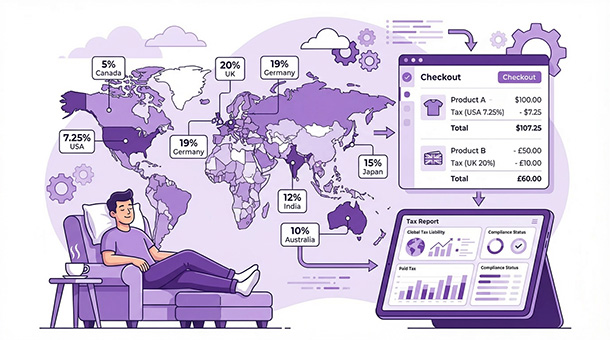
You sell to customers in California, London, and Sydney. California charges 7.25% sales tax, the UK charges 20% VAT, and Australia charges 10% GST. Calculating this manually for every transaction is impossible, and getting it wrong means fines. A backend uses tax automation APIs like TaxJar or Avalara to calculate the correct tax based on customer location, product type, and local regulations. It adds the tax to the checkout total, collects it, and stores records for your accountant. Subscription billing becomes more complex when you add international taxes, as covered in managing monthly memberships automatically.
Why tax compliance terrifies founders more than any other legal issue
Most founders ignore tax compliance until they receive a letter from a government agency demanding back taxes, penalties, and interest. By then, the amount owed has compounded across months or years of uncollected taxes, and the legal fees to resolve the situation cost more than the taxes themselves.
The problem isn’t that founders are dishonest. It’s that tax rules are genuinely complicated and change constantly. The United States alone has over 11,000 tax jurisdictions, each with different rates, exemptions, and filing requirements. A software subscription sold to a customer in New York is taxed differently than the same subscription sold to someone in Texas. A physical product shipped to Colorado has different tax rules than a digital download delivered to the same address.
International sales add another layer of complexity. The European Union requires you to collect VAT from customers based on their country, not yours. If you sell a $50 software subscription to someone in Germany, you owe the German government 19% VAT on that sale, regardless of where your business is incorporated. Missing this obligation creates legal exposure in every country where you have customers.
A backend connected to tax automation software handles all of this silently. You focus on selling, the backend handles compliance.
How backends calculate tax without slowing down checkout
Tax calculation needs to happen in milliseconds during checkout. A customer enters their shipping address, and your checkout page needs to display the correct tax amount before they confirm the purchase. If this calculation takes five seconds, customers assume your site is broken and abandon the cart.
Your backend calls a tax API the moment a customer enters their address. The API receives the customer’s location, the product type, and the sale amount, then returns the correct tax rate within 100-200 milliseconds. Your backend adds this to the order total and displays it on the checkout page before the customer clicks “buy now.”
The tax API handles all the complexity behind the scenes. It knows that software subscriptions are taxable in some US states but exempt in others. It knows that groceries have different tax rates than electronics in the UK. It knows which EU countries have reduced VAT rates for digital services. You don’t need to store or maintain any of this knowledge, the API updates automatically when tax laws change.
Understanding how your entire checkout flow connects, from payment processing to tax calculation to inventory updates, becomes much clearer when you see the full picture. If you’re still mapping out how these backend systems work together, start with how a backend handles your digital cashier, which explains the complete transaction workflow in plain business terms.
After the customer completes checkout, your backend stores the full tax breakdown in your database: the customer’s location, the applicable tax rate, the tax amount collected, and the tax jurisdiction. This record becomes the foundation of your tax filings at the end of each quarter.
The nexus problem that catches founders by surprise
In the United States, you’re only required to collect sales tax in states where you have “nexus,” a legal term meaning a significant business presence. Historically, nexus meant having a physical office or warehouse in a state. In 2018, the Supreme Court changed this with a ruling that allows states to require tax collection based on economic activity alone.
Now, if you sell more than $100,000 worth of products or complete more than 200 transactions in a state within a year, you have economic nexus there and must collect sales tax. With 45 US states charging sales tax, a growing online business can quickly develop nexus obligations in dozens of states without realizing it.
Your backend tracks cumulative sales by state automatically. When you approach the nexus threshold in a new state, it alerts you so you can register for a sales tax permit before your next transaction triggers an obligation. Once registered, the backend automatically collects tax from customers in that state going forward.
Missing nexus obligations is one of the most common and expensive tax mistakes online businesses make. The backend catches these thresholds passively, requiring no manual monitoring on your part.
VAT for European customers explained simply
Value Added Tax, the European system for taxing goods and services, works differently from US sales tax in ways that trip up American founders selling internationally.
In the US, sales tax is collected by the seller and remitted to the state. In Europe, VAT is a national tax that applies at every stage of the supply chain, but for digital services sold directly to consumers, the practical effect is simple: you collect VAT from European customers and remit it to their government.
The EU created a system called the One Stop Shop that simplifies this enormously. Instead of registering for VAT in every EU country where you have customers, you register in one EU country and file a single quarterly return covering all EU sales. Your backend calculates the correct VAT rate for each EU country, collects it at checkout, and generates the reports needed for your One Stop Shop filing.
The UK left the EU in 2020 and now has its own separate VAT system requiring its own registration if your UK sales exceed £85,000 annually. Your backend handles UK VAT separately from EU VAT, applying the correct 20% standard rate and storing UK-specific records for HMRC filings.
For founders who sell digital products globally, your backend might be calculating and collecting taxes for 50+ countries simultaneously. Each tax is calculated correctly, collected from the customer, and stored in your database waiting for quarterly filing. Without automation, this process would require a full-time tax accountant.
Product taxability rules that change everything
Not all products are taxed the same way, even within the same jurisdiction. This catches founders off guard when they assume a flat tax rate applies to everything they sell.
In the United States, groceries are often exempt from sales tax or taxed at reduced rates. Prescription medications are exempt in most states. Clothing is exempt in Pennsylvania, New York, and Minnesota. Digital products like software, ebooks, and streaming services have wildly inconsistent treatment, taxable in some states, exempt in others, taxable only above certain price thresholds in a few states.
Your backend assigns a product category code to each item you sell. The tax API uses this code to determine taxability in each jurisdiction. A children’s clothing item sold to a customer in Pennsylvania correctly shows zero tax at checkout. The same item sold to a customer in California correctly shows 7.25% tax. You don’t need to know these rules, the tax API knows them and your backend applies them automatically.
This becomes especially important for software businesses. If you sell both a one-time software license and a monthly SaaS subscription, these might be taxed differently in the same state. The backend applies the correct rule to each product type without mixing them up.
Storing tax records that survive an audit
Tax authorities can audit your business for up to seven years in most jurisdictions. An audit requires you to prove exactly how much tax you collected from each customer, on which products, in which jurisdictions, on which dates. Reconstructing this information from incomplete records is painful and expensive.
Your backend stores a complete tax record for every transaction automatically. Each record includes the transaction date, customer location, product purchased, gross sale amount, applicable tax rate, tax amount collected, and tax jurisdiction. These records are immutable, meaning they can’t be accidentally modified or deleted.
When your accountant prepares quarterly tax filings, they export these records from your database in the exact format required by each tax authority. When an auditor requests documentation, you generate a report covering every transaction in the audit period within minutes. No hunting through email receipts, no reconstructing records from bank statements, no gaps in your documentation.
The cost of poor record-keeping during an audit isn’t just back taxes owed. Tax authorities add penalties for inadequate documentation, interest on unpaid amounts, and in serious cases, can assess taxes based on estimates that may be far higher than your actual liability. Proper records stored in your backend protect you from all of these scenarios.
When to register for tax collection in new markets
Expansion into new markets triggers new tax obligations. Opening a warehouse in Texas creates sales tax nexus there immediately. Hiring a remote employee in Florida creates nexus in Florida from their first day. Attending a trade show in Illinois for more than a few days might create temporary nexus depending on state rules.
Your backend tracks your business’s tax exposure across all jurisdictions as your business grows. Combined with a tax automation service, it alerts you when new obligations arise so you can register proactively instead of discovering the obligation during an audit.
The registration process itself is straightforward for most US states: fill out an online form, receive a permit number, add it to your tax records. Some states take a few days, others are instant. Your backend stores each permit number and associates it with the correct jurisdiction so tax collection in that state activates immediately after registration.
International registration is more complex and usually requires local legal advice. But the backend handles the technical implementation once registration is complete, calculating and collecting the correct taxes without further configuration.
Why automating taxes costs less than ignoring them
Tax automation software costs $19-99 monthly depending on transaction volume and the number of jurisdictions you operate in. This covers automatic rate calculations, nexus monitoring, filing reports, and record storage.
Compare this to the alternative. A tax accountant charges $150-300 per hour. Manually tracking tax obligations across multiple jurisdictions takes 5-10 hours monthly at minimum. That’s $750-3,000 monthly in accounting fees just for compliance work, not strategic tax planning.
And those costs assume you’re doing everything correctly. A single audit that reveals uncollected taxes can result in back tax bills covering three years of sales, plus penalties and interest. A $500,000 revenue business that failed to collect sales tax in five states could face a $50,000+ bill from a single audit. Tax automation costs $1,200 annually. The risk of skipping it is catastrophic.
Here is the corrected closing paragraph:
Once tax collection runs automatically, the next layer of payment protection involves stopping bad actors from making fraudulent purchases that create fake tax liabilities and chargebacks. Using your backend to spot bad actors before they buy addresses this problem before it costs you money. And when customers complete legitimate purchases, automating the receipt sequence keeps them informed and builds the trust that drives repeat business. Automating order confirmations and thank you emails turns every successful transaction into a customer retention opportunity.
About the Author

AISalah
Bridges linguistics and technology at PointOfSaaS, exploring AI applications in business software. English Studies BA with hands-on back-end and ERP development experience.
Did you find this helpful?
Your feedback helps us curate better content for the community.