

I want to start with a question that sounds obvious but rarely gets a straight answer: what does going digital actually mean for a small business?
Not for a corporation running a five year digital transformation initiative with a dedicated technology budget and a team of consultants. For a founder managing a five-person operation from a home office in Florida. For an independent contractor who wants to stop losing hours every week to processes that should not require human intervention. For an early-stage startup trying to build operational infrastructure without burning the budget on software nobody ends up using.
The phrase gets used constantly. It shows up in business articles, in startup communities, in conversations between founders who are clearly trying to do something with technology but are not entirely sure what that something should look like. Most of the time it gets treated as self-explanatory as though the phrase contains its own definition and everyone listening already knows what it means.
They do not. And that gap between the phrase and its practical meaning at small business scale is the source of more wasted time and money than almost any other confusion I have seen in the SaaS space.
What going digital is not
The fastest way to a useful definition is starting with what going digital is not because the misconceptions are what send founders down the wrong path.
Going digital is not about having more technology. A business can subscribe to fifteen SaaS tools and still be fundamentally manual in its operations if those tools are not connected, not adopted consistently and not mapped to the workflows they were supposed to improve. The number of subscriptions is not the measure. What the subscriptions actually change about how the business operates is the measure.
Going digital is not about keeping up with trends. The businesses that adopt technology most effectively are not the ones chasing whatever was featured on Product Hunt last week. They are the ones that identified specific operational friction points tasks that take too long, information that gets lost, handoffs that require manual coordination and chose tools that address those friction points directly. Trend-driven adoption almost always produces a stack full of impressive tools that nobody uses consistently.
Going digital is not a one-time project. This is the misconception that produces the most expensive failures. A founder spends a weekend setting up a project management tool, announces to the team that the business is now digital and moves on to the next priority. Three months later the tool is abandoned and the business is operating the same way it was before. Going digital is not a configuration exercise. It is a behavioral change process that requires ongoing maintenance not indefinitely intensive maintenance but consistent enough to sustain the habits that make the tools deliver their value.
The practical definition that actually helps
Going digital for a small business means systematically replacing manual, informal or fragmented processes with software that reduces friction, increases visibility and scales without proportionally increasing the time or headcount required to manage the work.
Every word in that definition is doing specific work.
Systematically not randomly or reactively. The businesses that successfully go digital do so with a deliberate sequence rather than adding tools whenever a problem becomes painful enough. Systematic does not mean slow. It means intentional.
Replacing manual processes not supplementing them. One of the most common and most expensive going-digital mistakes is adding software alongside existing manual systems rather than replacing them. The result is a business running two parallel systems the new digital one and the old informal one with team members spending energy on both rather than fully committing to either. Digital adoption only delivers its value when the manual process it was meant to replace actually stops.
Reduces friction the operational definition of whether a tool is working. If a SaaS tool makes something harder rather than easier it is either the wrong tool for that workflow or the wrong tool for that team and both of those are important signals that the evaluation process should surface before the subscription starts.
Scales without proportionally increasing headcount this is the compounding value proposition of getting digital adoption right. A business that has systematically replaced manual coordination with software can take on more clients, deliver more work and grow its revenue without a proportional increase in the overhead required to manage operations. That leverage is what going digital actually promises when it delivers on its potential.

The three layers of going digital for a small business
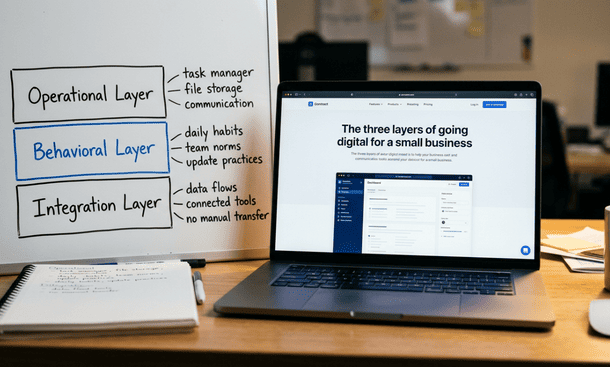
Going digital at small business scale involves three distinct layers. Understanding each one separately helps explain why so many digital initiatives produce partial results the founder addresses one or two layers and leaves the others untouched.
The operational layer covers the tools that manage the actual work project management, task tracking, file storage, communication and scheduling. This is usually the first layer founders address because it is the most visible. Missed deadlines, lost information and chaotic team coordination are painful enough that the motivation to add a tool is high. The challenge is that operational tools only deliver their full value when team members actually use them consistently which requires the second layer.
The behavioral layer covers the habits, norms and practices that determine whether operational tools get used or bypassed. This is the layer most founders skip entirely. Choosing the tool and configuring it is the part that gets done. Establishing the specific daily practices around it who updates what, when tasks get logged, what communication belongs in the tool versus in a text message is the part that determines whether the tool actually changes how the business operates. No amount of good software compensates for absent behavioral infrastructure.
The integration layer covers the connections between individual tools that allow information to flow across the stack without manual intervention. A project management tool that does not talk to the CRM means client information has to be entered twice. An invoicing platform that does not connect to the accounting software means manual reconciliation every month. A communication tool that operates in complete isolation from the project management tool means decisions get made in one place and recorded nowhere accessible. The integration layer is what separates a tool collection from a coherent stack.
Most small businesses address the operational layer. Fewer address the behavioral layer with the same seriousness. Fewer still build the integration layer intentionally rather than discovering its absence after the stack is already in place.
What this looks like in a real business
The most useful way to make the definition concrete is through a specific scenario that most small business founders will recognize.
A five-person marketing agency in Tampa has been operating for two years. The team is talented. The work is good. But the operations are a mess. Project status lives in the founder’s head and in a shared Google Doc that nobody updates consistently. Client feedback arrives through email, text messages and the occasional voice note. Invoices go out late because the founder has to manually check what was delivered before billing. New team members take three weeks to get up to speed because the knowledge about how things work is distributed across conversations and memory rather than documented anywhere.
That agency is not failing to go digital because it lacks access to tools. It is failing because it has not systematically addressed the three layers. The operational tools are partially in place Google Drive, some email templates, a Slack workspace that mostly serves as a general chat room. The behavioral layer does not exist there are no defined practices around how work gets logged, communicated or tracked. The integration layer is nonexistent every system is an island.
Going digital for that agency looks like choosing one tool per operational category, connecting those tools to each other at the critical handoff points and establishing the specific team practices that make using the tools the path of least resistance rather than an additional obligation. That is not a technology project. That is an operational design project that happens to use technology.
Why the definition matters before the tools do
The reason so much energy gets spent on which tool to choose rather than on what going digital actually means is that tools are tangible. You can sign up for them, configure them, screenshot them and show them to a client. The operational design work that determines whether those tools deliver value is invisible until it either works or it does not.
Founders who start with the definition what specific processes are we replacing, what does the behavioral layer need to look like, what integrations are critical make better tool decisions because they are evaluating options against a clear standard rather than against an abstract hope that something will feel better than what they have now.
That clarity is also what prevents the most expensive mistake in the going-digital journey: adding tools before the foundation is ready to support them. A CRM adopted before the team has a consistent practice around logging client interactions is a CRM that will hold incomplete data and erode trust in the system within months. A project management tool adopted before communication norms are established is a project management tool that will be used inconsistently and eventually bypassed for email and text.
Understanding why so many small businesses struggle with digital adoption despite genuinely trying to make it work takes the definition further into the specific patterns that cause well-intentioned digital initiatives to stall and what distinguishes the businesses that break the cycle from the ones that keep repeating it with a different subscription.
Going digital for a small business is not about technology. It is about operational design. The technology is the implementation layer of a decision that starts with identifying what needs to change about how the business operates what is manual that should not be, what is invisible that should be tracked, what requires coordination overhead that a connected system could eliminate.
Founders who approach going digital as a technology project tend to end up with expensive tool collections that require as much maintenance as the manual systems they replaced. Founders who approach it as an operational design project tend to end up with a stack that compounds value over time each tool working with the others, each layer reinforcing the next and the whole system delivering the leverage that going digital actually promises.
The first step is defining what you are actually trying to build before deciding what tools will help you build it.
Once that definition is clear the natural next question is understanding why so many businesses get the process wrong even when the intent is right and that diagnosis is exactly what why digital transformation fails small businesses so often and what the real causes look like in practice breaks down in full.
About the Author

Pamela
Pamela is a dynamic professional with a deep passion for SaaS and emerging technologies. She provides valuable insights into software trends, digital innovation, and cutting-edge tools that empower businesses to thrive and expand.
Did you find this helpful?
Your feedback helps us curate better content for the community.