

Getting your team into Basecamp is the easy part. Getting them to actually use it the way it was designed to be used that is a different problem entirely and it is the one most founders do not anticipate until they are already inside it.
Basecamp is not a neutral tool that adapts to any communication style. It has a specific philosophy about how work should be organized and discussed and that philosophy requires a genuine behavioral shift for most teams coming from Slack-heavy, task-manager-dependent workflows. The shift is not dramatic. But it is real. And without the right adoption approach it tends to get bypassed quietly rather than embraced with team members using Campfire for everything, skipping the message board entirely and eventually treating Basecamp as a slightly better version of the disorganized systems they were using before.
Every adoption challenge in Basecamp comes from the same root cause: team members not understanding or not accepting the distinction between what belongs in a message board and what belongs in Campfire. Once that distinction is genuinely internalized adoption tends to be stable. Until it is the tool runs below its potential regardless of how well it was set up.
Why Basecamp adoption fails differently than other tools
Most project management tools fail at adoption because they are too complex. Basecamp fails at adoption for a different reason it is too unfamiliar in its communication structure for teams conditioned by years of instant messaging culture.
The message board format specifically is the point of resistance. Slack, Teams and even email have trained most professionals to expect communication that is fast, conversational and immediately visible to everyone in the channel. Basecamp’s message board asks for something different written communication that is deliberate, named, organized by project and designed to be readable in context weeks after it was posted.
That is not a step backward. For most small businesses it is a significant operational improvement over the buried-conversation problem that instant messaging creates. But it requires a conscious adjustment that does not happen automatically when someone creates an account and gets invited to a project.
The second structural challenge is Basecamp’s project-centric organization. Most people are accustomed to viewing work through a personal task lens what am I assigned, what is due today, what do I need to do next. Basecamp surfaces work through a project lens here is everything happening in this project, here is who is involved, here is where things stand. That shift requires a different habit of navigation and team members who do not understand why the tool is structured that way tend to find it disorienting rather than clarifying.
The adoption conversation that most founders skip
The most reliable adoption accelerator for Basecamp is not a training session or an onboarding document. It is a direct conversation with your team before they log in for the first time about the specific operational problem Basecamp is solving.
Not the features it has. The problem it is solving.
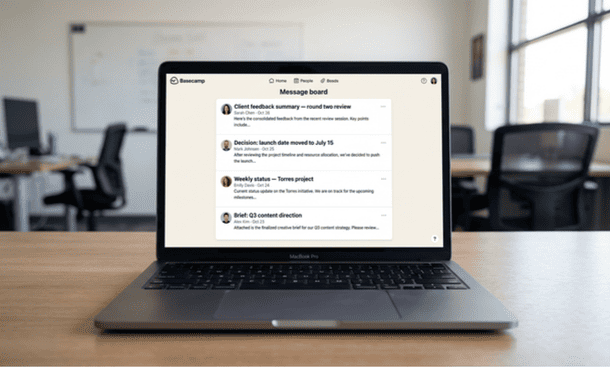
If your team has experienced the frustration of losing important context in a Slack thread — a decision that was made but cannot be found, a project brief that got buried three weeks ago, a client feedback summary that exists somewhere in a DM chain that frustration is the reason Basecamp’s message board exists. Connect the tool to the problem your team has already felt and adoption motivation shifts from “I was told to use this” to “I understand why this is better.”
This conversation takes 15 minutes. Hold it before the first login. The difference in adoption trajectory it produces is significant enough that it is the single most valuable 15 minutes in any Basecamp implementation.

Establishing the message board versus Campfire norm
This is the specific behavioral norm that determines whether Basecamp functions as designed or collapses into another general chat room.
The distinction is straightforward to explain but requires consistency to maintain. Campfire is for quick, ephemeral communication short questions, brief updates, casual coordination that does not need to be findable later. The message board is for anything that needs to be accessible in context project briefs, decisions, feedback summaries, status updates, anything that a team member who missed the original conversation would need to find and understand independently.
The practical test is simple: if someone joining the project three weeks from now would need to find this communication to understand what has happened so far it belongs on the message board. If it would be irrelevant or confusing out of context it belongs in Campfire.
Post this distinction clearly in the HQ message board before your team joins. Reference it in the team walkthrough. And for the first two weeks actively model the behavior yourself — when you have something that belongs on the message board, put it there rather than typing it quickly into Campfire because that is faster in the moment.
The first two weeks of any team’s Basecamp use tend to set the pattern that persists for months. If those two weeks establish the message board as the default for important communication the habit forms correctly. If those two weeks establish Campfire as the default for everything the product’s main value proposition has already been undermined.
How to handle team members who resist the format
Resistance to the message board format is the most common adoption friction in Basecamp implementations and it almost always comes from the same place: the friction of writing a formatted, named post when a quick message would feel faster.
The resistance is understandable. Writing a message board post does require slightly more effort than sending a Slack message. The value of that effort a piece of communication that is organized, searchable and readable in context months later is not immediately obvious until someone actually needs to find something that would have been lost in a chat thread.
Two approaches address this resistance effectively.
The first is demonstrating the value of the message board through a specific example from your own business. Find a moment when your team needed to locate a piece of communication from the past and could not find it or found it only after significant searching because it lived in a chat thread. That experience is the most persuasive argument for the message board format because it makes the cost of instant messaging visible rather than theoretical.
The second is lowering the bar for what constitutes a message board post. Some team members resist the format because they imagine every post needs to be a well-formatted document. It does not. A message board post can be three sentences. It can be a quick summary of a decision made in a meeting. It can be a brief status update on a project milestone. The format does not require formality it requires deliberateness. That distinction is worth making explicitly.
Getting consistent task updates from the whole team
The second most common Basecamp adoption problem after the message board resistance is inconsistent task updates. Tasks get created correctly. They do not get marked complete when the work is done. They do not get updated when something changes. The to do list becomes an unreliable picture of project status and the founder ends up sending messages asking for updates that the tool was supposed to eliminate.
This problem has two causes and both need to be addressed directly.
The first is habit gap. Most people are not accustomed to closing the loop on a task explicitly. They complete the work, move to the next thing and do not think to return to the tool and mark the task done. The fix is behavioral establishing a daily practice of spending five minutes at the end of the workday reviewing assigned tasks and updating their status. A short daily review is more effective than any reminder system because it builds the habit of treating task status as a professional responsibility rather than an administrative afterthought.
The second is task quality. When tasks are named vaguely “website update” rather than “upload revised homepage copy to staging server” it is genuinely unclear when the task is complete. Vague tasks produce uncertain completion because team members are not sure whether the task is fully done or only partially done. The fix is at the creation stage: specific, action-oriented task names that describe what done looks like make marking completion obvious rather than ambiguous.
Hold the task update norm to the same standard as the message board norm. Inconsistency during the first two weeks becomes the expected behavior. Consistency during the first two weeks becomes the habit that makes Basecamp a reliable operational system rather than a partially used reference tool.
The check in that prevents drift
Every Basecamp implementation starts to drift somewhere between week three and week six. The initial motivation has faded. Team members have started making small concessions to convenience a quick Slack message instead of a Campfire post, a task marked done without updating the description, a decision made in a DM that should have been posted on the message board.
Each individual concession feels minor. Accumulated over three weeks they represent a gradual return to the pre-Basecamp operating mode which was the reason you switched tools in the first place.
A structured check-in at week four prevents drift from becoming an established pattern. Not a formal review a direct 20-minute conversation with your team asking three questions. What are you still doing outside Basecamp that should be inside it? What part of the current setup feels wrong for how you actually work? And what one change would make you more likely to use the tool consistently?
Address the top two issues from that conversation before week five. Small adjustments at this stage restructuring a to-do list, clarifying a communication norm, renaming a project have an outsized effect on whether the adoption trajectory continues upward or levels off at partial use.
The goal of the check-in is not to solve every problem. It is to signal to your team that their experience of the tool matters and that the implementation is being maintained rather than abandoned after launch. That signal alone tends to increase voluntary adoption more than any feature or reminder system.

The adoption metric that tells you everything
Most founders do not track Basecamp adoption in any structured way. They have a general sense of whether the team is using it based on whether they personally see activity but no specific signal that tells them whether the implementation is on track or quietly sliding backward.
One metric covers most of what you need to know: the ratio of decisions and updates posted on the message board versus communicated through other channels in any given week.
If important project decisions are consistently showing up on the message board rather than in Slack, email or verbal conversations the implementation is working as designed. If important decisions are happening outside Basecamp and only occasionally making it onto the board the implementation is drifting regardless of how active Campfire looks.
That ratio is observable without any formal tracking. Spend five minutes at the end of each week asking whether the major decisions and updates from the past five days are findable in Basecamp. If they are the tool is serving its primary purpose. If they are not the drift is happening and the week-four check-in conversation needs to happen sooner.
Before building any adoption strategy it helps to ground the approach in a complete understanding of what Basecamp is actually designed to accomplish as a project management system for small businesses because adoption strategies work best when they are aligned with the product’s genuine purpose rather than trying to make it behave like a different tool.
Basecamp adoption is not a technical challenge. It is a behavioral one. The message board versus Campfire distinction is the central habit that determines whether the product delivers its full value. The task update norm is what makes the to-do system trustworthy. The week-four check-in is what prevents the gradual drift back to pre-Basecamp operating modes.
None of those things require technical skill or extensive time investment. They require consistency holding the norms, modeling the behavior and maintaining the implementation rather than building it once and assuming it will sustain itself.
Get the adoption right and Basecamp becomes the operational center of the business. Get it wrong and you end up with a well-configured workspace that the team uses inconsistently and eventually stops advocating for.
Before investing further in Basecamp it is also worth being honest about one more question whether Basecamp is genuinely the right tool for your specific business or whether there is a scenario where a different platform would serve you better. That honest disqualification framework is exactly what when Basecamp is the wrong choice and what to use instead covers directly.
About the Author

Pamela
Pamela is a dynamic professional with a deep passion for SaaS and emerging technologies. She provides valuable insights into software trends, digital innovation, and cutting-edge tools that empower businesses to thrive and expand.
Did you find this helpful?
Your feedback helps us curate better content for the community.