

So you’ve been hearing everyone from San Jose to San Diego talking about ERP analytics, but you’re still not totally sure what the hype’s about? You’re definitely not alone, dude. ERP analytics is basically the secret sauce that turns all that messy data sitting in your system into crystal-clear business insights that actually help you make smarter decisions. Before we dive deep, though, it helps to understand how this fits into the bigger picture of how California entrepreneurs are turning data into million-dollar decisions. Let’s break down exactly what ERP analytics is and why your startup probably needs it.
Understanding ERP analytics from the ground up
ERP stands for enterprise resource planning, which sounds super corporate and boring, but stick with me here. Think of your ERP system as the central nervous system of your business. It connects everything from your inventory and accounting to your sales pipeline and customer data. Now, ERP analytics is the brain that makes sense of all those signals.
Here’s the thing most founders miss. You’re already collecting mountains of data every single day. Every sale, every expense, every customer interaction, every inventory movement. That data is just sitting there in your system doing absolutely nothing unless you have a way to analyze it and extract meaningful patterns.
ERP analytics takes that raw data and transforms it into actionable intelligence. Instead of wondering why your cash flow is tight or guessing which products are actually profitable, you get concrete answers based on real numbers. It’s like having X-ray vision into your business operations.

The core components that make ERP analytics work
Breaking this down into digestible pieces, ERP analytics typically includes four main components that work together to give you that competitive edge.
First up is data integration. Your ERP analytics platform pulls information from all your different business systems into one unified view. That means your accounting software, CRM, inventory management, and everything else talks to each other automatically. No more manually exporting CSV files and trying to match up data in Excel at midnight.
Second is data visualization. Numbers in spreadsheets are cool and all, but your brain processes visual information way faster. ERP analytics creates dashboards with charts, graphs, and other visual elements that let you spot trends and anomalies in seconds instead of hours.
Third is reporting automation. Instead of spending your Friday afternoons building reports for your team or investors, the system generates them automatically. You can schedule daily sales reports, weekly inventory updates, or monthly financial summaries that just show up in everyone’s inbox without you lifting a finger.
Fourth is predictive analytics. This is where things get really interesting. The system doesn’t just tell you what happened last month. It uses historical patterns to forecast what’s likely to happen next quarter, helping you make proactive decisions instead of reactive ones.
Why California startups are obsessing over ERP analytics right now
The startup ecosystem here in California is ridiculously competitive. Whether you’re in tech, e-commerce, manufacturing, or services, you’re fighting for market share against companies that are leveraging every possible advantage. ERP analytics has become one of those non-negotiable advantages.
I was talking to a friend who runs a small e-commerce company in Irvine last month. She told me that before implementing ERP analytics, she was basically flying blind. She knew her revenue numbers, sure, but she had no idea which marketing channels were actually profitable after accounting for returns and customer service costs. Once she got her analytics dialed in, she discovered that Instagram ads were losing her money while Google Shopping was crushing it. That single insight let her reallocate her budget and increase profitability by 30 percent in one quarter.
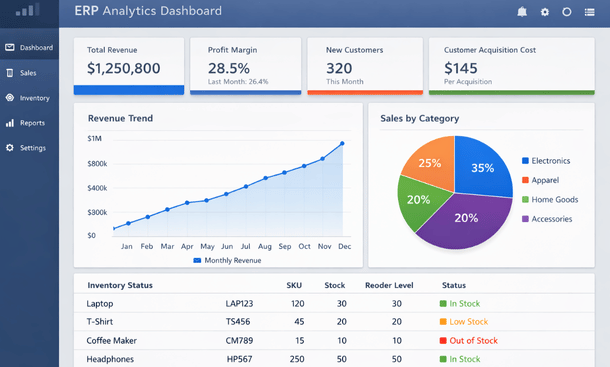
That’s the power of having visibility into your operations. You stop making decisions based on gut feelings and start making them based on evidence.
The difference between basic reporting and true analytics
Here’s something that confuses a lot of founders. Basic reporting and analytics are not the same thing, even though people use those terms interchangeably all the time.
Basic reporting tells you what happened. Your revenue last month was $50,000. Your inventory turnover was 4.2. Your customer acquisition cost was $75. Those are facts, and they’re useful, but they’re backward-looking.
True analytics goes deeper. It answers the why and the what-if questions. Why did revenue drop 15 percent in week three? What if we increased our marketing spend by 20 percent? Which customer segments are most likely to churn in the next 90 days?
Analytics uses techniques like trend analysis, cohort analysis, and predictive modeling to help you understand the drivers behind your numbers and anticipate future outcomes. That’s the difference between managing your business through the rearview mirror versus actually steering it forward.
Common misconceptions about ERP analytics for small businesses
Let me bust a few myths real quick because these misconceptions stop a lot of founders from even exploring ERP analytics.
Myth number one is that it’s only for big corporations. People hear “enterprise” and assume it’s not for their 10-person startup. That’s completely wrong. Modern ERP analytics platforms scale beautifully for small businesses, and honestly, small companies often benefit more because they’re more agile and can act on insights faster.
Myth number two is that it’s crazy expensive. Sure, enterprise-level systems can cost six figures, but there are tons of SaaS options now that run a few hundred bucks a month. When you consider that most founders waste way more than that on inefficient operations, the ROI is actually insane.
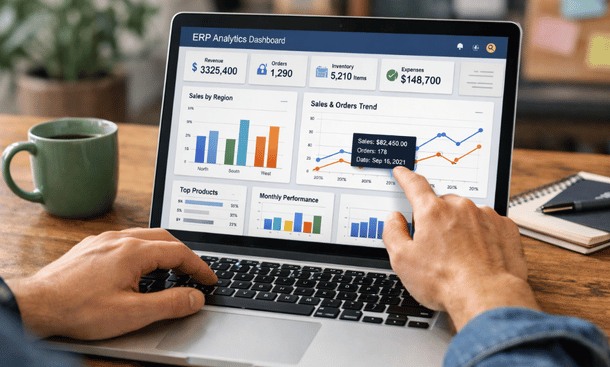
Myth number three is that you need a data science degree to use it. The whole point of modern ERP analytics is that it’s designed for business people, not statisticians. If you can use Google Maps, you can navigate an analytics dashboard.
Getting started with ERP analytics as a founder
If you’re sold on the concept but not sure where to begin, here’s the practical path forward.
Start by auditing what data you’re already collecting. Most businesses have way more data than they realize. Log into your accounting software, your CRM, your e-commerce platform, whatever systems you use daily. That’s your raw material.
Next, identify your biggest blind spots. What questions do you wish you could answer about your business but can’t right now? Maybe it’s understanding your true profit margins by product. Maybe it’s knowing which salespeople are bringing in the highest-value customers. Whatever keeps you up at night, write it down.
Then explore tools that can connect to your existing systems. You don’t need to rip out your entire tech stack. Look for analytics platforms that integrate with what you already use. Most modern tools have APIs and pre-built connectors that make integration relatively painless.
Finally, start small and expand gradually. Pick one dashboard or one report that would make your life significantly easier, get that working smoothly, then add more over time. Trying to build a comprehensive analytics system overnight is a recipe for frustration and abandonment.
The real-world impact on decision making
What actually changes when you have solid ERP analytics in place? Everything, basically.
Your team meetings become way more productive because you’re discussing actual data instead of opinions. Your financial planning gets more accurate because you’re forecasting based on trends instead of hope. Your inventory management improves because you know exactly what’s selling and what’s gathering dust.
I’ve seen founders use ERP analytics to identify their most profitable customer segments and double down on targeting those personas. I’ve watched companies catch cash flow problems weeks before they would’ve hit crisis mode. I’ve heard stories of businesses discovering that their best-selling product was actually losing them money once all costs were factored in.
These aren’t theoretical benefits. This is the stuff that determines whether your startup thrives or just survives.
Wrapping up your ERP analytics journey
Understanding what ERP analytics is represents the crucial first step toward running a genuinely data-driven business. Once you grasp these fundamentals, the natural next move is figuring out which specific tools and platforms will work best for your unique situation and budget.
Ready to explore your options? Check out our comparison of the best ERP analytics tools California entrepreneurs use to find the perfect match for your startup. And if you want the complete picture of how all these pieces fit together, dive into our comprehensive ERP analytics guide for California entrepreneurs where we cover everything from selection to implementation to optimization.
About the Author

mike
Mike is a tech enthusiast passionate about SaaS innovation and digital growth. He explores emerging technologies and helps businesses scale through smart software solutions.
Did you find this helpful?
Your feedback helps us curate better content for the community.