
Table of contents
- The geography problem nobody warns first-time founders about
- What a CDN actually is (and the warehouse analogy that makes it click)
- How a CDN works step by step
- Where your content lives without a CDN
- What changes when a CDN enters the picture
- What this means for your business in real numbers
- How BaaS platforms handle CDN setup for you
- The one thing to check in your BaaS dashboard today
Your app works perfectly. Your co-founder in Austin loves it. Your beta tester in Chicago says it feels snappy. Then a user in Berlin sends you a message: “This thing is painfully slow.” You check everything on your end and find nothing wrong. No errors, no crashes, no obvious culprits. The problem is not your code. It is the distance between your server and your user.
This is the geography problem that catches most first-time founders off guard, and it is one of the most common reasons a technically sound app still delivers a frustrating experience to a significant portion of its users. A content delivery network, the technology that solves this problem, is one of the most impactful infrastructure decisions you will make — and on most modern BaaS platforms, it is already made for you.
The geography problem nobody warns first-time founders about
When you deploy your app, your backend lives on a server in a specific physical location. That might be a data center in Virginia, Oregon, or Frankfurt depending on which cloud provider your BaaS uses and which region you selected at setup. Every time a user anywhere in the world opens your app and asks it to do something, that request travels from their device to your server and back.
At the speed of light, this sounds trivial. In practice, it is not. A round trip from Sydney to a server in Virginia can add 200 to 300 milliseconds of pure travel time to every single request, before your app has done a single calculation. For a user opening a page that makes a dozen requests to load properly, that delay compounds fast.
The technical term for this travel time is latency, the gap between when a user asks for something and when the response starts arriving. High latency is not a bug you can fix in your code. It is a physics problem. The only real solution is to move the content closer to where your users are.
This is not a problem that only affects global apps with users on every continent. If you are a UK-based founder whose backend sits on a US server, every single one of your local users is already experiencing this. Geography does not care about your roadmap.
What a CDN actually is (and the warehouse analogy that makes it click)
A content delivery network is a system of servers distributed across multiple locations around the world. Instead of every user request traveling all the way to your single origin server, a CDN intercepts those requests and serves the content from whichever server is closest to the user.
Think of it like a national distribution network for a retail brand. Your main warehouse — the origin server — holds the master inventory. But rather than shipping every customer order directly from that one central location, the brand keeps smaller fulfillment centers in major cities around the country. When someone in Manchester places an order, it ships from a fulfillment center in Leeds, not from a warehouse in Texas. The product is identical, the delivery is dramatically faster, and the main warehouse is not buried under the weight of every single request.
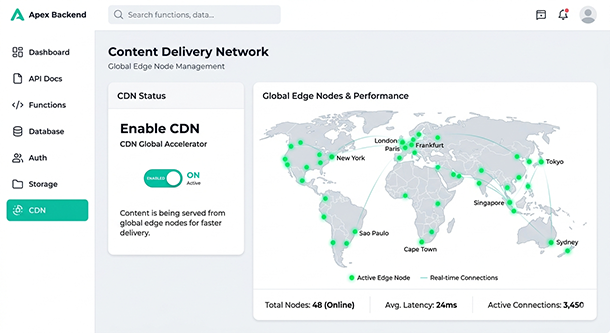
A CDN works the same way with your app’s content. Static assets like images, stylesheets, and scripts get copied to dozens or hundreds of edge locations around the globe. When a user in Tokyo opens your app, those assets load from a server in Tokyo — or close to it — rather than from wherever your origin server happens to sit.
The result is not a marginal improvement. For users far from your origin server, a properly configured CDN can cut load times in half or better. For a SaaS product where the first impression determines whether a trial user converts, that difference is not cosmetic — it is commercial.
How a CDN works step by step
Where your content lives without a CDN
Without a CDN, your architecture is a straight line. A user opens your app, a request leaves their device, travels across the internet to your single server, your server processes it and sends back the response, and the response travels all the way back. Every user in the world, regardless of where they are, makes that same full round trip every time.
This works fine at small scale with a geographically concentrated user base. The moment your users are spread across different countries, or your app starts gaining traction in regions you did not specifically target, the cracks appear. Some users will have a noticeably worse experience than others through no fault of their own, and you will have no clean technical explanation to give them.
What changes when a CDN enters the picture
When a CDN is in place, the architecture becomes a network rather than a straight line. Your origin server still exists and still holds your master data, but it is no longer the first stop for every request. The CDN sits in front of it.
The first time a user in a given region requests a piece of content, the CDN fetches it from your origin server and delivers it to the user. Then it stores, or caches, a copy at that edge location. Every subsequent user in that region who asks for the same content gets it served instantly from the nearby edge node. The origin server only gets involved when content is new, changed, or specifically requires a live database query.
For most of what a typical SaaS app serves — landing pages, onboarding screens, dashboard layouts, images, fonts — a CDN handles the delivery without the origin server being involved at all.
What this means for your business in real numbers
Speed is not just a technical metric. It has a direct, measurable relationship with how users behave. Studies across major consumer platforms consistently show that a one-second delay in page load time can reduce conversions by anywhere from seven to twenty percent depending on the product and audience. For a SaaS app charging a monthly subscription, that drop in conversion translates directly into revenue left on the table.
There is also the churn angle. Users who consistently experience a slow or unresponsive app are significantly more likely to abandon it, often without ever submitting a support ticket or giving you the chance to explain. They simply leave and look for a faster alternative. For early-stage founders who are counting on trial users to convert and stick around, a slow experience in certain geographies is a quiet growth killer that rarely shows up cleanly in your analytics.
Beyond user experience, a CDN also reduces the load on your origin server. When a large percentage of requests are handled at the edge, your server has more capacity left for the requests that genuinely need it — live data queries, authentication checks, and real-time features. This indirectly extends how long your current backend plan can carry you before you need to upgrade, which is a meaningful cost benefit as you scale. Understanding the full picture of how your backend handles growth is worth reading alongside a broader look at app scalability for startups and what it actually requires as your user base expands.
How BaaS platforms handle CDN setup for you
This is the part where most first-time founders exhale. Configuring a CDN from scratch — selecting edge locations, writing cache rules, setting expiry headers, managing cache invalidation when content changes — is a genuinely complex infrastructure task. On a self-managed stack, it typically requires a dedicated DevOps engineer and ongoing maintenance.
On a modern BaaS platform, it is either built in by default or available as a one-click configuration. Platforms like Supabase, Firebase, and Appwrite all route static assets through CDN infrastructure automatically. Your files, images, and front-end resources are distributed globally from the moment you deploy, without you writing a line of configuration.
What this means practically is that a first-time founder with no infrastructure background can launch an app on day one that loads quickly for users in Singapore, São Paulo, and Stockholm — not because they engineered it that way, but because the platform engineered it for them. The technical complexity is absorbed by the BaaS layer so you can spend your time on the product decisions that actually require your judgment.
Where BaaS CDN coverage can vary is in dynamic content — responses that involve live database queries or user-specific data. These requests typically still travel to the origin server. Some advanced BaaS tiers offer edge functions that allow even some dynamic logic to run closer to the user, but for most early-stage apps, the automatic CDN coverage for static assets alone delivers the most significant performance improvement.
The one thing to check in your BaaS dashboard today
Most BaaS platforms surface CDN configuration in their storage or hosting settings. The check is simple: find where your static files are hosted and confirm that CDN delivery is enabled. On most platforms it is on by default, but it takes less than two minutes to verify.
If your platform provides analytics on request origin or edge hit rates, spend a few minutes looking at where your users are actually coming from versus where your server is located. The gap between those two data points is a rough proxy for the latency your farthest users are experiencing, and seeing it visually often makes the case for CDN optimization more clearly than any benchmark.
For founders thinking about how individual performance features connect to the bigger picture of handling real user growth, the natural next step is understanding what happens to your database as that user base scales — and database optimization for startups is where that conversation begin.
About the Author

AISalah
Bridges linguistics and technology at PointOfSaaS, exploring AI applications in business software. English Studies BA with hands-on back-end and ERP development experience.
Did you find this helpful?
Your feedback helps us curate better content for the community.