

There is a pattern that shows up so consistently in small business digital adoption that once you recognize it you start seeing it everywhere. A founder identifies a real operational problem scattered communication, missed deadlines, invoices going out late, a team that does not know what anyone else is working on. They research tools, find something promising, sign up for a free trial, spend a weekend setting it up and announce to the team that things are going to be different now.
Thirty days later nothing is different. The tool is technically active. The subscription is running. And the business is operating almost exactly as it was before just with one more monthly charge and a faint sense of having failed at something that should have been straightforward.
Most founders assume the tool was wrong. They research again, find something with a better review score, repeat the cycle and arrive at the same outcome twelve months later with a different tool and the same unresolved problem.
The failure almost never starts with the tool. It starts earlier and runs deeper than most post-mortems acknowledge.
The five structural reasons small business digital adoption fails
These are not edge cases or unusual situations. They are the patterns that show up consistently across different industries, different business sizes and different tool categories because they are rooted in how small businesses approach software decisions rather than in the specific software they choose.
Reason one: choosing tools for complexity rather than fit
The most common failure mode. A founder evaluates a tool, sees a feature list that sounds impressive and interprets capability as value. The more features the more powerful. The more powerful the more valuable. That logic feels reasonable and it is almost completely wrong for a small business.
A tool with twenty features your team will not use is not more valuable than a tool with five features your team uses every day. Every unused feature is friction one more menu to navigate past, one more decision about whether this task belongs in this view or that one, one more thing a new team member has to learn before they can be productive. That friction compounds quietly over weeks until the tool that was supposed to make the business easier to run becomes something people avoid opening.
The founders who get lasting value from their digital tools are almost never the ones using the most sophisticated platforms. They are the ones using the simplest tool that covers their actual workflow and using it every day.
Reason two: treating the purchase as the implementation
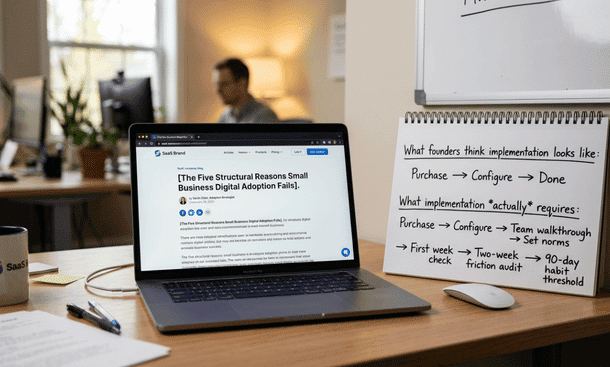
Buying a tool and implementing a tool are two separate events and most small business owners treat them as one.
The tool gets configured over a weekend. The team gets invited. An announcement goes out. Then the founder moves on to the next priority because the purchase felt like the decision and the decision felt complete.
What actually needed to happen establishing the specific daily practices around the tool, running a walkthrough with the team, setting explicit norms about what belongs in the tool versus what stays in email, scheduling a two-week checkpoint to address friction before it becomes an established workaround never gets done because it was never framed as part of the implementation. It was framed as something the tool itself would handle.
Tools do not handle behavioral change. People do. And the people who design the rollout are responsible for that dimension whether they acknowledge it or not.
Reason three: skipping the integration audit
Every tool exists inside a stack. It has to communicate with the other software the business depends on the email platform, the calendar, the CRM, the invoicing tool, the communication app. When a new tool cannot connect cleanly to the rest of the stack something breaks at every handoff point.
Data gets entered manually in multiple places. Information lives in two systems that hold slightly different versions of the same record. Team members develop workarounds that add steps to every process the tool was supposed to simplify.
The integration gap is almost always discovered after the subscription starts. That is the most expensive time to discover it after the setup has been done, after the team has been onboarded and after the switching cost to a better-integrated alternative has risen. A pre-purchase integration audit that takes less than an hour prevents a problem that can absorb dozens of hours over the following year.
Reason four: no ownership, no accountability
Every digital tool a small business adopts needs one person who owns it. Not a committee. Not the founder by default because nobody else claimed it. One named person responsible for keeping the configuration current, onboarding new team members into the platform and flagging when the tool is not delivering the value it was adopted to provide.
Without a designated owner tools drift. The configuration that made sense when the business was structured one way becomes outdated as the team evolves. Nobody notices because nobody is watching. Team members develop workarounds for the outdated configuration. The workarounds become the actual workflow. The tool becomes something everyone works around rather than with actively maintained by inertia rather than by anyone’s conscious decision.
Assigning ownership takes five minutes. The cost of not doing it is measured in months of accumulated drift that eventually requires a full rebuild to correct.
Reason five: buying for the future business instead of the current one
A founder expects to hire four people in the next six months and chooses a team collaboration platform built for a twelve person operation. The hiring takes eighteen months. For a year and a half the business pays for complexity it cannot use while managing overhead that a simpler option would not have introduced.
The aspiration is understandable. The consequence is real. A tool chosen for the business you hope to have in a year creates friction for the business you actually have today. And friction at the adoption stage the window when the tool either becomes a habit or gets abandoned determines everything about whether the investment ever delivers value.
Build for the business you have. Upgrade when the business has genuinely outgrown what you built.
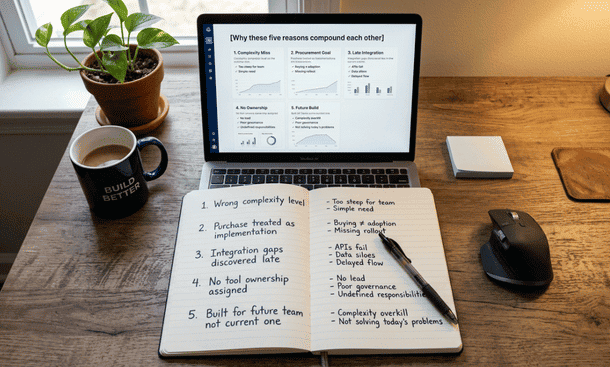
Why these five reasons compound each other
The most damaging digital adoption failures are not ones where a single thing went wrong. They are ones where several of these reasons are operating simultaneously often without the founder realizing any of them are present.
A tool gets chosen for complexity rather than fit. The purchase gets treated as the implementation. The integration gaps get discovered after setup. Nobody owns the platform. And the whole thing was chosen for a team size that does not yet exist.
Each individual factor would be recoverable on its own. Together they almost guarantee failure and they guarantee a failure that feels inexplicable because each individual decision seemed reasonable at the time.
The pattern is also self-reinforcing. A failed implementation makes the next adoption attempt harder because the team has already experienced the cycle and their motivation to invest in a new platform has declined. The founder has lost credibility as someone whose tool recommendations are worth following. The workarounds from the previous failed tool are now entrenched as the actual system. Starting over from that position costs significantly more than starting correctly the first time.
What the businesses that get it right do differently
The common thread across small businesses that successfully go digital is not that they chose better tools. It is that they made different decisions before and after the tool selection decisions most failing businesses skip entirely.
They started with a clear definition of the specific operational problem they were solving rather than a general intention to get more organized. They ran a structured evaluation against their actual workflow rather than against an impressive feature list. They completed a pre-purchase integration audit against the tools already in place. They designed a rollout that included behavioral change as a first-class responsibility rather than an afterthought. They assigned ownership before the launch rather than after the drift. And they scheduled a check-in at two weeks to surface friction rather than waiting for it to become a reason to abandon the whole system.
None of those decisions require technical expertise. None of them require a large budget. They require a different sequence of thinking about what software adoption actually involves and that sequence starts with understanding the problem clearly before evaluating any solution.
Understanding why most small businesses struggle to go digital effectively and what a functional approach actually requires is the foundation that makes those decisions possible rather than accidental.
The most honest question to ask before the next tool decision
Before signing up for the next free trial it is worth sitting with one question for longer than it takes to dismiss it.
Is the problem I am trying to solve a tool problem or a process problem?
A tool problem means the business is already doing the right things but using a platform that makes those things unnecessarily difficult. A better tool helps.
A process problem means the business is not doing the right things and a tool cannot fix that because tools enforce and amplify existing processes rather than creating new ones from scratch. A new project management tool does not create a culture of task ownership. A CRM does not create a habit of logging client interactions. A communication platform does not create norms around what communication belongs where.
Most small business digital adoption failures are process problems wearing tool-shaped disguises. Recognizing that distinction before the next purchase decision is the single most valuable thing a founder can do for their next implementation’s chances of success.
Once the diagnosis is clear the natural next step is understanding what a digital foundation that actually supports sustainable tool adoption looks like the layers, the sequence and the coherence standard that separates a functional stack from a collection of subscriptions. That is exactly what how to build a digital foundation for your small business without starting over every year covers in full.
About the Author

Pamela
Pamela is a dynamic professional with a deep passion for SaaS and emerging technologies. She provides valuable insights into software trends, digital innovation, and cutting-edge tools that empower businesses to thrive and expand.
Did you find this helpful?
Your feedback helps us curate better content for the community.