
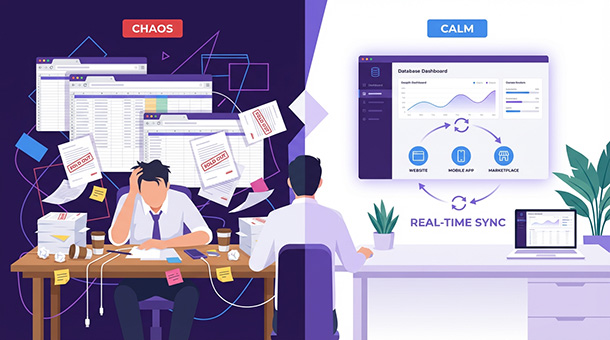
You sell the same product on your website, Amazon, and a mobile app. Someone buys the last unit on Amazon, but your website still shows it in stock. Ten minutes later, another customer orders it from your site, and now you’re apologizing for an item you don’t have. A backend solves this by updating inventory the moment a sale happens anywhere. When one platform sells a product, your backend immediately subtracts from the count everywhere else. Real-time inventory sync prevents overselling and angry customers. Connecting your backend to payment systems makes order processing smoother, as explained in connecting your backend to Stripe and PayPal.
The spreadsheet nightmare that kills growing businesses
You started simple. One product, one sales channel, manually updating a Google Sheet after each sale. Then you added a second product, opened an Amazon store, launched a mobile app, and suddenly you’re updating inventory in four places every time something sells.
Monday morning, you sell three units on your website. You update the spreadsheet but forget to update Amazon. By Tuesday, someone orders the same item on Amazon, and you realize you’re out of stock. You issue a refund, apologize, and promise yourself you’ll stay on top of inventory. By Friday, it happens again on a different platform.
This isn’t a discipline problem, it’s a system problem. Manual inventory management works when you’re selling ten items per week from one channel. It collapses completely when you’re processing hundreds of orders across multiple platforms. You need a system that updates inventory automatically the moment a sale happens anywhere, and that system is your backend database.
How backends turn inventory into a single source of truth
Instead of tracking inventory separately on each platform, your backend stores one master inventory count in a database table. Every sales channel, your website, mobile app, Amazon integration, and physical store register, reads from and writes to this same database.
When someone buys a product on your website, the backend subtracts one from the inventory count in the database. Amazon’s API checks that same database before showing the product as available. Your mobile app displays the updated count within seconds. Your physical store register queries the database before completing a sale. Everyone sees the same number because there’s only one number.
This prevents the disaster scenario where two customers buy the same item simultaneously on different platforms. The backend processes the first purchase, updates the count to zero, then rejects the second purchase because inventory is gone. The second customer sees “out of stock” instead of completing an order you can’t fulfill.
The technical term for this is a “single source of truth,” but the business term is “not lying to customers about what you actually have.”
Why this matters beyond just preventing overselling
Accurate inventory unlocks business intelligence you can’t get from spreadsheets. Your backend can tell you which products sell fastest, which sit on shelves too long, and when to reorder before running out. This data lives in the same database as your sales records, so you can answer questions like “how many days of inventory do we have left at current sales velocity?”
Understanding how your backend handles the entire transaction workflow, from payment to inventory updates, becomes crucial as you scale. If you’re unclear about how all these pieces fit together, start with how a backend handles your digital cashier, which explains the complete order processing system from a founder’s perspective. Once you see how payment, inventory, and customer data connect in one system, managing multi-channel sales becomes much less overwhelming.
You can set up automatic alerts when inventory drops below a threshold. The backend sends you an email when a product reaches five units, giving you time to reorder before selling out completely. You can pause sales on specific platforms when inventory is low, prioritizing your highest-margin channel until new stock arrives.
This level of control is impossible with spreadsheets because they don’t react to events in real time. By the time you manually check inventory and decide to pause Amazon sales, you’ve already oversold by twenty units. A backend makes these decisions instantly based on rules you define once.
The API handshake that keeps platforms synchronized
Amazon, Shopify, WooCommerce, and every major sales platform offers an API that lets your backend read and write inventory data. When you sell a product on Amazon, their API sends your backend a webhook notification saying “product X just sold, update your inventory.” Your backend subtracts one from the count and pushes the new number back to Amazon, Shopify, and your website.
This two-way sync happens in seconds. A customer buys on Amazon at 3:00:00 PM, your backend updates the database at 3:00:02 PM, and your website reflects the new count by 3:00:05 PM. The delay is so short that customers browsing your site never see stale inventory numbers.
Supabase makes this integration straightforward with edge functions that listen for webhooks from each platform. You create one function per sales channel, each configured to accept that platform’s specific webhook format. When Amazon sends a webhook, the Amazon function processes it. When Shopify sends one, the Shopify function handles it. Both functions update the same central inventory table, keeping everything synchronized.
The alternative is building custom middleware that polls each platform every few minutes, checking for changes. That approach wastes API calls, delays updates, and creates race conditions where two platforms read outdated inventory simultaneously. Webhooks eliminate these problems by pushing updates the instant they happen.
Handling inventory holds during checkout
A customer adds an item to their cart, spends five minutes entering shipping details, then clicks “buy now.” In those five minutes, three other customers bought the same product on different platforms. When the first customer finally completes checkout, you’re out of stock, but you already charged their card.
Backends prevent this with inventory holds, also called reservations. When a customer starts checkout, the backend temporarily reserves one unit for a short window, usually 10-15 minutes. Other customers see the reduced inventory count immediately. If the first customer completes the purchase, the hold converts to a sale. If they abandon the cart, the hold expires and the unit becomes available again.
This requires storing two numbers per product: actual inventory and available inventory. Actual inventory is the physical count in your warehouse. Available inventory is actual minus active holds. Your sales channels display available inventory, not actual, so customers only see products you can actually fulfill.
The backend manages hold expiration automatically. Every few minutes, an edge function checks for holds older than 15 minutes and releases them back to available inventory. No manual intervention, no stale holds clogging your system, no customers waiting indefinitely for reserved units.
Multi-location inventory that knows where products actually are
You expand from one warehouse to three, each serving different regions. A customer in California orders a product that’s out of stock in your Los Angeles warehouse but available in New York. Shipping from New York takes five extra days and costs twice as much. Your backend needs to know which warehouse has inventory and route orders intelligently.
This requires adding a location dimension to your inventory table. Instead of storing “50 units of product X,” you store “20 units in LA, 15 in New York, 15 in Chicago.” When a California customer orders, your backend checks LA first, then expands the search if LA is out of stock.
The routing logic can get sophisticated. Some backends calculate shipping costs from each location and choose the cheapest option. Others prioritize fastest delivery over cost. Advanced systems predict future demand by region and suggest inventory transfers between warehouses before stockouts happen.
This level of complexity sounds like enterprise software, but modern backends make it accessible to small businesses. You define the rules once, the backend executes them automatically, and you avoid manual decisions about which warehouse ships each order.
When inventory sync prevents revenue loss
Accurate inventory directly impacts revenue. Every time you oversell and refund an order, you lose the sale, pay processing fees, and damage customer trust. Every time you show “out of stock” for items sitting in a warehouse because your systems aren’t synced, you lose sales to competitors.
The math is brutal. A business doing $50,000 monthly revenue with a 2% oversell rate loses $1,000 per month in refunded sales plus another $500 in processing fees and shipping costs for products you can’t deliver. Over a year, poor inventory management costs $18,000 in direct losses, not counting the customers who never return after a bad experience.
A backend eliminates these losses for the cost of a $25 monthly Supabase plan. The ROI is immediate and measurable. You stop refunding oversold orders, start capturing sales you previously missed, and build customer trust by consistently delivering what you promise.
Once inventory syncs reliably across platforms, the next bottleneck becomes managing recurring payments for customers who want monthly memberships instead of one-time purchases, which is exactly what managing monthly memberships automatically solves. And if you’re selling internationally, you’ll also need to handle the complexity of calculating taxes correctly for every region, which is where understanding how your backend helps you stay legal globally becomes essential.
About the Author

AISalah
Bridges linguistics and technology at PointOfSaaS, exploring AI applications in business software. English Studies BA with hands-on back-end and ERP development experience.
Did you find this helpful?
Your feedback helps us curate better content for the community.