
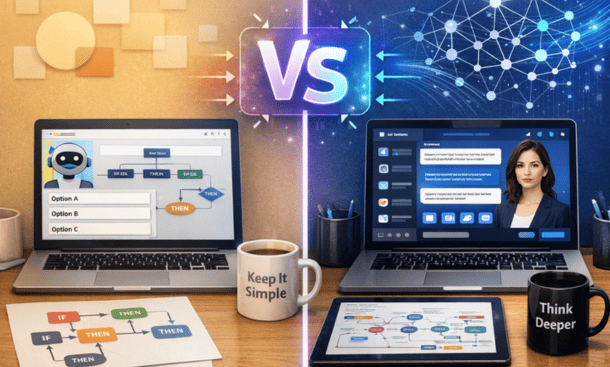
The terms chatbot and AI agent get used interchangeably, but they represent different levels of automation capability. Chatbots follow predetermined conversation flows and work best for straightforward questions like business hours or return policies. AI agents use natural language processing to understand context, make decisions, and complete multi-step tasks like processing refunds or updating account information. Choosing between them depends on your support complexity and volume. For a comprehensive breakdown of how these tools fit into your overall automation strategy, check out our detailed resource on how to automate customer service effectively.
Understanding chatbots and their limitations
Chatbots operate on rule-based logic that maps specific inputs to predetermined outputs. You build conversation trees where each customer response triggers a specific branch in the dialogue. When someone asks about store hours, the bot recognizes keywords like “hours” or “open” and delivers the pre-written response you configured.
This approach works well for common questions with straightforward answers. A clothing retailer might use a chatbot to handle sizing questions, return windows, and shipping costs. These queries don’t require interpretation or judgment, just accurate information delivery.
The limitation becomes apparent when customers ask questions outside the predefined script. If your chatbot is programmed to handle “what’s your return policy” but someone asks “can I return this sweater I bought last week,” the bot might fail to recognize the intent and respond with something generic like “I don’t understand your question.”
Where basic chatbots excel
Simple chatbots shine in scenarios where you need to deflect high volumes of repetitive questions. Restaurant businesses use them to share menus, take reservations for specific time slots, and provide directions. Dental offices deploy them to confirm appointments and send pre-visit instructions.
The setup time is minimal. Most chatbot builders let you create functional bots in a few hours using templates. You select a use case like “appointment booking,” customize the responses with your business information, and connect it to your website or Facebook page.
Costs stay low because you’re essentially paying for a sophisticated FAQ system. Basic plans start around $50 to $100 monthly and scale based on conversation volume. For businesses handling thousands of simple inquiries, this represents significant savings compared to human labor.
What makes AI agents different
AI agents use machine learning models to understand natural language, interpret intent, and generate contextually appropriate responses. Instead of following rigid conversation trees, they analyze what customers are actually trying to accomplish and figure out how to help them.
The technology behind AI agents includes natural language understanding, entity recognition, and decision-making capabilities. When a customer says “I need to change my delivery address because I’m moving next week,” the agent understands this involves updating account information and can walk through the verification and modification process.
Context awareness sets AI agents apart from basic chatbots. The agent remembers previous messages in the conversation and pulls relevant information from your systems. If a customer asks “can you cancel that,” the agent knows what “that” refers to based on earlier context.
Tasks AI agents can handle
AI agents manage complex workflows that require multiple steps and system integrations. They process returns by verifying order details, generating return labels, initiating refunds, and updating inventory systems. This level of orchestration isn’t possible with rule-based chatbots.
Troubleshooting technical issues becomes feasible with AI agents. A SaaS company might deploy an agent that asks diagnostic questions, checks system status, reviews user settings, and provides step-by-step solutions. The agent adapts its approach based on what it learns during the conversation.
Personalization happens automatically because AI agents access customer data in real time. They reference purchase history, subscription tier, previous support interactions, and account settings to tailor their responses. A customer asking about upgrading their plan receives options relevant to their current usage patterns.
The cost and complexity tradeoff
AI agents require more investment than basic chatbots. Pricing typically starts around $500 to $1,000 monthly for small deployments and scales with usage. Enterprise solutions run several thousand dollars monthly because they include advanced features, higher message volumes, and dedicated support.
Implementation takes longer because you need to train the AI model on your specific business context. This involves feeding it product documentation, common customer questions, policy information, and examples of how you want it to handle various scenarios. Training AI agents for customer support requires ongoing refinement as you identify gaps in knowledge or response quality.
The technical expertise requirement increases as well. While many platforms offer user-friendly interfaces, getting optimal performance requires understanding how to structure training data, evaluate model responses, and tune settings. Some businesses hire specialists or work with implementation partners to accelerate this process.
Matching the tool to your support needs
The decision between chatbots and AI agents depends on three factors: query complexity, volume, and your tolerance for setup time.
Start with a chatbot if your customers primarily ask simple factual questions that have consistent answers. A small e-commerce store selling fewer than 100 products can probably handle most inquiries with a well-configured chatbot that covers shipping, returns, and product information.
Consider an AI agent when you’re fielding requests that require understanding context, making decisions, or completing actions across multiple systems. SaaS businesses with complex products, service businesses managing appointments and scheduling, or any operation where customer needs vary significantly benefit from AI agent capabilities.
Budget considerations
Calculate your current support costs before making a decision. If you’re spending $5,000 monthly on human agents and 70 percent of inquiries are simple, a $200 chatbot investment makes sense even if it only handles half of those simple queries. That still saves roughly $1,750 monthly while providing 24/7 availability.
For businesses where support costs exceed $15,000 monthly and query complexity is high, an AI agent at $1,000 to $2,000 monthly represents better value. The agent handles both simple and complex inquiries, potentially eliminating the need for multiple support tiers or reducing escalations to senior staff.
The hybrid approach many businesses take
You don’t have to choose exclusively between chatbots and AI agents. Many operations use both technologies in a tiered system where the chatbot handles initial triage and the AI agent manages anything requiring deeper analysis.
A customer initiates a conversation with the chatbot, which quickly identifies whether the inquiry is simple or complex. Simple requests get resolved immediately. Complex requests get routed to the AI agent, which has access to more sophisticated tools and data. This hybrid model optimizes costs because you’re not paying for AI agent capabilities when a basic chatbot suffices.
The handoff between systems needs to be seamless from the customer perspective. Modern platforms handle this by maintaining conversation context as requests move from chatbot to AI agent to human support. The customer doesn’t need to repeat information or restart their inquiry.
Getting started with the right automation tool means first understanding your specific requirements and constraints. Once you’ve chosen between chatbots and AI agents, the next critical decision involves selecting a platform that offers the features you need at a price point that makes sense. Our comparison of the best AI customer service platforms breaks down the leading options by capabilities, pricing tiers, and ideal use cases to help you make an informed choice.
About the Author

Mateo
I’m Mateo, a SaaS blogger and digital strategist dedicated to helping startups accelerate growth through automation, data-driven decision-making, and performance-focused marketing systems. Over the past few years, I’ve worked with early-stage software companies to refine their go-to-market strategies, optimize conversion funnels, and implement scalable automation frameworks that drive measurable revenue growth. On my blog, I share proven insights from real-world SaaS cases, including actionable frameworks for churn reduction, onboarding optimization, and lead-to-customer conversion. My mission is simple: to empower founders and marketers with practical strategies that turn innovative software into sustainable, profitable success.
Did you find this helpful?
Your feedback helps us curate better content for the community.