
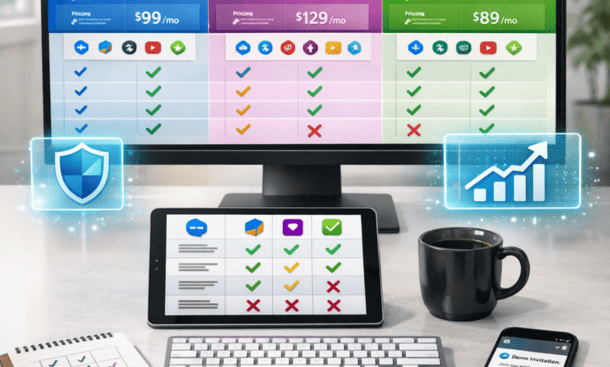
Selecting a customer service platform requires balancing functionality against cost and implementation time. Most entrepreneurs need tools that integrate with existing systems, require minimal technical expertise, and scale as ticket volume grows. The market offers everything from basic chatbot builders at $50 per month to enterprise AI agents costing thousands. The right choice depends on your current support volume, team size, and technical capabilities. Before diving into specific platforms, it helps to understand the broader landscape of automation options covered in our guide to automating customer service with AI technology.
What to look for in a customer service platform
Platform selection starts with understanding which features actually matter for your business versus what sounds impressive in marketing materials. Too many entrepreneurs get distracted by advanced capabilities they’ll never use while overlooking fundamental requirements.
Integration capability tops the list because your support platform needs to communicate with your existing tools. It should connect to your CRM, e-commerce platform, email system, and any other software where customer data lives. Without these connections, your agents work with incomplete information and customers get inconsistent experiences.
Ease of setup determines how quickly you’ll see value from your investment. Platforms requiring extensive developer time or weeks of configuration create opportunity costs. Look for solutions offering pre-built templates, visual conversation builders, and straightforward onboarding processes.
Scalability matters even if you’re starting small. Your platform should handle growing message volumes without performance degradation or dramatic price increases. Understanding the pricing structure as you scale prevents unpleasant surprises six months down the road.
The technical expertise question
Some platforms are designed for non-technical users while others assume you have developers on staff or access to technical consultants. Be honest about your team’s capabilities before committing to a solution.
No-code platforms let you build and deploy chatbots using drag-and-drop interfaces. You click through setup wizards, select from pre-configured options, and customize text responses. These tools work well for straightforward use cases but may limit flexibility as your needs become more sophisticated.
Low-code platforms offer visual builders for common tasks but allow developers to write custom code when needed. This hybrid approach provides flexibility without requiring deep technical knowledge for basic implementations.
Developer-focused platforms give you maximum control through APIs and SDKs but expect you to handle most configuration through code. These solutions make sense if you have engineering resources and need highly customized implementations.
Platform options by business size and needs
For very small businesses and solopreneurs
Tidio and ManyChat serve businesses just starting with automation. Both platforms offer free tiers that handle basic chatbot functionality, making them risk-free options for testing whether automation helps your operation.
Tidio focuses on website chat and provides templates for common e-commerce scenarios like abandoned cart recovery and product recommendations. The free plan includes three operators and unlimited chatbots. Paid plans start at $29 monthly and add features like email integration and visitor tracking.
ManyChat specializes in social media automation, particularly Facebook Messenger and Instagram. It excels at conversational marketing and drip campaigns. The free tier supports up to 1,000 contacts. Pro plans begin at $15 monthly and scale based on contact volume.
These platforms work best when you need basic automation quickly and can’t justify spending hundreds monthly. The tradeoff is limited customization and fewer advanced features compared to mid-tier solutions.
For growing businesses with moderate support volume
Intercom and Zendesk represent the middle market where most small to medium businesses land. Both offer comprehensive support ecosystems that grow with your company.
Intercom combines live chat, chatbots, and help desk functionality in one platform. Its Resolution Bot handles common questions while routing complex inquiries to human agents. The visual conversation builder requires no coding. Pricing starts around $74 monthly for basic features, with the complete platform running $395 to $999 monthly depending on contact volume and features.
Zendesk provides ticketing, live chat, and AI-powered bots through its Answer Bot feature. The platform integrates with hundreds of business tools and offers extensive customization options. Plans start at $55 per agent monthly for basic support features. AI capabilities begin at $115 per agent monthly.
Both platforms require more investment than entry-level options but deliver professional-grade functionality. They make sense when you’re handling hundreds of daily inquiries and need robust reporting, team collaboration features, and reliable uptime.
For businesses needing advanced AI capabilities
Drift and Ada push into sophisticated AI agent territory with natural language understanding, predictive routing, and automated workflow completion.
Drift emphasizes conversational marketing alongside support, making it popular with B2B companies. Its AI qualifies leads, books meetings, and routes conversations based on buyer intent. Pricing isn’t publicly listed but typically starts around $2,500 monthly for small deployments.
Ada focuses purely on automated customer service with an AI agent that handles complex, multi-turn conversations. The platform learns from interactions and improves over time. Implementation requires more upfront work to train the AI on your specific business context. Pricing starts around $1,000 monthly for smaller volumes.
These platforms justify their cost when support complexity is high and ticket volume makes hiring additional human agents expensive. Setting up your first customer service chatbot on a simpler platform often makes sense before graduating to these advanced solutions.
Specialized platforms for specific industries
Some platforms target particular verticals with pre-built functionality for industry-specific needs.
HealthTap and Luma Health serve healthcare providers with HIPAA-compliant automation for appointment scheduling, patient intake, and basic triage. These platforms understand medical terminology and integrate with electronic health record systems.
Podium focuses on local service businesses like dental offices, auto repair shops, and home services. It combines customer messaging, payment collection, and review generation in one platform. Pricing starts around $289 monthly.
Legal technology platforms like Clio and MyCase include client communication features designed for law firms, with secure messaging and matter-specific conversation threading.
Industry-specific platforms cost more than general solutions but save implementation time because they’re pre-configured for your use case. A dental office can deploy Luma Health in days versus weeks with a generic platform that needs extensive customization.
The hidden costs nobody talks about
Platform subscription fees represent just part of your total automation investment. Factor in these often-overlooked expenses when budgeting.
Training time for your team to learn the platform affects productivity during implementation. Budget 10 to 20 hours for each team member to become proficient with basic features. More complex platforms require additional learning time.
Content creation involves writing bot responses, building conversation flows, and developing your knowledge base. This work takes longer than most entrepreneurs expect. Plan for 40 to 60 hours of content development for a comprehensive implementation.
Ongoing optimization never really ends. You’ll continuously refine bot responses, add new conversation flows, and update content as products and policies change. Allocate 5 to 10 hours monthly for maintenance and improvements.
Integration work may require developer time even on user-friendly platforms. Connecting to your specific tech stack, setting up custom data flows, or building unique features adds cost. Budget $2,000 to $5,000 for custom development work if your needs extend beyond standard integrations.
Making your final decision
Start by listing your top five support pain points. Maybe customers complain about slow response times, your team spends hours on repetitive questions, or you can’t afford to hire more agents. Prioritize platforms that directly address your specific problems rather than those with the most features.
Test before committing. Most platforms offer free trials lasting 14 to 30 days. Use this time to build a basic implementation with real customer data and see how the platform performs under actual conditions.
Talk to current customers of platforms you’re considering. Ask about implementation challenges, ongoing support quality, and whether the platform delivered promised value. Online reviews provide some insight but direct conversations reveal more nuanced perspectives.
Consider your 12-month trajectory when evaluating options. If you expect rapid growth, starting with a scalable mid-tier platform makes more sense than beginning with an entry-level tool you’ll outgrow quickly.
Choosing the right platform sets the foundation for successful automation, but the platform alone doesn’t guarantee results. What matters more is how you configure and deploy your chosen tool. Following a step-by-step guide to setting up your first customer service chatbot determines whether your investment generates positive ROI or creates new problems for your team and customers.
About the Author

Mateo
I’m Mateo, a SaaS blogger and digital strategist dedicated to helping startups accelerate growth through automation, data-driven decision-making, and performance-focused marketing systems. Over the past few years, I’ve worked with early-stage software companies to refine their go-to-market strategies, optimize conversion funnels, and implement scalable automation frameworks that drive measurable revenue growth. On my blog, I share proven insights from real-world SaaS cases, including actionable frameworks for churn reduction, onboarding optimization, and lead-to-customer conversion. My mission is simple: to empower founders and marketers with practical strategies that turn innovative software into sustainable, profitable success.
Did you find this helpful?
Your feedback helps us curate better content for the community.