

Sales automation has shifted from basic email schedulers to intelligent systems that handle everything from lead qualification to deal forecasting. AI analyzes prospect behavior, personalizes outreach at scale, and identifies which leads are most likely to convert. For entrepreneurs juggling multiple responsibilities while trying to hit revenue targets, these tools offer a way to compete with larger sales teams without the overhead. If you’re wondering whether automation can actually move the needle on your bottom line, our complete guide on how to automate sales processes with AI breaks down the entire framework from strategy to implementation.

How AI changes the sales game
Sales has always been a numbers game, but the math changes completely when you introduce intelligent automation. Traditional sales processes require reps to manually research prospects, craft individual emails, follow up repeatedly, update CRM records, and qualify leads through discovery calls. Each of these steps consumes time that could be spent actually closing deals.
AI sales automation handles the repetitive work while your team focuses on high-value conversations. The technology doesn’t just save time through basic task automation like scheduling emails. It makes decisions based on data patterns humans can’t process at scale.
When a prospect visits your pricing page three times in two days, opens every email you send, and downloaded your case study, that’s a buying signal. AI picks up on these patterns across hundreds or thousands of prospects simultaneously and flags the hottest opportunities for immediate attention. Your sales team stops wasting time on tire-kickers and focuses on people ready to buy.
The revenue multiplication happens because you’re optimizing both sides of the equation. You’re reducing the time and cost required to move each prospect through your pipeline while simultaneously improving conversion rates by prioritizing the right leads at the right moments.
Where the real ROI comes from
Most entrepreneurs think about sales automation in terms of time savings, which matters but tells only half the story. The bigger impact comes from consistency and intelligence that’s impossible to maintain manually.
Your best sales rep has great instincts about which prospects to prioritize and when to follow up. They remember details from previous conversations and personalize their approach accordingly. But even your best rep can only manage so many relationships effectively before things start slipping through the cracks.
AI scales those best practices across your entire pipeline. It tracks every interaction, identifies patterns in what converts, and applies those insights to every prospect. When data shows that prospects who engage with specific content within 48 hours of signup are five times more likely to close, the system automatically triggers personalized follow-up for anyone matching that pattern.
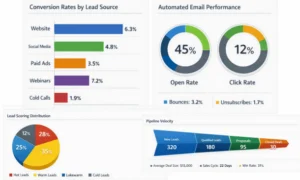
The compound effect builds over time. Small improvements in response speed, personalization quality, and lead prioritization each contribute a few percentage points to conversion rates. Stack those improvements across hundreds of deals and you’re looking at 30-50 percent revenue increases without adding headcount.
What AI actually automates in your sales process
The technology handles distinct categories of work that previously required human attention. Lead enrichment pulls data from public sources to build complete prospect profiles automatically. Instead of your reps spending 15 minutes researching each lead on LinkedIn, company websites, and news sources, AI compiles that information instantly.
Outreach sequencing manages multi-touch campaigns across email, social media, and other channels. You define the strategy once, the system executes it for every prospect while adapting based on engagement. Someone who opens three emails but doesn’t reply gets different follow-up than someone who never opens anything.
Conversation intelligence analyzes sales calls and meetings to extract insights. The AI identifies which talking points resonate, which objections come up most frequently, and which reps are using language that correlates with closed deals. This creates a feedback loop where your entire team learns from what’s working.
Pipeline management becomes predictive rather than reactive. AI forecasts deal closure probability based on dozens of factors like engagement level, deal size, prospect seniority, and historical patterns. You know which deals need attention and which are likely to close without intervention.
Meeting scheduling eliminates the back-and-forth email chains. AI assistants coordinate calendars, suggest times, send reminders, and even handle rescheduling requests. What used to take five or six emails happens in one interaction.
The mistakes that kill automation ROI
Entrepreneurs get excited about automation possibilities and try to automate everything immediately. This creates three problems that undermine results.
First, automating a broken process just makes you fail faster at scale. If your manual outreach gets 2 percent response rates because your messaging is weak, automating that same messaging to reach more people doesn’t fix the fundamental problem. You need to dial in your approach with manual testing before scaling through automation.
Second, over-automation removes the human touch that builds trust. AI should handle research, data entry, scheduling, and initial qualification. But when a prospect raises a nuanced concern or asks a complex question, they need to talk with a human who understands context and can have a real conversation. Companies that try to automate too much of the sales conversation end up feeling robotic and impersonal.
Third, poor data hygiene sabotages automation effectiveness. If your CRM contains duplicate records, outdated contact information, and inconsistent data formatting, your automation will work with garbage inputs and produce garbage outputs. A lead scoring model trained on messy data will make bad predictions about prospect quality.
The right approach starts narrow and expands over time. Pick one high-volume, low-complexity task that currently consumes significant time. Automate that single process, measure results, refine your approach, then move to the next opportunity.
When your business is ready for sales automation
Not every business benefits from sales automation immediately. The technology delivers maximum value when you have certain conditions in place.
You need consistent deal flow with at least 50-100 new leads monthly. Below that threshold, the setup time and platform costs often exceed the value you’ll extract. Manual processes work fine when you’re talking to ten prospects per month.
Your sales process should follow a relatively predictable pattern. If every deal is completely unique with custom pricing, bespoke solutions, and one-off negotiations, automation has less to grab onto. The technology excels when there’s repeatable structure even if details vary.
You must have baseline systems established. That means a CRM where you actually track interactions, defined stages in your sales process, and some documentation of what good outreach looks like. Automation amplifies existing processes rather than creating them from scratch.
The inflection point typically hits when your sales team spends more than 60 percent of their time on administrative work and less than 40 percent actually talking to prospects. At that stage, automation immediately frees up capacity and improves productivity metrics.
How automation changes your sales team’s role
Implementing AI doesn’t eliminate sales jobs, it eliminates sales tasks that shouldn’t require human attention. Your team’s role evolves from doing everything manually to orchestrating an automated system that handles the repetitive parts.
Reps spend more time on strategy and relationship building. Instead of researching 20 companies per day, they focus on the five highest-priority conversations where they can actually close business. The quality of interactions improves because they’re not rushing through calls to get to the next administrative task.
Sales managers shift from tracking activity metrics to coaching on outcomes. When automation handles pipeline updates and activity logging, managers can focus on developing skills, refining messaging, and removing obstacles. The conversation changes from “did you send your follow-up emails” to “let’s role-play how to handle that pricing objection.”
The psychological shift matters as much as the tactical one. Sales professionals often resist automation because they worry about being replaced. The reality is that automation makes good salespeople more valuable by multiplying their effectiveness. A rep who could previously manage 40 active opportunities can now manage 100 because AI handles qualification, research, and routine follow-up.
Understanding these fundamentals gives you the foundation to evaluate whether sales automation makes sense for your business and what results you should expect. The next critical decision involves identifying which leads actually deserve your team’s attention and which can be nurtured automatically until they’re sales-ready. Our breakdown of how AI handles lead scoring and qualification shows you exactly how to separate prospects ready to buy from those who need more time.
About the Author

Mateo
I’m Mateo, a SaaS blogger and digital strategist dedicated to helping startups accelerate growth through automation, data-driven decision-making, and performance-focused marketing systems. Over the past few years, I’ve worked with early-stage software companies to refine their go-to-market strategies, optimize conversion funnels, and implement scalable automation frameworks that drive measurable revenue growth. On my blog, I share proven insights from real-world SaaS cases, including actionable frameworks for churn reduction, onboarding optimization, and lead-to-customer conversion. My mission is simple: to empower founders and marketers with practical strategies that turn innovative software into sustainable, profitable success.
Did you find this helpful?
Your feedback helps us curate better content for the community.