
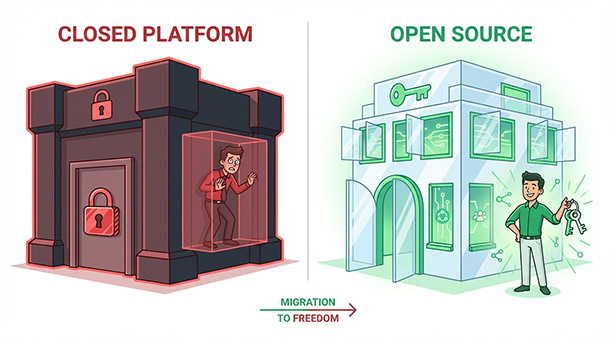
Open source sounds like a developer buzzword, but for founders it’s actually an insurance policy. When you build on a closed platform, you’re renting space in someone else’s building with no escape hatch. If they raise prices, change terms, or shut down, you’re stuck rebuilding from scratch. Supabase being open source means you own the keys to your own backend, and you can move it anywhere if you ever need to. Understanding why Supabase works as your startup’s foundation includes knowing how open source protects your business for the long haul, not just the next funding round.
What open source actually means for your business
The code running your backend is publicly available
Open source means that all the code powering Supabase, the database, authentication system, storage, and edge functions, is published publicly on GitHub for anyone to read, use, or modify. This isn’t just marketing talk or partial transparency. The entire technology stack is visible.
For founders, this visibility creates accountability. You can see exactly how your data is stored, how authentication works, and how security is implemented. You’re not trusting a black box that could have hidden vulnerabilities or backdoors.
More importantly, you can download that code, run it on your own servers, and operate Supabase independently if you ever need to. That’s the insurance policy most founders don’t realize they’re buying when they choose open-source tools.
You’re not locked into Supabase’s hosting
When you use Supabase’s hosted service, you’re paying for convenience: managed servers, automatic updates, monitoring, and support. But you’re not locked into using their hosting forever. If Supabase ever raises prices beyond your budget, changes terms you disagree with, or shuts down entirely, you can self-host.
Self-hosting means running the same Supabase software on your own cloud infrastructure like AWS, Google Cloud, or DigitalOcean. Your app continues working exactly as before because the underlying technology hasn’t changed. You’re just managing the servers yourself instead of paying Supabase to do it.
This flexibility is something closed platforms can’t offer. If you build on a proprietary backend and that company goes under or becomes hostile, your only option is a painful migration to a completely different system.
Real scenarios where open source saves your business
Pricing changes that threaten your margins
Imagine you’ve built a successful app with 50,000 users paying you $10 monthly. Your backend costs are predictable at $200 per month, giving you healthy margins. Then your backend provider announces a 5x price increase to $1,000 monthly, citing “infrastructure improvements.”
With a closed platform, you have two terrible options: absorb the cost and kill your profitability, or migrate to a different backend in a panic while your business hemorrhages money. Both options damage your business and distract from growth.
With Supabase, you have a third option: self-host. You spin up servers on DigitalOcean for $300 monthly, migrate your hosted Supabase instance to your own infrastructure in a weekend, and continue operating with minimal disruption. Your costs increased, but you controlled the timeline and maintained profitability.
Service shutdowns that erase your foundation
Backend services shut down more often than founders realize. Parse, a popular mobile backend, shut down in 2017, forcing thousands of apps to migrate on tight deadlines. Numerous smaller platforms have vanished without warning, taking startups down with them.
If Supabase ever faced financial trouble or decided to sunset their service, the open-source code ensures continuity. The community could fork the project, maintaining and updating it independently. Companies already self-hosting would continue unaffected.
You’d have months or years to transition gracefully instead of weeks to frantically rebuild. That breathing room is invaluable when your business depends on stability.
Geographic or regulatory requirements
Some businesses face regulations requiring data to stay within specific countries or regions. Healthcare apps in Europe might need data stored exclusively on EU servers. Government contractors might require infrastructure on government-approved clouds.
Closed platforms operate where they operate. If their servers don’t meet your compliance requirements, you can’t use them. Open-source Supabase lets you deploy wherever regulations demand, whether that’s a specific AWS region, a private data center, or even air-gapped networks with no internet access.
This flexibility opens markets that would otherwise be inaccessible to your business.
The self-hosting option you hope you never need
Understanding what self-hosting involves
Self-hosting Supabase means running the software on servers you control. You rent cloud infrastructure from AWS, DigitalOcean, or Google Cloud, install Supabase’s open-source stack, and configure it to match your hosted setup.
The technical complexity is moderate. If you have a developer or technical co-founder, they can handle it in a day or two. If you’re non-technical, you’d hire a contractor or DevOps consultant to set it up, costing a few thousand dollars.
Once running, self-hosted Supabase requires ongoing maintenance: applying security updates, monitoring performance, managing backups, and scaling resources as your user base grows. This operational overhead is why most founders prefer Supabase’s hosted service.
But the option exists if you need it, which is the point. You’re not trapped.
When self-hosting makes financial sense
For most startups, self-hosting only makes sense at significant scale. If you’re paying Supabase $5,000+ monthly for hosting, you could probably self-host for $2,000-$3,000 monthly plus engineering time.
Below that threshold, the cost savings don’t justify the operational complexity and risk. You’d spend more on developer time managing infrastructure than you’d save on hosting fees.
The exception is when self-hosting solves a non-financial problem: compliance requirements, data sovereignty, or dependency concerns that justify the extra work.
Open source is the strategic foundation that makes every other Supabase decision safer — but it’s most valuable when you understand what you’re actually protecting. The database, authentication, storage, edge functions, and security layers you’ve built your startup on are all covered in depth in The Entrepreneur’s Guide to Supabase, which walks through each feature and why it matters for your business — so when you choose to stay on Supabase, you’re staying because you understand exactly what you have, not because leaving feels too hard.
The community supports self-hosters
Because Supabase is open source, a community of developers and companies self-host and share knowledge publicly. When you encounter issues, you find answers in GitHub discussions, community forums, or documentation contributed by other self-hosters.
This community support reduces risk. You’re not alone figuring out configuration, troubleshooting errors, or optimizing performance. Hundreds or thousands of others have solved the same problems and documented their solutions.
Closed platforms can’t offer this. Their support ends at their official channels, and if they don’t prioritize your issue, you’re stuck waiting or working around it.
How open source protects you from vendor lock-in
Lock-in happens gradually, then suddenly
Vendor lock-in starts innocently. You choose a backend because it’s easy, fast, and solves your immediate problems. You build features using their proprietary APIs, store data in their formats, and integrate deeply with their ecosystem.
Months or years later, you realize switching would require rewriting significant portions of your app. The backend provider knows this and starts raising prices, reducing support quality, or adding restrictions they know you can’t escape.
By the time lock-in becomes painful, extracting yourself costs tens or hundreds of thousands of dollars in developer time and business disruption.
Supabase uses standard, portable technologies
Supabase’s architecture relies on PostgreSQL for databases, standard S3-compatible storage, and JavaScript for edge functions. These aren’t proprietary technologies owned by Supabase. They’re open standards used across the industry.
If you ever migrate away from Supabase, your PostgreSQL database exports to any PostgreSQL-compatible service. Your storage migrates to AWS S3, Cloudflare R2, or any S3-compatible provider. Your edge functions run on platforms supporting similar runtimes.
This portability minimizes migration costs. You’re not translating from a proprietary system to industry standards. You’re moving from one PostgreSQL host to another, which is orders of magnitude simpler.
Your data remains yours, always
With closed platforms, your data lives in formats only they understand. Exporting might be difficult, lossy, or deliberately obstructed to discourage leaving. Some platforms charge exorbitant fees for data exports or limit how much you can download.
Supabase gives you direct access to your PostgreSQL database. You can export everything anytime using standard database tools. No permission needed, no fees charged, no lock-in through data hostage-taking.
This transparency ensures that even if you love Supabase, you’re staying by choice, not because leaving is too painful to contemplate.
The community advantage of open-source backends
Thousands of developers improve the codebase
Closed platforms employ dozens or hundreds of engineers working on features and fixes. Open-source projects like Supabase benefit from thousands of developers worldwide contributing improvements, reporting bugs, and suggesting features.
This distributed innovation means Supabase evolves faster and more creatively than a closed platform of similar size could. A developer in Singapore fixes a bug affecting Asian users. A startup in Germany contributes a feature their industry needs. Everyone benefits from these contributions.
For founders, this means the tool you’re building on improves constantly, driven by real-world usage across diverse industries and geographies.
Security vulnerabilities get discovered and fixed faster
Closed platforms have security through obscurity. Since nobody outside the company can examine the code, vulnerabilities might hide for years before discovery. When they’re found, you hope the company fixes them quickly and competently.
Open-source security works through transparency. Anyone can examine Supabase’s code for vulnerabilities. Security researchers, ethical hackers, and paranoid developers audit the code continuously, reporting issues publicly.
This scrutiny makes open-source software more secure over time, not less. Vulnerabilities get discovered faster, fixed faster, and validated faster by independent experts.
You can contribute fixes that benefit your business
If you discover a bug or need a feature Supabase hasn’t prioritized, you can hire a developer to implement it and contribute it back to the project. Your fix becomes part of the official codebase, benefiting everyone while solving your immediate problem.
Closed platforms don’t offer this. If they haven’t built a feature you need, your options are waiting indefinitely, finding workarounds, or paying them custom development fees that might cost tens of thousands of dollars.
Open source gives you agency. You’re not entirely dependent on the vendor’s roadmap and priorities.
Comparing Supabase to closed alternatives
Firebase and AWS Amplify lock you in
Firebase, Google’s mobile backend, and AWS Amplify are powerful but completely proprietary. The code running them is closed, the data formats are specific to their platforms, and migrating away requires rebuilding significant portions of your app.
If Google decides Firebase no longer fits their strategy or AWS changes Amplify’s pricing model, you have limited options. You can pay whatever they charge or embark on an expensive migration to a different platform.
Many startups have felt this pain. Firebase shut down or deprecated features with little notice, forcing apps to scramble. AWS services sometimes 10x in price when leaving free tiers, catching founders off guard.
Proprietary backends offer less transparency
Closed platforms don’t publish how they handle security, store data, or implement features. You trust them because you have no choice. If they have vulnerabilities, questionable practices, or architectural flaws, you won’t know until something goes wrong.
Supabase’s transparency lets you or your developers audit exactly how things work. You can verify security claims, understand performance characteristics, and make informed decisions instead of blind trust.
This transparency becomes critical when dealing with sensitive data, regulated industries, or high-stakes applications where trust isn’t enough.
Open source doesn’t mean unsupported
Some founders worry that open source means no support, abandoned projects, or relying on community forums for help. Supabase offers the same professional support as closed platforms: dedicated support teams, SLAs, priority response times for paid customers.
The difference is that support comes from people intimately familiar with code you can also examine yourself. If support can’t solve your issue, you have the option to investigate independently or hire expertise.
Closed platforms offer support or nothing. Open source offers support, community knowledge, and direct code access. That’s more support, not less.
If you’re ready to explore how Supabase handles the other critical backend piece, understanding how the dashboard and tools work together helps you manage your startup’s infrastructure confidently from day one.
About the Author

AISalah
Bridges linguistics and technology at PointOfSaaS, exploring AI applications in business software. English Studies BA with hands-on back-end and ERP development experience.
Did you find this helpful?
Your feedback helps us curate better content for the community.