
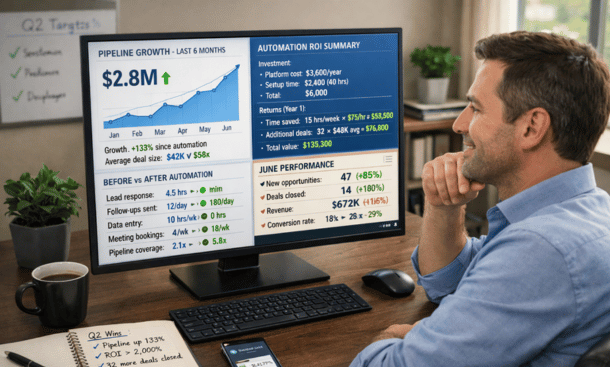
Implementing sales automation without measuring its impact is how entrepreneurs waste money on tools that look impressive but don’t move revenue numbers. You need specific metrics that connect automation activities directly to pipeline growth and closed deals, not vanity numbers about emails sent or tasks completed. The metrics that actually matter reveal whether your automation is generating qualified opportunities faster, helping reps close deals at higher rates, or just creating busy work that doesn’t translate to revenue. Most businesses discover they’re tracking the wrong numbers entirely until they map metrics to actual business outcomes. To understand how measurement fits into your complete automation strategy, our guide on automating sales processes with AI walks through the entire framework from implementation through optimization.
Why most automation metrics mislead you
Sales automation platforms love showing you impressive activity numbers. Your dashboard displays thousands of emails sent, hundreds of calls logged, dozens of meetings scheduled. These numbers feel like progress because they’re growing consistently, but they might not correlate with the only number that actually matters: revenue.
Activity metrics become dangerous when teams optimize for the wrong goals. If you’re tracking emails sent as a success metric, reps will send more emails even if response rates are dropping. If you’re measuring calls made, you’ll get more dials to unqualified prospects who were never going to buy. The volume goes up while conversion rates decline because nobody’s paying attention to quality.
The disconnect happens because activity metrics measure inputs while you actually care about outputs. Inputs are things you control: how many emails to send, how many calls to make, how many sequences to run. Outputs are things prospects control: whether they respond, book meetings, and eventually buy. Successful automation improves the conversion from inputs to outputs, not just the volume of inputs.
Another trap is measuring automation success in isolation from human performance. Your chatbot might be handling 500 conversations monthly with a 60 percent containment rate, which sounds great until you realize those 200 escalated conversations are consuming so much rep time that overall team productivity has declined. You need to measure the complete system, not individual components.
Pipeline velocity reveals automation effectiveness
Pipeline velocity measures how quickly deals move from initial contact through closed won status. This metric captures multiple factors that automation should improve: time to first response, lead qualification speed, meeting booking rates, and sales cycle length.
Calculate baseline velocity before implementing automation. Take the average number of days from when a lead enters your system until they become a customer. If you’re running 60-day sales cycles on average, that’s your starting point. After implementing automation, track whether this number decreases.
Breaking down the velocity components
Time to first contact should drop dramatically with automation. Manual processes might mean leads wait hours or days for initial response. Automated systems respond in seconds. If your time to first contact doesn’t improve significantly after implementing automation, something’s configured wrong.
Lead qualification time measures how long it takes to determine whether a prospect fits your ideal customer profile and has genuine buying intent. Manual qualification through discovery calls might take a week of back-and-forth scheduling. AI qualification through chatbots or email sequences should compress this to 24-48 hours.
Meeting booking efficiency tracks how many interactions it takes to get a prospect on your calendar. Without automation, scheduling often requires five or six emails coordinating availability. Automated scheduling tools should reduce this to one or two clicks from the prospect’s perspective.
Sales cycle length from first meeting to closed deal might not change dramatically with automation unless you’re also automating proposal generation, contract routing, or other late-stage processes. But even small reductions here compound significantly across many deals.
Track velocity by lead source and segment. Automation might accelerate your inbound marketing leads significantly while having minimal impact on outbound cold prospects. Understanding these differences helps you prioritize where to expand automation efforts.
Conversion rates at each funnel stage
Pipeline conversion rates show what percentage of prospects move from one stage to the next. Automation should improve these percentages by ensuring timely follow-up, consistent messaging, and better qualification.
Lead to qualified opportunity conversion reveals how well your automation identifies genuine prospects versus tire-kickers. Before automation, this might be 15 to 20 percent because reps spend time on anyone who expresses initial interest. After implementing AI qualification, this should improve to 25 to 35 percent because you’re filtering out poor fits earlier.
Qualified opportunity to meeting booked shows whether your outreach and scheduling automation actually gets prospects to commit time. Manual scheduling often sees 40 to 50 percent of qualified leads eventually booking meetings. Automated scheduling with instant availability and reminder sequences should push this to 60 to 70 percent.
Meeting to proposal conversion indicates whether the prospects reaching your reps are actually qualified and worth pursuing. If this rate drops after implementing automation, your qualification criteria might be too loose. You’re routing more meetings but they’re lower quality. This metric keeps you honest about whether automation is generating real opportunities or just activity.
Proposal to close rate generally shouldn’t change much with early-stage automation since this depends primarily on your product, pricing, and sales skills. However, if you implement automation for proposal delivery, e-signatures, and contract management, you might see improvements here too from reduced friction in the buying process.
Calculating true conversion improvement
Don’t just compare percentages before and after automation. Account for volume changes too. If your lead-to-opportunity rate improves from 20 to 25 percent but you’re now processing three times more leads, that 5 percentage point improvement represents a 3.75x increase in qualified opportunities generated.
The math works like this: 1,000 leads at 20 percent conversion = 200 opportunities. 3,000 leads at 25 percent = 750 opportunities. That’s not just a 25 percent improvement in conversion, it’s a 275 percent improvement in output. This is why automation ROI compounds when you layer volume increases on top of efficiency gains.
Cost per acquisition and customer acquisition cost
Cost per acquisition measures how much you spend to acquire each new customer through your automated sales process. This metric matters more than any other for determining automation ROI because it directly connects to profitability.
Calculate your pre-automation CAC by adding all sales and marketing costs for a period and dividing by customers acquired. If you spent $50,000 and acquired 25 customers, your CAC is $2,000. After implementing automation, track whether this number decreases as you acquire more customers with similar or lower spending.
Automation reduces CAC through multiple mechanisms. Lower labor costs per deal happen when reps spend time exclusively on high-value activities. If automation handles qualification and scheduling, your reps can manage larger pipelines without needing to expand headcount. You might acquire 40 customers with $55,000 in costs, dropping CAC to $1,375.
Improved conversion rates reduce waste on prospects who never close. When automation filters out poor fits earlier, you stop spending rep time on deals that were never going to happen. This efficiency shows up as lower cost per customer even if total spending stays flat.
Faster sales cycles mean you can process more deals with the same resources. If automation cuts your average sales cycle from 60 to 45 days, reps can handle 33 percent more annual pipeline without working harder. This increased throughput directly reduces CAC.
Separating platform costs from total CAC
Include automation platform subscriptions in your CAC calculation. If you’re paying $500 monthly for sales automation tools, that’s $6,000 annually that needs to factor into cost per customer. The automation only creates positive ROI if the total CAC including platform costs is lower than before, or if revenue per customer increases enough to justify slightly higher acquisition costs.
Many businesses find that automation increases CAC slightly in the first few months during implementation and learning curves, then drops significantly as the system matures and volume scales. Don’t panic if initial numbers look worse. Track the trend over six to twelve months to see the real impact.
Revenue per sales rep
Revenue per rep measures total productivity of your sales team. Automation should increase this metric significantly by removing low-value work and letting reps focus on activities that directly generate revenue.
Calculate baseline by dividing total sales revenue by number of reps. If you generated $1.2 million with four reps last year, revenue per rep was $300,000. After implementing automation, this should increase even if you don’t add headcount. Maybe you hit $1.8 million with the same four reps, bringing revenue per rep to $450,000.
The improvement comes from capacity expansion. When automation handles qualification, scheduling, data entry, and follow-up, reps gain 10 to 15 hours weekly for actual selling activities. That’s roughly doubling the time spent on revenue-generating conversations.
Deal size might increase too if reps can focus on higher-value opportunities. Without automation, reps chase every lead regardless of potential deal size because pipeline anxiety drives behavior. With consistent lead flow from automation, they can prioritize larger opportunities that require more attention and close at higher values.
Account for seasonal and market factors
Don’t attribute all revenue improvements to automation without considering external factors. If you implemented automation in Q1 and revenue spiked in Q4, some of that growth might be seasonal. If you launched a new product or entered a new market, that affects numbers too.
The cleanest way to isolate automation impact is tracking cohorts. Compare deals that went through your automated process versus deals that followed the old manual approach during the same time period. If automated deals close faster, at higher rates, or at larger sizes than manual deals, you’ve proven automation impact independent of other variables.
Meeting show rates and engagement quality
Meeting show rates indicate whether the prospects your automation qualifies are genuinely interested or just clicking buttons to make chatbots go away. This metric keeps your qualification criteria honest.
Track what percentage of scheduled meetings actually happen. Manual processes typically see 60 to 70 percent show rates because prospects only schedule when they’re truly interested. Automated scheduling should maintain or improve this rate, not decrease it.
If show rates drop below 50 percent after implementing automation, your qualification is too loose. The chatbot or email sequences are routing unqualified prospects to sales calendars. Tighten your qualification criteria, add confirmation sequences that verify interest, or implement reminder systems that reduce no-shows.
Engagement during meetings reveals quality. Are prospects prepared and asking good questions, or do they seem confused about why they’re on the call? Are deals progressing to next steps, or dying after first meetings? Track the percentage of meetings that result in follow-up actions like proposal requests or technical evaluation starts.
Demo completion rates matter for product-led sales. If prospects book demos but drop off halfway through, that’s a signal. Either your targeting is off and you’re attracting wrong-fit prospects, or your demo experience needs improvement. Automation should increase both the volume of demos and the completion rate by sending better-qualified prospects.
Building dashboards that drive decisions
Tracking metrics only creates value if you actually review them regularly and make decisions based on what you find. Build a simple dashboard that shows your key metrics in one view updated weekly or monthly.
Include trend lines, not just point-in-time numbers. Seeing that your pipeline velocity was 45 days last month doesn’t tell you much. Seeing that it’s decreased from 60 days six months ago shows clear improvement trajectory.
Set target benchmarks for each metric based on your business model and goals. If you need $2 million in annual revenue with four reps, that’s $500,000 per rep. If your current performance is $350,000 per rep, you know you need 43 percent improvement to hit your goal. This clarity helps prioritize which automation initiatives will have the biggest impact.
[Image Placeholder: Create a mockup of an executive dashboard showing 6-8 key sales metrics in various chart types – line graphs for trends, bar charts for comparisons, gauges for targets, and heat maps for conversion rates across different segments]
Review metrics with your entire team, not just management. Sales reps who understand that automation is improving their pipeline quality and reducing busy work become advocates instead of resisters. Transparency builds buy-in when people see proof that changes are working.
Create alert thresholds for critical metrics. If your lead-to-opportunity conversion rate drops below 20 percent or meeting show rates fall under 60 percent, you should get notified immediately rather than discovering problems in your monthly review. Early warning systems let you fix issues before they significantly impact results.
Measuring sales automation effectively requires focusing on metrics that directly connect to revenue outcomes rather than activity levels. These measurements prove whether your investments are paying off and guide decisions about where to expand or adjust your automation strategy. When you can demonstrate clear ROI through improved conversion rates, lower acquisition costs, and higher rep productivity, automation shifts from nice-to-have to business-critical. Understanding the fundamentals of what automation can accomplish sets the foundation for choosing metrics that matter. Our explanation of what AI sales automation is and why it multiplies revenue helps you connect specific automation capabilities to the outcomes you should measure.
About the Author

Mateo
I’m Mateo, a SaaS blogger and digital strategist dedicated to helping startups accelerate growth through automation, data-driven decision-making, and performance-focused marketing systems. Over the past few years, I’ve worked with early-stage software companies to refine their go-to-market strategies, optimize conversion funnels, and implement scalable automation frameworks that drive measurable revenue growth. On my blog, I share proven insights from real-world SaaS cases, including actionable frameworks for churn reduction, onboarding optimization, and lead-to-customer conversion. My mission is simple: to empower founders and marketers with practical strategies that turn innovative software into sustainable, profitable success.
Did you find this helpful?
Your feedback helps us curate better content for the community.