
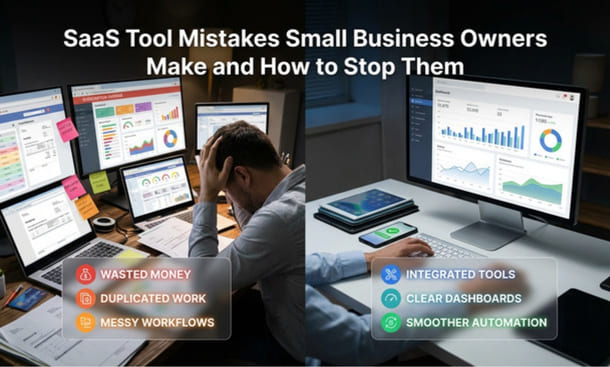
Most SaaS mistakes do not feel like mistakes when they happen. They feel like reasonable decisions made with the information available at the time. The tool looked capable. The pricing seemed fair. The timing made sense. Nobody signs up for software intending to waste money on it.
The problem is that the most expensive SaaS mistakes are structural patterns built into how tools get chosen, adopted and maintained that produce predictable bad outcomes regardless of which specific tools are involved. Recognizing those patterns is what makes it possible to break them before they cost anything.
What follows are the seven mistakes that show up most consistently across small business SaaS stacks. Not edge cases or unusual situations patterns that repeat across different industries, different business sizes and different tool categories because they are rooted in how small businesses tend to approach software decisions rather than in the specific tools they choose.
Mistake one: buying for the business you want instead of the business you have
This is the most common and most expensive SaaS mistake small business owners make. It happens when a tool gets chosen based on where the business is headed rather than where it actually is and the gap between those two points determines how much of the tool’s capability goes unused.
A solo consultant signs up for a sophisticated team collaboration platform because she expects to hire two people in the next six months. The hiring takes eighteen months. For a year and a half she pays for seats and features designed for a team she does not yet have while managing complexity the tool introduces that a simpler option would not.
A five person agency adopts an enterprise CRM because the founder read that it scales well. The platform requires a dedicated administrator to configure properly. Nobody on the team has that bandwidth. Six months later the CRM holds three contacts and the team is managing client relationships through a shared spreadsheet exactly as they were before.
The antidote is deliberate. Before committing to any tool ask one question: does this tool solve a problem the business has today or a problem the business might have in a year? Solutions to current problems deliver value immediately. Solutions to future problems create overhead now and may never deliver the value that justified them if the anticipated growth does not materialize on schedule.
Build for the business you have. Upgrade when the business has genuinely outgrown what you built.
Mistake two: the over tooled stack
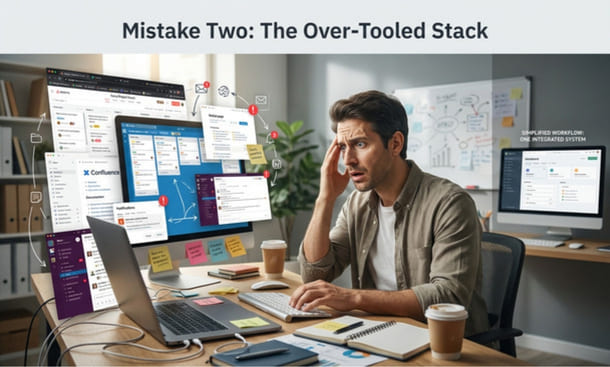
At some point between their first and third year most small businesses accumulate more SaaS tools than they can maintain not because they made reckless decisions but because each individual addition made sense at the time and nobody audited the stack as a whole.
A project management tool gets added. Then a separate task management tool because the project management tool felt too heavy for daily tasks. Then a note-taking tool because the task management tool does not handle meeting notes well. Then a documentation tool because the note-taking tool does not have the right structure for long-form references. By the end of that sequence there are four tools doing work that one well-chosen tool could handle and the team is spending as much time deciding which tool to use for which type of content as they are actually doing the work.
Over-tooling is not just a budget problem. It is a cognitive load problem. Every tool in the stack is a system that needs to be learned, maintained and kept current. Every additional tool is a place where work can get lost, where context switching happens and where the mental overhead of managing the stack itself increases.
The audit question for this mistake is simple: for every tool currently in the stack could its core function be handled by a tool already present without meaningful loss of quality? If the answer is yes for more than one tool the stack has grown past the point where it is helping the business and into the territory where it is creating the friction it was supposed to eliminate.
Mistake three: ignoring the integration layer until it is too late
Integration failures are almost always discovered after the purchase which is the most expensive time to discover them.
A business adopts a new CRM. Three weeks into implementation the team realizes the CRM does not connect to the invoicing platform. Every client record requires manual entry in two separate systems. The duplication takes 40 minutes per week across the team. Over a year that is more than 30 hours of manual data entry that a $20 per month integration would have eliminated entirely.
The mistake is not choosing a tool that lacks an integration. Every tool has gaps in its integration library. The mistake is not auditing those gaps before the purchase not checking whether the specific connections the business depends on exist and work at the depth the workflow requires.
A useful pre-purchase integration audit takes less than an hour. List every tool the new platform needs to communicate with. Check the integration documentation for each connection not the marketing page but the actual technical documentation that describes what data syncs, in which direction and how frequently. Identify any gaps and decide whether they represent workarounds the business can absorb or deal-breakers that should redirect the decision.
Mistake four: treating the free plan as a long-term strategy
Free plans exist to demonstrate value and create switching costs not to serve as a permanent operational tier for growing businesses. Most free plans are deliberately limited in ways that become increasingly constraining as the business scales, and the moment those limits are hit the business faces a forced upgrade decision under time pressure rather than on its own terms.
The most common free plan traps in small business SaaS stacks are seat limits that cut off at exactly the point where the team is growing, storage limits that fill up during the business’s most active period, and feature gates that lock the capabilities that would deliver the most value automations, integrations, reporting behind paid tiers.
None of that is a reason to avoid free plans. They are a legitimate starting point for tools where the business is genuinely not sure how much value the platform will deliver. The mistake is staying on a free plan past the point where the limitations are creating real operational friction because the upgrade conversation feels uncomfortable.
If a free plan limitation is causing a team member to develop a workaround the cost of that workaround in time, in error rate, in the cognitive overhead of maintaining a parallel process is almost always higher than the monthly cost of the upgrade it is avoiding.
Mistake five: no owner, no accountability
Every tool in a small business stack needs one person who owns it. Not a committee. Not the founder by default because nobody else claimed it. One named person who is responsible for keeping the configuration current, onboarding new team members into it and flagging when it is not delivering value.
Without a designated owner tools drift. The configuration that made sense when the business was structured one way becomes outdated as the business evolves. Nobody notices because nobody is watching. The team develops workarounds for the outdated configuration. The workarounds become the actual workflow. The tool becomes a nominal part of the stack that everyone works around rather than with.
Assigning ownership is a five-minute conversation. The ongoing cost of not having it is measured in months of accumulated drift and the periodic rebuilding projects that follow when someone finally acknowledges that the tool has not been working properly for a long time.
Mistake six switching tools instead of fixing the implementation
When a SaaS tool is not delivering the expected value the natural instinct is to conclude that the wrong tool was chosen and begin evaluating alternatives. Sometimes that is the right call. More often the tool was chosen correctly and the implementation was the problem and switching tools without fixing the implementation just transfers the same failure to a new platform.
The signal that distinguishes a tool problem from an implementation problem is specificity. If the team can articulate concrete ways the tool fails to support their workflow specific actions that do not work, specific data that cannot be captured, specific integrations that do not exist that is a tool problem. The platform is genuinely not capable of what the business needs.
If the team’s feedback is more general it feels complicated, nobody remembers to update it, things get lost that is almost always an implementation problem. The tool may be perfectly capable of what the business needs but the configuration does not reflect the actual workflow, the team was not involved enough in the rollout and the daily habit of using it was never properly established.
Switching tools to solve an implementation problem is the most expensive mistake on this list because it resets the implementation clock entirely new evaluation, new setup, new onboarding, new adoption curve while leaving the root cause intact. The next tool will fail the same way unless the implementation approach changes.
Before concluding that a tool needs to be replaced spend two weeks treating the problem as an implementation failure. Reconfigure the workspace to better reflect the actual workflow. Run a structured team walkthrough of the core actions. Set a clear usage norm and hold it for 30 days. If the tool still fails to deliver value after that honest attempt the switch is justified. If it improves the tool was never the problem.
Mistake seven never auditing the stack
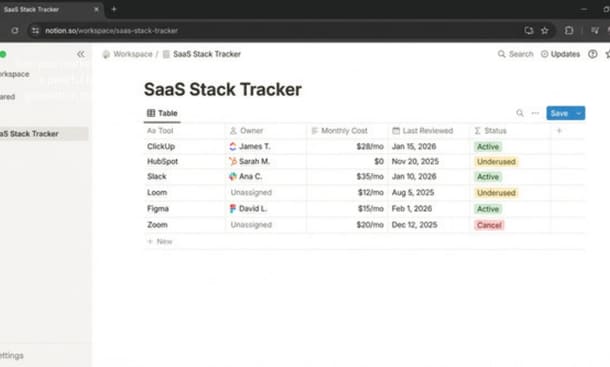
SaaS stacks do not maintain themselves. A tool that was the right choice eighteen months ago may be the wrong choice today because the business has changed, because better alternatives have emerged or because the integration that made the tool valuable has been broken by an update that nobody noticed.
Most small businesses audit their stack once at the moment of a financial crisis or a team complaint that is impossible to ignore and then return to a state of inattention until the next crisis. That cycle is expensive. The tools that should have been canceled six months ago are still on the statement. The integration that broke in November is still creating manual work in March. The tool that the last team member to leave was the only one who knew how to use is still being paid for even though nobody can access it properly.
A quarterly stack audit takes two hours and answers four questions. Which tools are being used consistently by the people who were supposed to use them? Which tools have integrations that are no longer functioning correctly? Which tools are being paid for at a tier that no longer matches how the business uses them? And which tools could be consolidated with something already in the stack without meaningful operational loss?
Two hours per quarter. Four questions. The cost of not doing it is visible on the credit card statement every month.

The pattern underneath every mistake
These seven mistakes are not independent failures. They are connected by the same root cause a reactive rather than intentional approach to SaaS tool decisions.
Reactive decisions get made when a problem is already acute. A team member complains. A deadline gets missed because of a broken workflow. A credit card statement arrives with a line item that cannot be explained. The tool gets chosen, implemented or retained under pressure rather than through deliberate evaluation and the pressure produces the shortcuts that become the mistakes.
Intentional decisions get made before the pressure arrives. The stack gets audited before the friction becomes a crisis. Tools get evaluated against the business’s actual workflow before the free trial starts. The implementation gets designed before the rollout happens. Ownership gets assigned before the drift begins.
The gap between reactive and intentional is not expertise or experience. It is a set of habits evaluation frameworks, audit schedules, ownership assignments applied consistently before the decision rather than after the damage.
Those habits are what a complete framework for choosing SaaS tools that fit your small business is built around because the mistakes above are not inevitable. They are predictable. And predictable mistakes can be prevented before they happen.
Every mistake on this list has been made by smart founders running real businesses. None of them are signs of carelessness or poor judgment. They are the natural result of making fast decisions in a market designed to encourage fast decisions where free trials create urgency, feature lists make tools look essential and the real cost of a poor choice only becomes visible weeks after the purchase.
The antidote is not slower decisions. It is better-structured ones. The evaluation framework applied before the trial. The integration audit completed before the purchase. The implementation plan built before the rollout. The stack audit scheduled before the next crisis.
Each of those habits costs time upfront. Each of them saves significantly more time downstream than they consume. And together they produce something that most small business owners spend years trying to build through trial and error a tool stack that compounds operational value over time rather than quietly draining it.
The full cycle starts earlier than most founders realize at the moment the selection process begins, before any tool enters the conversation. That is where why SaaS tools fail small businesses and what the real cause of that failure actually is begins and where the pattern either gets broken or gets repeated one more time.
About the Author

Pamela
Pamela is a dynamic professional with a deep passion for SaaS and emerging technologies. She provides valuable insights into software trends, digital innovation, and cutting-edge tools that empower businesses to thrive and expand.
Did you find this helpful?
Your feedback helps us curate better content for the community.