

At some point in the evaluation process the feature comparisons stop mattering. You have read enough reviews. You understand the pricing tiers. You know which tools scored well on which dimensions. What you actually want to know is whether this works for someone running a business like mine.
That is a fair question and it is one that most comparison guides never answer because it requires something those guides deliberately avoid specificity. Real businesses. Real workflows. Real numbers.
The stories on this page come from operators across different industries and different business sizes who made the same fundamental decision: to stop managing their work through a combination of memory, email threads and group chats and to move everything into a single simple system. What they gave up, what they gained and what surprised them along the way is more useful than any feature comparison because it shows what the transition actually looks like from the inside.
The Brooklyn creative agency that stopped losing Fridays
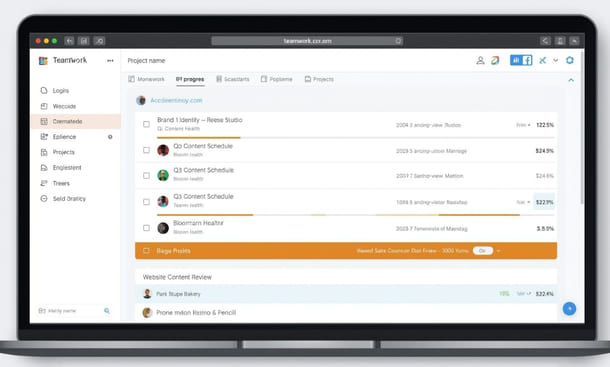
Nina runs a five-person brand and content agency in Brooklyn. For the first two years the agency operated through a combination of email, a shared Google Drive folder and a Slack workspace that had grown into something she describes as genuinely unnavigable.
The work was getting done. Clients were mostly satisfied. But the operational overhead was enormous. Every Friday afternoon Nina spent two to three hours manually reconstructing the status of every active project pulling information from email threads, checking Slack for updates, opening Google docs to see whether deliverables had actually been completed or just discussed. By the time she had a clear picture of where everything stood the week was over.
She moved the agency onto Teamwork after a two-week evaluation process. The setup took one full day and a second partial day for team onboarding. Within three weeks the Friday reconstruction sessions had dropped from two to three hours to under 30 minutes. Within six weeks she stopped doing them entirely because the information she needed was current and visible inside the tool at all times.
The change she talks about most is not the time saved though that was significant. It is the quality of the conversations she now has with clients. Because she can see the real-time status of every deliverable without asking her team she can answer client questions immediately and accurately instead of saying she will check and follow up. That responsiveness changed how several long term clients talked about the agency in referral conversations.
The tool did not make her team better at their work. It made the work they were already doing visible in a way that had value far beyond the internal operational benefit.
The Manhattan consultant who stopped working weekends
David runs a one-person management consulting practice in Manhattan. His client roster sits between four and six active engagements at any given time each with its own deliverable schedule, its own communication cadence and its own set of stakeholders who expect him to have answers ready when they ask.
For three years he managed everything through a combination of his email inbox, a legal pad he carried everywhere and a mental model of his workload that he describes as always feeling one missed detail away from collapse. He worked most Sunday mornings to get ahead of the week. He answered client emails at 11pm because that was when he finally had enough clarity about where things stood to respond accurately.
He tried ClickUp first. Found it too complex for a one-person operation. Tried Notion next. Built an elaborate workspace over a weekend that he stopped using within a month because maintaining it felt like a second job. Landed on Paymo after a recommendation from another independent consultant specifically because the time tracking was built directly into the project management workflow rather than being a separate tool he had to remember to use.
The shift in his working pattern was not immediate. The first two weeks felt awkward he kept defaulting to the legal pad out of habit. By week four the tool had become the default and the legal pad had moved to a drawer. By month two he had stopped working Sunday mornings entirely.
The metric that surprised him most was billable hour recovery. Because Paymo connected time tracking to projects automatically he discovered in the first month that he had been consistently under-billing for a specific type of client work not by a small amount. The visibility that came from having time tracked against actual projects rather than estimated in a spreadsheet revealed a gap he had been absorbing for years without realizing it.
The tool paid for itself in the first month through recovered billing alone. Everything after that was operational clarity he had not expected to value as much as he did.
The Queens contractor who got his subcontractors online
Marcus runs a general contracting operation in Queens managing residential renovation projects across three to four active sites at any given time. His team is a mix of direct employees and subcontractors electricians, plumbers, tile workers most of whom are not particularly comfortable with software and had never used a project management tool before he introduced one.
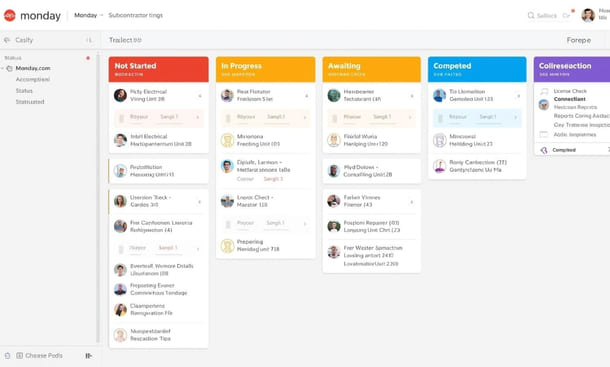
He had tried two tools before landing on monday.com. Both failed for the same reason: the interface was complex enough that his subcontractors stopped logging in after the first week. He was the only one updating the system which meant the system reflected his perspective on project status rather than actual ground-level reality.
Monday.com worked where the others did not for a reason that had nothing to do with features. The interface was visual enough that his subcontractors could understand what they were looking at without explanation. Color coded status columns green for on track, yellow for delayed, red for blocked communicated project health without requiring anyone to read a description. A subcontractor on a job site could open the mobile app, find their tasks for the day and update a status in under a minute.
Within six weeks all of his regular subcontractors were updating their own task statuses consistently. That single change moving from Marcus being the sole updater to the whole team maintaining the system transformed the tool from a personal tracker into a genuine operational hub.
The downstream effects were tangible. Material ordering became more accurate because task completion data gave him earlier visibility into what each phase would need and when. Client update calls became shorter because he could pull accurate progress information in real time rather than relying on his own site visits. One client explicitly mentioned in a contract renewal conversation that the project communication had been the best they had experienced with any contractor they had worked with.
The Miami startup that closed its pre-seed round looking organized
Valentina and her co-founder Jorge bootstrapped a B2B logistics software company in Miami while both maintained part-time consulting work on the side. For the first eight months they ran the entire operation through a shared Notion document that had started as a clean product roadmap and evolved into something neither of them could fully navigate anymore.
The problem surfaced in an investor meeting. A potential pre-seed lead asked them to walk through their current development priorities and their go-to-market timeline. Valentina knew the answers. Jorge knew the answers. But the answers they gave were slightly different not because they disagreed but because the information existed in multiple places and neither version was definitively current.
The investor passed. The feedback was diplomatic but the underlying message was clear: for a two-person company the operational picture should be sharper than this.
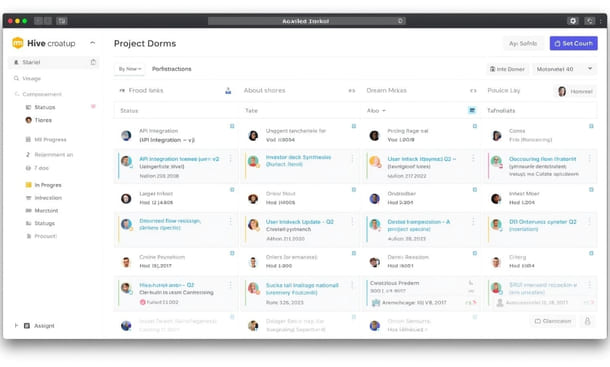
They rebuilt their entire operation inside Hive over a long weekend product roadmap, sprint tracking, investor pipeline, content calendar, partnership outreach. The transition from Notion was easier than expected because both were document-forward tools and the data migration was straightforward.
The difference was not the tool. It was the discipline that came from switching. The act of rebuilding forced them to make explicit decisions about what lived where, who owned what and how updates would be maintained. The clarity that had existed in their heads got externalized into a structure that both of them could point to as the source of truth.
Four months later they closed a $650,000 pre-seed round. During due diligence the lead investor reviewed their Hive workspace as part of the operational assessment. The feedback afterward included a specific comment about the clarity of their roadmap and the quality of their task ownership documentation unusual for a company at their stage and explicitly noted as a positive signal.
Valentina does not credit the tool with closing the round. She credits the discipline the tool made easier to maintain and the fact that they rebuilt it during a moment of genuine motivation rather than waiting until the next investor meeting made the urgency real.
What these stories have in common
Four businesses. Four different industries. Four different tools. The outcomes they describe are remarkably similar.
In every case the problem was not the quality of the work being done. The work was getting done. The problem was that the work was invisible to team members, to clients, to investors and sometimes to the operators themselves. Nobody could see what was in flight, what was blocked, what was coming up next or who was responsible for what.
The tools did not fix the work. They made the work visible. And visibility changed everything downstream client communication, team accountability, billing accuracy, investor confidence, personal working hours.
The second pattern worth noting is that none of these transitions were painless. Nina restructured her Teamwork workspace twice in the first month. David abandoned two tools before finding the one that fit. Marcus had to wait six weeks before his subcontractors adopted the system consistently. Valentina and Jorge rebuilt from scratch after a failed first attempt with a different tool.
The operators who got results were not the ones who found a perfect tool and had a perfect implementation. They were the ones who stayed consistent through the messy middle period the two to six weeks where the new system is real enough to require maintenance but not yet embedded enough to feel natural and made targeted adjustments instead of starting over.
That persistence is not a personality trait. It is a decision. And it is the one that separates the businesses that end up with a functioning operational system from the ones that cycle through tools indefinitely without building anything that sticks.
The pattern underneath the pattern
There is something deeper in these stories that the surface-level outcomes do not fully capture.
Every operator in this series describes a version of the same shift. Before the system they carried their business in their head. After the system they carried it in a tool. That sounds like a small change. The effect is not small.
Carrying a business in your head means every unresolved task, every pending decision and every open loop is competing for cognitive space at all times. It is the reason so many entrepreneurs work Sunday mornings and answer emails at midnight not because the work requires those hours but because the mental model of the business never fully switches off.
Moving that mental model into a tool that holds it reliably changes the relationship between the founder and the business. The anxiety of possibly forgetting something diminishes. The need to do the Friday reconstruction session disappears. The Sunday morning catch-up becomes optional rather than necessary.
That is what simple project management software for small business in 2026 actually delivers at its best not just operational efficiency but the cognitive relief that comes from trusting a system instead of trusting your own memory.
Reading about tools and reading about results are different experiences. The stories on this page are meant to answer the question that feature comparisons cannot: has this actually worked for someone in a situation like mine?
The answer across every story here is yes. With different tools, different timelines and different specific outcomes but the same underlying shift from invisible work to visible work and from reactive operations to intentional ones.
If you are still at the beginning of this process still deciding whether the investment of time and setup is worth it the clearest starting point is understanding why simplicity specifically is the right filter for a small business evaluation. That argument, and the operational logic behind it, is laid out in full in why simple project management software is the smarter choice for small business owners who want systems that actually get used.
About the Author

Pamela
Pamela is a dynamic professional with a deep passion for SaaS and emerging technologies. She provides valuable insights into software trends, digital innovation, and cutting-edge tools that empower businesses to thrive and expand.
Did you find this helpful?
Your feedback helps us curate better content for the community.