

There’s a moment that a lot of small business founders describe the same way. It’s not the moment they launched their product or landed their first big client. It’s a quieter moment the moment they realized they actually had their operations under control.
For some it comes after a stressful quarter finally runs smoothly. For others it’s when a new team member gets up to speed in days instead of weeks. For a lot of founders it happens the first time they check their project management dashboard in the morning and just know without sending a single message or holding a single meeting exactly where everything stands.
That moment is what a good system buys you. And the stories below are proof that it’s not just possible it’s repeatable.
These are real stories from founders and early-stage startup operators who decided to stop winging it. Their businesses are different. Their tools of choice vary. But the turning point they all describe is remarkably similar.
From creative chaos to scalable creative agency
Maya runs a small creative agency in Tampa that specializes in brand identity and content for DTC brands. When she started it was just her and one contractor, and they managed everything through a shared Google Drive and a very long email thread that she describes as “genuinely unreadable by month three.”
By the time she brought on two more people the cracks were serious. Deadlines were getting missed not because the work wasn’t being done but because nobody had a shared understanding of when things were actually due. Clients were following up more than they should have been. Maya was spending her Sunday evenings rebuilding her mental map of where every project stood.
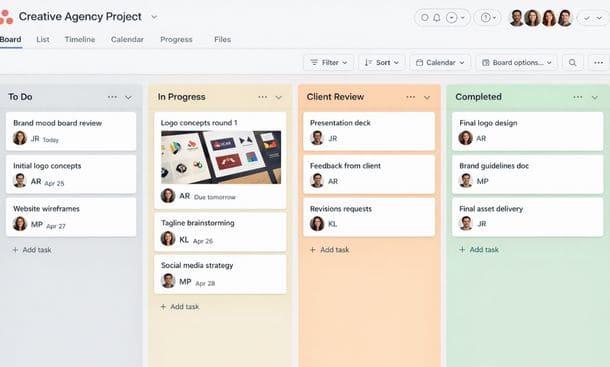
She moved everything into Asana over the course of a single weekend. Not perfectly she’s clear about that. The first version of her setup was rough and she restructured it twice in the first month. But within six weeks her team had a rhythm.
The change she talks about most isn’t the tool itself. It’s what happened to her Sunday evenings. She stopped working them. Not because there was suddenly less to do but because she no longer needed to manually reconstruct the state of her business from memory. It was all there, up to date, visible to everyone.
Her agency has since grown to eight people and she credits the early decision to systematize as the thing that made that growth possible without doubling her stress level alongside it.
The e-commerce founder who almost drowned in spreadsheets
Daniel started an e-commerce brand selling outdoor gear from his apartment in Orlando. For the first year he ran everything out of spreadsheets. Inventory tracking, supplier communication, content calendar, customer feedback all of it lived in a Google Sheets document that had grown into something he’s reluctant to describe in detail.
When he hired his first two full time employees he made the spreadsheet accessible to everyone and quickly realized that what worked as a personal system completely fell apart as a shared one. People were overwriting each other’s entries. Nobody could tell which version of a task list was current. His operations manager quit after two months and cited “total lack of clarity” in her exit conversation.
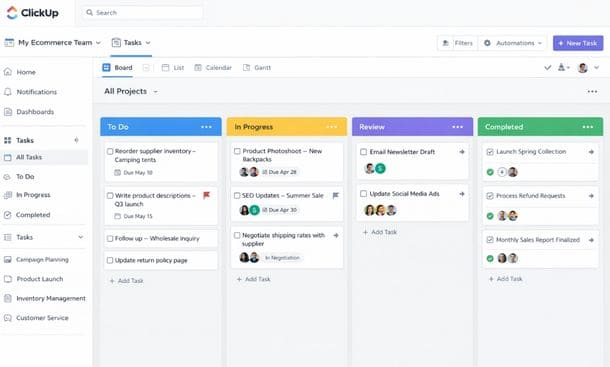
Daniel spent a week researching tools before landing on ClickUp, specifically because of its free plan and the ability to manage everything from product launches to customer service follow-ups in a single workspace.
The setup took longer than he expected closer to three weeks of iteration before it felt stable. But the result was a workspace where his team could see every active project, every pending task and every upcoming deadline without asking him anything.
The metric he tracks most closely now is what he calls “clarification messages” the Slack messages his team used to send him asking where something stood or what they should be working on next. In the three months before ClickUp he counted an average of 22 of those messages per week. Three months after getting the system stable that number dropped to four.
He still gets those messages occasionally. But now they’re about things that genuinely need his input rather than things that should have been visible in the system.
A two-person startup that punched way above its weight
Priya and her co-founder Marcus run a B2B SaaS startup based in Miami that they bootstrapped while both working part-time consulting gigs on the side. For about eight months they operated almost entirely through a combination of Notion docs and voice memos sent over WhatsApp, which Priya describes as “a system that worked perfectly inside our heads and nowhere else.”
The problem surfaced when they started talking to investors. During one early conversation a potential investor asked them to walk through their product roadmap and current development priorities. Priya knew the answer. Marcus knew the answer. But they gave slightly different answers in the same meeting not because they disagreed but because they had never actually documented their shared understanding in one place.
That meeting didn’t go anywhere. And Priya decided that week that they needed to operate like a real company even though they were two people working from Marcus’s spare bedroom.
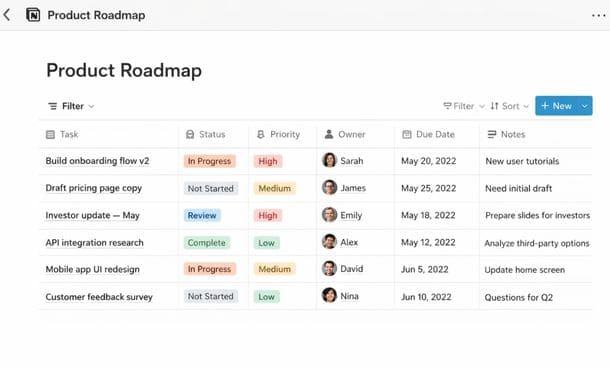
They built their entire operation inside Notion product roadmap, sprint planning, investor CRM, content pipeline, partnership tracking. Because they were already Notion users for documentation it wasn’t a huge behavioral shift. The difference was intentionality. They went from using Notion as a dumping ground for notes to using it as a structured operating system.
Six months later they closed a pre-seed round. During the due diligence process the investor specifically mentioned that their operational clarity was unusual for a company at their stage. They could pull up any project, any decision log, any roadmap item and show its full history in seconds.
Priya doesn’t attribute their fundraise to their Notion setup. But she does think the discipline of building and maintaining that system changed how they thought about their business and that mindset shift showed up in every conversation they had with investors.
The pattern that shows up in every story
These three businesses are different in almost every way industry, size, stage, tool of choice, geography. But when you look at the turning points they describe, the same pattern emerges every time.
The problem was never effort. Every one of these founders was working hard. The problem was visibility. Without a shared system, the work that was happening was invisible to teammates, to clients, to investors, sometimes even to the founder themselves.
The solution wasn’t a specific tool. It was the decision to stop carrying the business inside their heads and start putting it somewhere everyone could see it.
That decision made early enough and followed through with enough consistency is what separates the founders who scale smoothly from the ones who hit a ceiling they can’t explain.
It’s also worth saying that none of these setups were perfect from day one. Maya restructured hers twice. Daniel counted three major revisions before his team stopped complaining. Priya and Marcus still update their Notion structure every quarter as the business evolves. A project management system isn’t a one-time build. It’s a living thing that grows with your business.
What these stories are really about
If there’s one thing i want you to take from this page it’s that the barrier to getting organized is lower than you think.
You don’t need a big team. You don’t need a technical background. You don’t need weeks of setup time or a perfect plan before you start. You need a decision and a willingness to iterate.
The founders in these stories are not exceptional people with exceptional resources. They’re people who got tired of the chaos and decided to do something about it and then did it imperfectly until it worked.
That’s available to you right now.
If you’re still in the earlier stages of figuring out what a solid system even looks like, the full breakdown of how a project management system for small business actually works is the best place to build that foundation. And if you’re ready to stop reading and start building, the step by step guide on how to set up a project management system from scratch — along with our guide to the Best Project Management Tools for Small Teams in 2026 will walk you through exactly how to go from blank workspace to something your team actually uses.
The founders who figure this out early don’t just run better businesses. They enjoy running them more. And honestly, that part matters just as much as anything else.
About the Author

Pamela
Pamela is a dynamic professional with a deep passion for SaaS and emerging technologies. She provides valuable insights into software trends, digital innovation, and cutting-edge tools that empower businesses to thrive and expand.
Did you find this helpful?
Your feedback helps us curate better content for the community.