
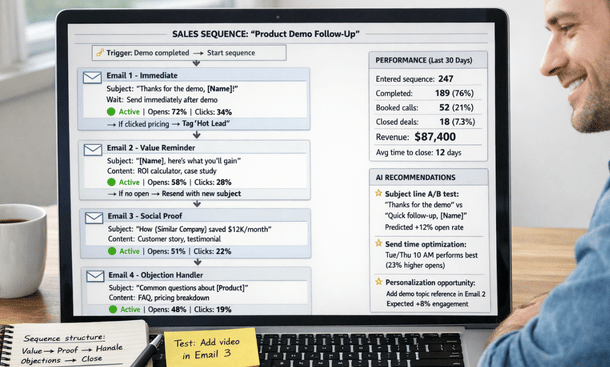
Email sequences are where the real revenue lives because they systematically move subscribers from awareness through consideration to purchase without manual follow-up for each person. Most businesses either don’t use sequences at all or create basic welcome emails that barely engage subscribers and generate no sales. The difference between sequences that print money and sequences that waste subscriber attention comes down to strategic planning, psychological triggers, AI-powered timing, and continuous optimization based on performance data. Building effective sequences isn’t about copying templates from the internet, it’s about understanding your customer journey, mapping content to each stage, and using AI to personalize and optimize at scale. To see how email sequences fit into your broader automation strategy, our guide on automating email marketing with AI walks through the complete framework.
Why most email sequences fail to convert
The typical approach to email sequences involves sending a series of pre-written messages at fixed intervals to everyone who joins your list. This one-size-fits-all method ignores individual subscriber behavior, timing preferences, and varying levels of purchase readiness, resulting in mediocre performance that leaves money on the table.
Generic content that could apply to anyone fails to resonate with specific subscribers. When your welcome sequence talks about features and benefits without addressing the particular problem each subscriber faces, the content feels irrelevant. People delete or ignore emails that don’t speak directly to their situation.
Fixed timing assumes everyone moves through your funnel at the same pace. Some subscribers research extensively for weeks before buying while others make quick decisions. Sending your sales pitch on day 5 to everyone misses both groups, reaching slow researchers too early and fast decision-makers too late.
No behavioral adaptation means sequences continue running regardless of subscriber actions. If someone visits your pricing page three times after email two, they’re showing clear buying signals. But most sequences ignore this and keep sending educational content for days instead of accelerating to sales messages.
Lack of personalization beyond inserting first names creates impersonal experiences. AI enables personalizing content recommendations, product suggestions, examples, and messaging based on subscriber data, but most sequences treat everyone identically regardless of their profile or behavior.
The psychology behind sequences that convert
Effective email sequences leverage psychological principles that influence decision-making and build trust over time. Understanding these principles helps you structure sequences that naturally guide subscribers toward purchase.
Reciprocity principle dictates that people feel obligated to give back when they receive value. Start sequences by delivering genuine value through useful content, tools, or insights before asking for anything. This goodwill makes subscribers more receptive to your eventual offers.
Consistency and commitment theory shows that people tend to follow through on small commitments to remain consistent with their self-image. Each small engagement with your emails, like clicking a link or reading content, creates micro-commitments that increase the likelihood of larger commitments like purchases later.
Social proof reduces perceived risk by showing that others have successfully used your product or service. Including customer testimonials, case studies, and usage statistics throughout sequences builds confidence that buying from you is a safe decision.
Scarcity and urgency create motivation to act now rather than later. Limited-time offers, countdown timers, or quantity limitations in later sequence emails push hesitant subscribers toward decision rather than endless deliberation.
Building a high-converting welcome sequence
The welcome sequence runs when someone first joins your list, making it your most important automation because it shapes first impressions and sets the foundation for the relationship. Every subscriber goes through this sequence, so optimizing it impacts everyone.
Welcome sequence structure checklist:
Email 1 – Immediate welcome (sent instantly):
- ☐ Thank subscriber for joining
- ☐ Deliver promised lead magnet or resource
- ☐ Set expectations for future emails (frequency and topics)
- ☐ Include quick win or immediate value
- ☐ Encourage reply or social media follow for engagement
Email 2 – Your story and credibility (send 1-2 days later):
- ☐ Share your background or company origin story
- ☐ Explain why you’re qualified to help with their problem
- ☐ Include social proof like customer count or results achieved
- ☐ Provide additional valuable content related to their interests
- ☐ Ask question to encourage reply and learn about subscriber
Email 3 – Address main problem (send 2-3 days after email 2):
- ☐ Identify the core challenge your audience faces
- ☐ Explain why this problem exists and why solutions fail
- ☐ Introduce your unique approach or methodology
- ☐ Share case study or example of someone overcoming this problem
- ☐ Provide actionable tip they can implement immediately
Email 4 – Overcome objections (send 2-3 days after email 3):
- ☐ Address common concerns or hesitations about your solution
- ☐ Provide detailed explanation or demonstration of how it works
- ☐ Include FAQ section answering typical questions
- ☐ Share additional testimonials specific to objections
- ☐ Offer low-risk way to try or learn more
Email 5 – Soft introduction to offer (send 2-3 days after email 4):
- ☐ Mention your product or service naturally within valuable content
- ☐ Explain who it’s designed for and what results it delivers
- ☐ Include customer success story showing transformation
- ☐ Provide link to learn more without hard sales pitch
- ☐ Continue delivering value even while introducing offer
Email 6 – Direct offer with urgency (send 3-4 days after email 5):
- ☐ Present clear offer with specific benefits and pricing
- ☐ Create urgency through limited-time bonus or discount
- ☐ Address final objections directly
- ☐ Include strong call-to-action with clear next steps
- ☐ Make purchasing process simple and frictionless
AI optimization improves this basic structure by personalizing content based on subscriber data, adjusting send timing based on engagement patterns, branching to different content based on clicks and actions, and identifying when someone is ready to buy before the scheduled sales email.
Creating abandoned cart recovery sequences
For e-commerce businesses, abandoned cart sequences directly recover revenue from people who showed clear purchase intent but didn’t complete transactions. These sequences generate 5 to 15 percent additional revenue from existing traffic.
The first email sends within 1-2 hours of cart abandonment while the products are still fresh in the customer’s mind. This email reminds them of what they left behind, shows product images, includes direct cart recovery link, and addresses common reasons for abandonment like checking shipping costs or comparing options.
The second email sends 24 hours after abandonment if the cart remains incomplete. This message creates urgency by mentioning limited stock availability or expiring prices, includes customer reviews of abandoned products, offers assistance if they have questions, and possibly provides small incentive like free shipping.
The third email sends 48-72 hours after abandonment as a final reminder. This email creates stronger urgency through clear deadline for cart availability, offers limited-time discount if you haven’t already, showcases complementary products they might have missed, and includes customer service contact if they need help completing purchase.
AI enhancement tracks which products get abandoned most frequently and creates specific messaging for those items. The system identifies price sensitivity by analyzing at what discount levels people convert and automatically adjusts offers. Timing optimization sends each email when that specific customer is most likely to engage based on their behavior patterns.
Building post-purchase sequences that maximize lifetime value
The customer journey doesn’t end at purchase. Post-purchase sequences build loyalty, encourage repeat purchases, and increase customer lifetime value through strategic follow-up.
Order confirmation and thank you email sends immediately after purchase confirming the transaction, providing order details and tracking information, setting expectations for delivery, thanking customer for their business, and offering immediate support contact if needed.
Product tips and onboarding email sends 2-3 days after delivery helping customers get maximum value from their purchase. Share usage tips and best practices, provide tutorial videos or guides, suggest complementary products that enhance their purchase, and request feedback on their experience so far.
Review request email sends 7-10 days after delivery giving adequate time to use the product. Ask for honest review on your site or third-party platforms, make leaving review easy with direct links, offer incentive like discount on next purchase, and show appreciation for taking time to share feedback.
Cross-sell and upsell email sends 2-3 weeks after purchase when customer has experienced value from initial purchase. Recommend complementary products based on what they bought, highlight products frequently purchased together, offer bundle deals for multiple items, and create urgency with limited-time offers for existing customers.
Re-engagement email sends 30-60 days after purchase maintaining relationship with customers who haven’t returned. Share new products or content relevant to their interests, provide exclusive customer-only offers, ask what content or products they’d like to see, and remind them of the value your brand provides.
AI analyzes purchase patterns to identify optimal timing for upsells based on when similar customers typically make second purchases. The system recommends specific products based on collaborative filtering showing what customers who bought similar items purchased next. Personalization adjusts messaging and offers based on customer value tier and engagement history.
Measuring sequence performance and optimization
Building sequences is only the beginning. Continuous measurement and optimization separate sequences that generate consistent revenue from those that underperform.
Key metrics to track for each sequence:
| Metric | What It Measures | Target Range | How to Improve |
|---|---|---|---|
| Open Rate | % of recipients who open emails | 20-40% | Test subject lines, optimize send times, clean inactive subscribers |
| Click Rate | % who click links in emails | 3-8% | Improve content relevance, clearer CTAs, better value proposition |
| Conversion Rate | % who complete desired action | 1-5% | Stronger offers, address objections, optimize landing pages |
| Revenue Per Subscriber | Average revenue generated per person | Varies by business | Better targeting, higher-value offers, improved conversion paths |
| Sequence Completion Rate | % who stay subscribed through entire sequence | 70-90% | Reduce email frequency, improve relevance, segment better |
| Time to Purchase | Days from subscription to first purchase | Varies by product | Identify and fix bottlenecks, accelerate high-intent subscribers |
A/B testing reveals what actually works versus assumptions. Test one variable at a time like subject lines, send timing, content format, offer positioning, call-to-action wording, or email length. Run tests long enough to reach statistical significance, typically 100+ conversions per variation.
Engagement-based branching creates separate paths based on subscriber actions. High engagers who open every email and click frequently move to accelerated sales sequences. Low engagers receive more educational content before sales pitches. Non-engagers enter re-engagement sequences attempting to revive interest.
AI-powered optimization continuously tests variations and automatically implements winning approaches. The system analyzes which subject lines perform best for different segments, identifies optimal send times for each subscriber, determines ideal sequence length based on conversion data, and adjusts content based on engagement patterns.
Building effective email sequences requires combining psychological understanding, strategic planning, quality content, and continuous optimization. AI handles the complexity of personalization and timing while you provide the strategy and messaging that resonates with your audience. Once you have sequences converting subscribers into customers, the final piece involves measuring overall email marketing performance to prove ROI and guide strategic decisions. Our guide on email marketing automation metrics shows you exactly which numbers matter and how to use data to systematically improve results.
About the Author

Mateo
I’m Mateo, a SaaS blogger and digital strategist dedicated to helping startups accelerate growth through automation, data-driven decision-making, and performance-focused marketing systems. Over the past few years, I’ve worked with early-stage software companies to refine their go-to-market strategies, optimize conversion funnels, and implement scalable automation frameworks that drive measurable revenue growth. On my blog, I share proven insights from real-world SaaS cases, including actionable frameworks for churn reduction, onboarding optimization, and lead-to-customer conversion. My mission is simple: to empower founders and marketers with practical strategies that turn innovative software into sustainable, profitable success.
Did you find this helpful?
Your feedback helps us curate better content for the community.