
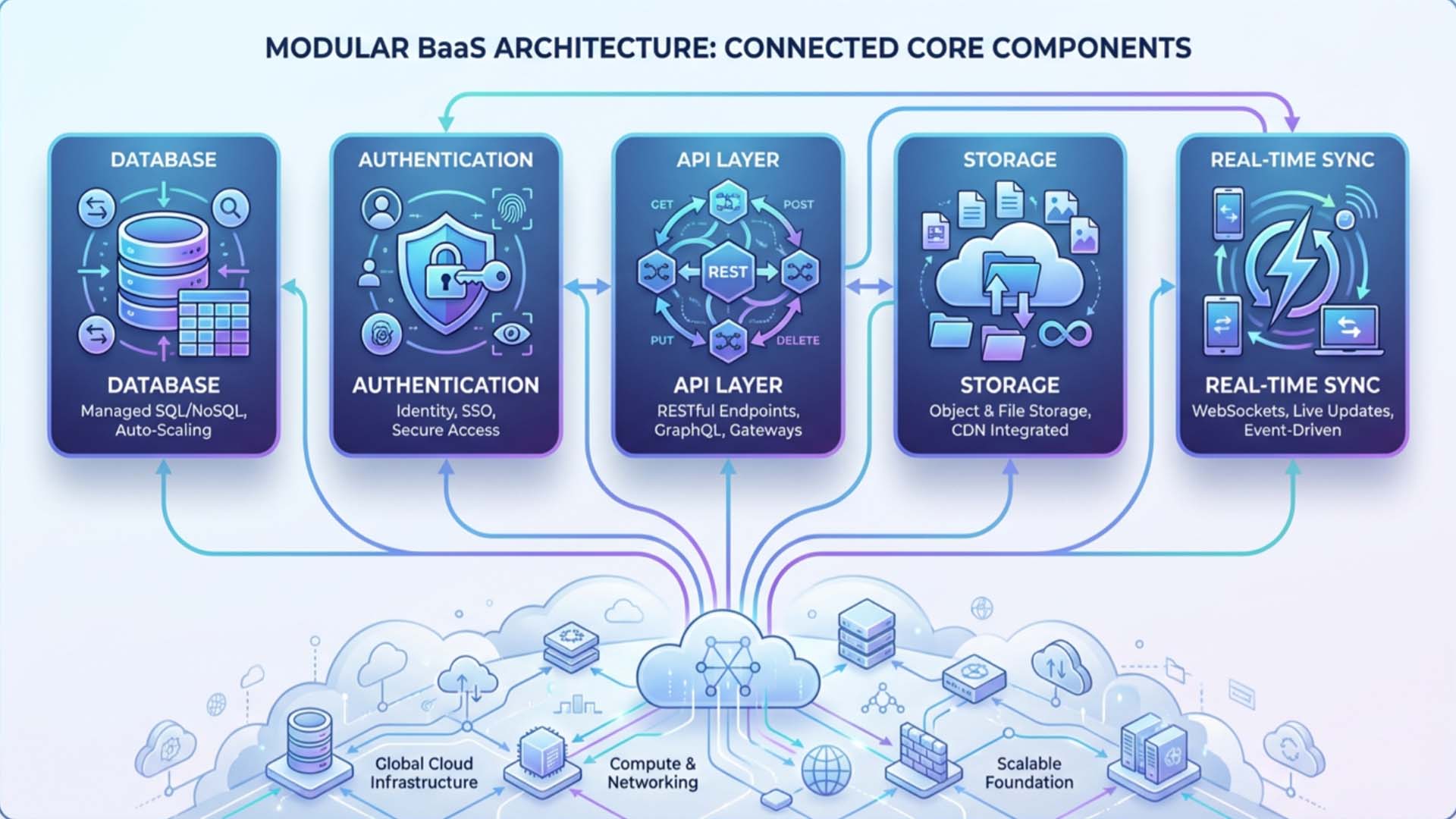
Behind every Backend as a Service platform lies a sophisticated architecture of interconnected components designed to handle the heavy lifting of backend development. These platforms bundle together databases, user authentication, RESTful and GraphQL APIs, file storage, and real-time synchronization capabilities into a cohesive ecosystem. Each component operates as a managed service, abstracting away infrastructure complexity while providing developers with simple interfaces and SDKs. Whether you’re building a mobile app, web application, or IoT solution, understanding these core technical building blocks helps you evaluate which features matter most for your project and how they integrate with our comprehensive Backend as a Service framework.
Database management: the foundation of data storage
At the heart of every BaaS platform sits a managed database system. This is where your application stores user profiles, product catalogs, transaction records, and any other persistent data your application needs. BaaS providers handle all the complex aspects of database administration—backups, security patches, performance optimization, and scaling—so you can focus on structuring your data and querying it effectively.
Different BaaS platforms take different approaches to databases. Some provide traditional relational databases like PostgreSQL, which store data in tables with clearly defined relationships between them. Others offer NoSQL databases that store data as flexible JSON-like documents, making it easier to adapt your data structure as your application evolves. A few platforms give you both options, letting you choose based on your specific needs.
The real power comes from how BaaS platforms expose these databases to your application. Instead of writing raw SQL queries or managing database connections, you typically interact with the database through client libraries that feel natural in your programming language. Creating a new user record might be as simple as db.collection(‘users’).create({ name, email }) rather than constructing complex query strings.
Most BaaS databases include built-in features that would take significant effort to implement yourself. Automatic indexing speeds up common queries. Real-time subscriptions let your application receive instant updates when data changes. Row-level security policies ensure users can only access data they’re authorized to see. These features come pre-configured and tested, eliminating entire categories of bugs and security vulnerabilities.
Authentication and authorization: securing user access
User authentication represents one of the most critical and complex aspects of backend development. BaaS platforms provide comprehensive authentication systems that handle everything from basic email/password login to social authentication with Google, Facebook, or GitHub, to enterprise single sign-on solutions.
When a user signs up through a BaaS authentication system, the platform handles password hashing using industry-standard algorithms, generates secure session tokens, manages email verification, and provides password reset functionality. You don’t write any of this security-critical code yourself—you call authentication methods provided by the platform’s SDK.
Authorization goes hand-in-hand with authentication. Once the platform knows who a user is, it needs to determine what that user can do. BaaS platforms typically provide role-based access control, letting you assign users to groups like “admin,” “editor,” or “viewer.” More sophisticated platforms offer fine-grained permissions where you can define exactly which database records a user can read, update, or delete based on custom rules.
The authentication component integrates seamlessly with other BaaS features. When a user makes a database query, the authentication system automatically ensures they’re logged in and authorized. When they upload a file, the same security context applies. This integrated security model prevents the kind of authorization gaps that often plague custom-built backends where different components handle security inconsistently.
API layer: connecting frontend to backend
Every BaaS platform provides an API layer that lets your frontend application communicate with backend services. This API handles requests from your web or mobile app, processes them according to your business logic, and returns appropriate responses. The difference from traditional API development is that much of this structure comes pre-built.
Most modern BaaS platforms support both REST APIs and GraphQL. REST APIs organize backend functionality into logical endpoints—/users for user operations, /posts for content, and so on. GraphQL provides a more flexible query language that lets your frontend request exactly the data it needs in a single API call, reducing unnecessary data transfer and improving performance.
Some platforms automatically generate API endpoints based on your database structure. Create a “products” table in your database, and you immediately have endpoints to create, read, update, and delete products without writing any server code. Other platforms let you write custom serverless functions that run backend logic in response to API calls, giving you more control when you need it.
The API layer also handles common concerns like rate limiting to prevent abuse, request validation to ensure data integrity, and CORS configuration to control which domains can access your backend. These production-ready features come configured out of the box, though you can adjust them based on your requirements.
File storage and content delivery
Applications frequently need to store and serve files—user profile photos, document uploads, product images, or video content. BaaS platforms provide managed file storage that handles uploads, compression, transformation, and delivery without requiring you to manage storage servers or configure CDNs.
When a user uploads a profile photo to your app, the BaaS storage system receives the file, stores it securely, generates a URL for accessing it, and applies any transformations you’ve configured. You might automatically resize images to multiple dimensions, convert videos to web-friendly formats, or generate thumbnails. The platform handles all of this processing and serves files through a content delivery network for fast global access.
Security for file storage works similarly to database security. You define rules about who can upload files, who can view them, and whether they’re publicly accessible or require authentication. The storage component integrates with the authentication system, so checking permissions happens automatically.
Modern BaaS storage systems also provide features like automatic backup, versioning that preserves old versions of files, and metadata search that lets you find files based on attributes beyond just filename. These capabilities would require significant engineering effort to build reliably from scratch.
Real-time synchronization: instant updates
One feature that distinguishes BaaS platforms from traditional backends is built-in real-time synchronization. When data changes in your database—whether a user posts a comment, updates their status, or receives a message—your application can receive that update instantly without constantly polling the server.
This real-time capability powers collaborative features like chat applications, live notifications, multiplayer games, and any scenario where multiple users need to see changes immediately. BaaS platforms implement this using websockets or similar technologies that maintain persistent connections between your app and the backend.
From a development perspective, real-time features are remarkably simple to implement. You subscribe to specific data queries, and your application receives automatic updates whenever that data changes. The platform handles connection management, reconnection after network interruptions, and efficiently broadcasting updates to all subscribed clients.
Real-time synchronization also enables offline-first applications. Mobile apps can work without internet connectivity, storing changes locally, then automatically sync with the backend when connection restores. The BaaS platform resolves any conflicts between local and server data according to rules you define.
Serverless functions: custom backend logic
While BaaS platforms provide many pre-built features, you sometimes need custom backend logic—complex calculations, third-party API integrations, or business workflows specific to your application. Most BaaS platforms include serverless functions (sometimes called cloud functions or edge functions) that let you run custom code in response to events or HTTP requests.
These functions run in a managed environment where the platform handles scaling, monitoring, and infrastructure. You write the function code, deploy it to the platform, and it executes whenever triggered. You might write a function that runs when a new user signs up to send a welcome email, or one that processes payments when users make purchases.
Serverless functions integrate with other BaaS components. They can read and write to the database, access uploaded files, send notifications, and call external APIs. This lets you extend the platform’s capabilities while still benefiting from managed infrastructure.
Understanding the complete picture
Each BaaS component serves a specific purpose, but their real value comes from how seamlessly they work together. Authentication protects your database. Database changes trigger real-time updates. Serverless functions orchestrate complex workflows across multiple components. This integration eliminates much of the glue code you’d write in traditional backend development.
For entrepreneurs and solopreneurs evaluating BaaS platforms, understanding these components helps you assess whether a platform provides everything your application needs. Some projects require sophisticated real-time features, others prioritize file storage and delivery, while some need primarily database and authentication.
Now that you understand how BaaS platforms work internally, the natural next question becomes whether this approach makes sense for your specific project. The architectural benefits are clear, but how does BaaS stack up against building a traditional custom backend? Exploring the comparison between these approaches reveals important trade-offs around development speed, cost, flexibility, and long-term scalability that every founder should consider before committing to an architecture.
About the Author

AISalah
AISalah bridges linguistics and technology at PointOfSaaS, exploring AI applications in business software. English Studies BA with hands-on back-end and ERP development experience.
Did you find this helpful?
Your feedback helps us curate better content for the community.