
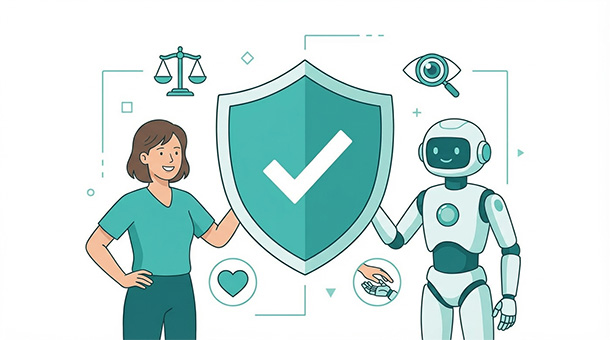
Your AI chatbot gives medical advice when it should refer users to doctors. Your resume screening tool accidentally filters out qualified candidates from certain backgrounds. Your content moderation system flags harmless posts while missing actual violations. AI mistakes aren’t just embarrassing, they’re liability risks that damage trust permanently. Ethical AI implementation means adding human review for high-stakes decisions, being transparent about what AI can and can’t do, and testing for bias before launching. BaaS platforms provide the tools, but you define the safety rules.
Why AI mistakes hit harder than regular bugs
A traditional software bug crashes a page or shows an error message. Users refresh, the problem gets fixed, and life moves on. AI mistakes feel different because they involve judgment, decisions, and sometimes sensitive topics that affect real people in meaningful ways.
An AI that recommends the wrong product wastes a user’s time. An AI that gives incorrect medical information could genuinely harm someone. An AI that screens job applications with hidden bias perpetuates discrimination at scale. The difference between a bug and an AI mistake is that bugs break functionality while AI mistakes break trust.
Trust, once damaged by AI behavior, recovers slowly. A single viral screenshot of your AI saying something offensive reaches thousands of people before you even know it happened. Social media amplifies AI failures instantly, turning an edge case into a reputation crisis within hours.
The stakes scale with your user base. A biased algorithm affecting ten users is a problem. The same algorithm affecting ten million users is a systemic crisis that attracts regulatory attention, media coverage, and potential legal action. Building ethical guardrails early costs less than retrofitting them during a crisis.
Understanding bias before it shows up in production
AI models learn patterns from training data. If that data contains biases, the model reproduces and often amplifies them. A hiring tool trained on historical hiring decisions inherits past discrimination. A content recommendation engine trained on engagement data pushes sensational content because that’s what historically drove clicks.
Bias isn’t always obvious during development. Your test dataset might look balanced, but subtle patterns slip through. Gender-correlated language in job descriptions influences model outputs without anyone noticing until a journalist or regulator starts asking questions.
Demographic representation in your user base affects model performance unevenly. A speech recognition feature trained primarily on English accents performs poorly on users with strong regional accents. An image recognition system trained mostly on lighter skin tones struggles with accurate detection across diverse complexions.
Testing for bias requires intentional effort beyond standard QA. Create test cases specifically designed to surface unfair treatment. Feed identical inputs with different demographic signals and verify outputs remain consistent. If changing a name from “James” to “Maria” in a loan application prompt changes the AI’s recommendation, your system has a problem.
Document known limitations honestly rather than pretending they don’t exist. Users and regulators respond better to transparency about imperfections than to discovered coverups. A product page that says “our AI works best with standard English pronunciation and we’re actively improving multilingual support” builds more trust than silence until someone complains publicly.
Building human oversight into AI workflows
Fully automated AI decisions work beautifully for low-stakes tasks. Categorizing support tickets, suggesting product recommendations, and summarizing meeting notes carry minimal risk if the AI gets something slightly wrong. Users adapt, correct, or ignore minor inaccuracies without lasting damage.
High-stakes decisions need human review before execution. Anything that affects someone’s access to services, financial transactions, content that reaches public audiences, or decisions with legal implications should include a human checkpoint. The AI provides a recommendation, a human reviews and approves or overrides before action happens.
Human-in-the-loop workflows integrate seamlessly through your BaaS platform. An edge function processes an AI decision, flags it for review based on confidence score or risk category, and routes it to an internal dashboard. A team member reviews the recommendation, approves or modifies it, and the system executes the final decision.
Confidence scoring helps prioritize human review efficiently. AI models output confidence levels alongside decisions. High confidence results on low-risk tasks proceed automatically. Low confidence results on any task, or any results on high-risk tasks regardless of confidence, get flagged for human review. You don’t review everything manually, just the cases that actually need attention.
Escalation paths should exist for every AI feature in your product. Define in advance what happens when the AI can’t handle a situation, produces an uncertain result, or generates content that triggers safety filters. Clear escalation paths prevent the AI from making consequential decisions in ambiguous situations where human judgment matters more than speed.
Transparency practices that build user trust
Users interact with AI features more comfortably when they know it’s AI handling their request. Labeling AI-generated content, responses, and recommendations removes the unsettling feeling of not knowing whether a human or algorithm produced something.
Simple disclosure language works better than lengthy disclaimers. “This response was generated by AI and may contain inaccuracies” tells users exactly what they need to know in one sentence. They can factor that information into how they use the response without reading a paragraph of legal text.
Confidence indicators help users calibrate their trust appropriately. Showing “high confidence” or “low confidence” alongside AI outputs gives users a signal about when to rely on the AI versus when to verify independently. A chatbot that says “I’m not entirely sure about this, you might want to check our documentation” feels more trustworthy than one that states everything with equal certainty.
Feedback mechanisms let users correct AI mistakes and improve the system over time. A simple thumbs up or down button after AI responses provides signal about quality. More detailed feedback options like “this response was inaccurate” or “this doesn’t apply to my situation” help you understand failure patterns specifically.
Explanation capabilities build deeper trust for consequential decisions. If your AI recommends against a loan application, being able to explain why that decision was made, even in general terms, gives users a fair chance to address the issue. Black box decisions that simply say “denied” without reasoning feel arbitrary and often violate regulatory expectations.
Handling sensitive topics and guardrails
Certain topics require your AI to behave differently than it would by default. Medical questions should always include disclaimers directing users to professionals. Legal questions need clear statements that AI responses don’t constitute legal advice. Financial recommendations should emphasize that past performance doesn’t guarantee future results.
Content moderation guardrails prevent your AI from generating or amplifying harmful content. Define explicit boundaries in your system prompts: the AI should never provide instructions for illegal activities, never generate content targeting vulnerable groups, and never create material designed to deceive users.
Safety filters on AI outputs catch problematic content before it reaches users. Your edge function receives an AI response, runs it through a moderation check, and either passes it through or blocks it based on safety criteria you define. This adds a fraction of a second to response time but prevents embarrassing or harmful outputs from ever appearing.
Topic routing directs sensitive queries away from general AI processing. If a user mentions self-harm, depression, or crisis situations in a chatbot conversation, the system should immediately shift from AI responses to resources and human support contacts. Detecting these signals requires dedicated monitoring that runs before any general AI processing happens.
Age-appropriate content filtering adjusts AI behavior based on user demographics. If your platform includes younger users, AI features should automatically apply stricter content guidelines. Setting these guardrails at the platform level prevents individual feature developers from forgetting edge cases that matter.
Testing for ethical issues before launch
Red teaming involves deliberately trying to make your AI behave badly before real users do it accidentally or maliciously. Ask your team to craft prompts designed to bypass safety guidelines, extract harmful content, or produce biased outputs. Document every failure and fix it before launch.
Diverse testing panels catch bias that homogeneous teams miss. If your engineering team shares similar backgrounds, demographics, and perspectives, they’ll test with similar assumptions. Bringing in testers from different backgrounds surfaces issues that never occur to the original developers.
Automated bias detection tools exist specifically for scanning AI outputs across demographic categories. Run your model against standardized test suites that measure fairness across gender, race, age, and other protected characteristics. These tools don’t catch everything, but they flag the most common and legally significant biases.
Edge case libraries help systematically test unusual inputs that might trigger unexpected AI behavior. “What if someone asks about competitor products?” “What if a user inputs text in a language your AI wasn’t trained on?” “What if someone pastes malicious code into a chatbot?” Documenting and testing edge cases before launch prevents the most embarrassing production failures.
Load testing reveals whether ethical guardrails hold under pressure. An AI that behaves perfectly with 10 simultaneous users might degrade when 10,000 users hammer it simultaneously. Safety filters that work at low volume might get bypassed when processing speed becomes the priority. Test your ethical safeguards at realistic scale before launching to your full user base.
Ethical guardrails protect your users and your reputation, but they’re most effective when integrated into your AI architecture from the beginning. Understanding how data flows, how costs accumulate, and how different features work together helps you build responsible AI that scales sustainably. The founder’s guide to AI: how to give your app “brains” using BaaS covers the complete system, from technical implementation to ethical considerations, giving you a framework for building AI products that users trust and regulators approve.
Responding when AI does make mistakes
Despite every precaution, AI will eventually produce something wrong, offensive, or harmful. How you respond determines whether the incident becomes a minor correction or a lasting reputation problem.
Acknowledge mistakes quickly and honestly. A public statement that says “our AI generated an inaccurate response in this situation, we’ve identified the cause and fixed it” earns more respect than silence or defensive denial. Users forgive mistakes far more easily than they forgive coverups.
Document the failure internally with full details. What triggered the mistake, what the AI output was, who was affected, and exactly what caused the problem. This documentation prevents the same failure from recurring and provides evidence that you took the issue seriously.
Affected users deserve direct communication. If someone received incorrect medical information, financial advice, or content that violated their trust, notify them specifically rather than hoping they didn’t notice. Direct acknowledgment respects users as individuals rather than treating them as anonymous traffic statistics.
Update your guardrails and testing procedures based on what happened. Every AI failure teaches you something about your safety architecture’s blind spots. The correction process should make your system more resilient, not just fix the specific instance that caused the problem.
Building an ethical AI culture within your team
Ethical AI isn’t a feature you add once and forget. It’s an ongoing practice that requires everyone on your team to consider the human impact of AI decisions, not just whether the code runs correctly.
Include ethical considerations in your product development process alongside technical requirements. When planning a new AI feature, ask “who could this harm?” before asking “how do we build this?” If the answer to the first question is concerning, redesign the feature before writing code.
Designate someone on your team as responsible for AI ethics, even if it’s a part-time responsibility initially. This person reviews new AI features for potential bias, maintains testing procedures, and monitors for ethical issues in production. Without designated responsibility, ethical concerns consistently lose to shipping deadlines.
Share AI failure stories from other companies as learning material, not just cautionary tales. Understanding how Uber’s hiring algorithm discriminated, how Amazon’s resume screener failed, or how various chatbots produced offensive content provides concrete examples that make abstract ethical principles real and actionable.
Regular audits of existing AI features catch drift where initially sound systems gradually produce worse outcomes over time. Data distributions change, user behavior evolves, and models that were fair when launched might become biased as the world around them shifts. Quarterly reviews keep your ethical standards current without requiring constant monitoring.
Regulatory landscape and what it means for founders
AI regulation is evolving rapidly across regions. The European Union’s AI Act classifies AI applications by risk level, with high-risk systems requiring mandatory human oversight, bias testing, and documentation. Understanding where your product falls in that classification helps you prepare before compliance becomes mandatory.
The United States takes a more fragmented approach with sector-specific regulations. Healthcare AI faces FDA scrutiny, financial AI falls under banking regulators, and employment AI encounters workplace discrimination laws. Know which regulatory bodies might examine your AI features and what they expect.
Building compliance into your architecture from the start costs dramatically less than retrofitting it later. Audit trails, bias documentation, human oversight capabilities, and transparency features that you’ve already built for ethical reasons also satisfy most regulatory requirements. Good ethics and good compliance overlap significantly.
Staying informed doesn’t require becoming a regulatory expert. Follow reputable technology policy publications, join founder communities where AI regulation gets discussed, and consult a lawyer when launching AI features in regulated industries. Awareness prevents the kind of expensive surprises that come from ignoring evolving rules.
The regulatory trend moves consistently toward more accountability, not less. Companies that demonstrate responsible AI practices proactively attract better partnerships, enterprise customers, and investor confidence. Companies that treat ethics as an afterthought face increasing scrutiny, fines, and reputational damage as regulations tighten.
Ethical AI isn’t about perfection, it’s about intention. Founders who understand bias, transparency, and human oversight are already ahead of most others who ship AI features and hope nothing goes wrong. Knowing these principles now means fewer costly mistakes later, whether you build one AI feature next month or ten features next year. The cost of AI: budgeting for your app’s monthly brain bill breaks down exactly what AI features cost to run, so the budget side of responsible AI development stays realistic from the start.
About the Author

AISalah
AISalah bridges linguistics and technology at PointOfSaaS, exploring AI applications in business software. English Studies BA with hands-on back-end and ERP development experience.
Did you find this helpful?
Your feedback helps us curate better content for the community.