

Picking an ERP vendor is kind of like getting married. You’re committing to a long-term relationship that will impact almost every aspect of your business operations. The vendor you choose determines whether your implementation succeeds or fails, whether you get support when things break, and whether your system grows with you or becomes an expensive limitation.
The scary part is that every vendor looks amazing during courtship. Slick demos, enthusiastic sales reps, impressive client lists, and promises that everything you need is absolutely achievable. Then you sign the contract and discover the reality doesn’t match the sales pitch.
I’ve watched too many California entrepreneurs get burned by vendor relationships that started with optimism and ended in regret. The costs of choosing wrong go way beyond money – you’re looking at failed implementations, operational disruptions, frustrated employees, and potentially starting over with a different system after burning through hundreds of thousands of dollars.
Let me show you the red flags that indicate a vendor won’t deliver on their promises, so you can make a choice you won’t regret three years from now.
Sales process red flags that predict future problems
The vendor’s sales behavior tells you everything about how they’ll treat you after the contract is signed. Pay attention to these warning signs during evaluation.
High-pressure sales tactics are the biggest red flag. When sales reps push you to sign quickly, offer special pricing that expires this week, or discourage you from doing thorough due diligence, they’re showing you exactly how they operate. Companies confident in their product don’t need artificial urgency to close deals.
California’s business culture values transparency and collaboration. Vendors using aggressive East Coast sales tactics are revealing a fundamental mismatch with how you operate.
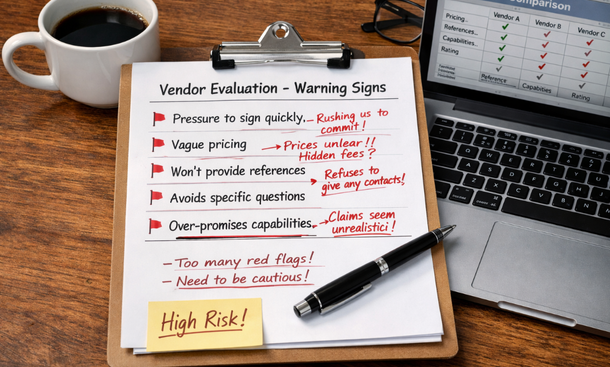
Vague or incomplete pricing is another major warning. If the vendor won’t provide detailed cost breakdowns including implementation, training, support, and potential additional fees, they’re hiding something. Legitimate vendors provide transparent pricing because they know surprises after contract signing destroy trust.
Watch for reluctance to provide customer references. Every vendor claims hundreds of happy clients. Ask for references from companies similar to yours in size, industry, and location. If they make excuses about confidentiality or can’t produce references, that’s a massive red flag.
Dismissing your concerns or questions indicates they don’t respect your input. When you ask about specific functionality and the rep waves it off with “that’s easy, we handle that all the time” without showing you, they’re not taking your requirements seriously.
Talking exclusively about features without understanding your business processes means they’re selling product, not solving your problems. Good vendors ask tons of questions about how you operate before suggesting solutions.
Implementation capability assessment
A vendor’s product might be solid, but if their implementation team can’t deploy it successfully, you’re headed for disaster.
Ask about their implementation methodology. Do they follow a structured process with defined phases, deliverables, and checkpoints? Or do they wing it based on whoever gets assigned to your project? Lack of proven methodology means inconsistent results.
Request details about who will actually work on your implementation. You want names, resumes, and experience levels. If the sales rep promises their best consultants but won’t commit to specific people, you’re probably getting whoever’s available when your project starts.
Check implementation team experience with businesses like yours. A consultant who specializes in manufacturing might struggle with retail operations. Industry expertise matters because business processes differ significantly across sectors.

Beware of vendors who outsource implementation to third-party partners they don’t directly control. The vendor might build great software, but if implementation is handled by an independent consulting firm with no accountability to the vendor, you’re stuck in the middle when problems arise.
Ask about consultant turnover rates. High turnover means you’ll likely lose your project lead mid-implementation and have to start over with someone new who doesn’t understand your requirements.
Review their project management approach. How do they track progress, handle change requests, manage timeline slips, and communicate status? Vendors without solid project management create chaos.
Request examples of implementation timelines for companies your size. If they claim your implementation will take three months when similar projects took nine months, they’re either lying or incompetent about project scoping.
Product capability verification beyond demos
Sales demos show carefully scripted scenarios using clean sample data. Your business operates nothing like those demos.
Demand to test the system with your actual data and workflows. Upload sample customer records, products, and transactions. Try to complete real business processes you run daily. This reveals whether the system actually handles your requirements or just looks like it might.
Ask pointed questions about edge cases and exceptions. Every business has unusual situations that don’t fit standard processes. How does the system handle returns of discontinued products? What happens when customers have multiple ship-to addresses? Can you process orders with partial backorders? Generic answers like “the system is very flexible” don’t count.
Request access to the actual product documentation, not marketing materials. Read through user guides, admin manuals, and API documentation. This shows you the real complexity and limitations the sales rep didn’t mention.

ERP System Evaluation
Test integrations with tools you currently use. If the vendor claims seamless integration with your e-commerce platform, CRM, or shipping software, make them prove it. Set up test integrations and verify data flows correctly in both directions.
Look for gaps between what you need and what’s provided out of the box. Customization is expensive and creates maintenance headaches. The more customization required to meet basic needs, the worse your total cost of ownership.
Check system performance with realistic data volumes. Your demo might run great with 100 customer records, but how does it perform with 50,000? How many concurrent users can it support? What’s the response time for complex reports?
Customer reference conversations that reveal truth
Talking to current customers gives you unfiltered insight into what working with this vendor is really like.
Don’t just call the references the vendor provides. Those are their happiest customers. Search LinkedIn for people at other companies using the same ERP and reach out cold. You’ll get more honest feedback.
Ask specific questions that bypass generic positive responses. Instead of “are you happy with the system,” ask “what do you wish you knew before signing the contract?” or “if you could change one thing about working with this vendor, what would it be?”
Find out about post-implementation support quality. How long do tickets take to resolve? Do they actually fix bugs or just provide workarounds? When you need help with complex problems, do you get knowledgeable assistance or template responses?

Ask about hidden costs that emerged after go-live. Did they get surprised by fees for additional users, premium support, extra integrations, or functionality they assumed was included?
Learn about upgrade experiences. When the vendor releases new versions, does the upgrade process go smoothly or create disruptions? Do customizations break with each update?
Find out how long implementation actually took versus initial estimates. If every reference mentions projects running six months over schedule, expect the same.
Ask whether they’d choose the same vendor again knowing what they know now. The pause before they answer tells you as much as their words.
Support and service level agreement scrutiny
Your relationship with the vendor really begins after go-live when you need ongoing support.
Review support service level agreements carefully. What response times are guaranteed for different priority levels? What happens if they miss those commitments? Weak SLAs with no consequences mean support quality depends on vendor goodwill, not contractual obligations.
Understand what’s included in base support versus premium tiers. Can you call with questions or only submit tickets? Do you get a dedicated support contact or work with whoever answers? Is support available during your business hours or only during the vendor’s preferred time zone?
Check support team qualifications. Are you getting help from experienced consultants who know the product deeply or first-level support reading from scripts? Can they actually solve problems or just escalate everything?
Test their support process during evaluation. Submit a question through their support portal and see how long it takes to get a useful response. The treatment you get as a prospect is better than what you’ll get as a customer.
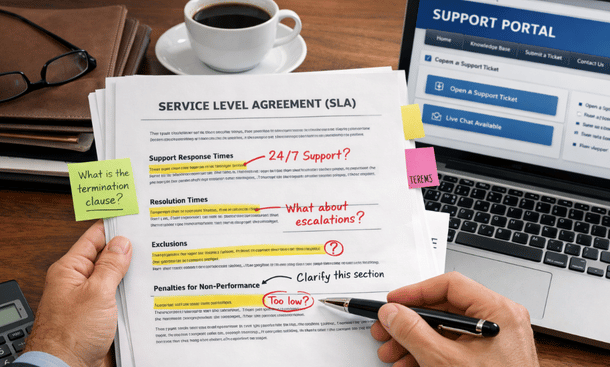
Ask about support escalation paths. When standard support can’t resolve your issue, who do you escalate to and how quickly? Dead ends where critical problems sit unresolved for weeks kill businesses.
Find out about support costs over time. Some vendors include the first year of support then charge increasing fees annually. Others raise support costs dramatically after initial contracts expire. Project your five-year support expenses.
Verify support coverage for customizations and integrations. Many vendors provide excellent support for core product functionality but won’t touch anything customized. If custom code breaks, you’re on your own.
Financial stability and longevity indicators
Choosing a vendor who goes out of business or gets acquired leaves you stranded with an orphaned system.
Research the vendor’s financial situation. Are they profitable or burning through venture capital? How long have they been in business? What’s their funding situation?
Check for signs of financial distress like aggressive discounting, staff departures, reduced marketing presence, or delayed product updates. Struggling vendors cut support staff first, which directly impacts your experience.
Look at their customer base growth. Are they adding customers or losing them? Declining customer counts might indicate product or service problems that current customers are fleeing.
Consider acquisition risk. Venture-backed vendors often get acquired by larger companies. Sometimes that’s good, sometimes the acquiring company kills the product or changes everything. Ask what happens to your contract if they’re acquired.
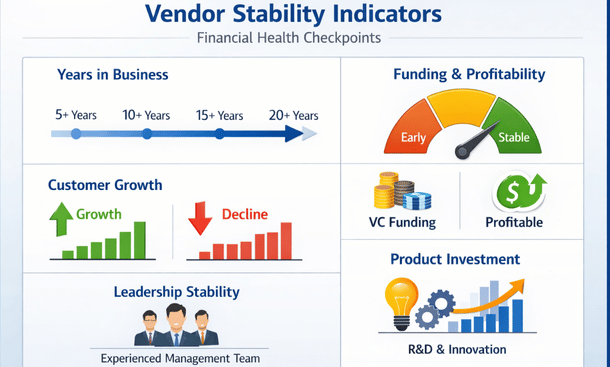
Evaluate their product development investment. When was the last major update? Do they continuously improve the product or has development stalled? Stagnant products become obsolete quickly in California’s tech-forward business environment.
Look at leadership stability. Frequent executive turnover indicates internal problems. Vendors with consistent leadership teams are more likely to maintain strategic direction and honor commitments.
Contract terms that protect or hurt you
The contract governs everything, so read it carefully and negotiate terms that protect your interests.
Watch for auto-renewal clauses with short cancellation windows. Some contracts automatically renew for another year if you don’t cancel 90 days in advance. You can get locked into bad vendor relationships for years through these provisions.
Understand price increase terms. Can the vendor raise prices annually? By how much? Price protection clauses limit your exposure to unexpected cost increases.
Review termination clauses carefully. Can you terminate for cause if they fail to deliver? What are the penalties for early termination? Some contracts make leaving so expensive you’re essentially trapped.
Check data ownership and portability provisions. You need clear rights to export your data in usable formats if you switch vendors. Contracts that make data extraction difficult or expensive create vendor lock-in.
Examine limitation of liability clauses. If the vendor’s mistakes cost you money, can you recover damages? Many contracts limit vendor liability to subscription fees, which is nothing compared to potential business losses from system failures.

Contract Review Session
Look for escape hatches like implementation failure provisions. If the vendor can’t deliver a working system after reasonable effort, you need the ability to terminate without penalties and get refunds.
Verify that promises made during sales are actually in the contract. Verbal commitments mean nothing. If the sales rep promised specific functionality, guaranteed response times, or committed to certain deliverables, make sure the contract reflects those promises.
Consider having a lawyer review contracts before signing, especially for agreements worth hundreds of thousands of dollars. Legal fees are tiny compared to the costs of bad contracts.
Making the final vendor decision with confidence
After evaluating multiple vendors and checking for red flags, how do you make the final choice?
Create a weighted scoring system for decision factors that matter most to you. Assign points for implementation quality, support capabilities, product fit, pricing, references, and any other criteria important to your business.
Score each vendor objectively across all criteria. This removes emotion from the decision and gives you a defensible rationale for your choice.
Involve multiple stakeholders in the final decision. The people who will use the system daily should have input. Their buy-in makes implementation smoother.
Trust your gut about the relationship fit. You’ll work with this vendor for years. If something feels off during sales, it won’t get better after signing.
Don’t choose based solely on price. The cheapest option often becomes the most expensive through implementation delays, poor support, and limited functionality forcing costly workarounds.
Once you’ve chosen a vendor carefully, you’ll face important decisions about how much to customize their standard system to fit your unique processes.
Understanding ERP customization best practices helps you balance flexibility with maintainability for long-term success.
Vendor selection represents one of the most critical ERP implementation mistakes to avoid, as the wrong partner dooms your project regardless of how good the software is
About the Author

mike
Mike is a tech enthusiast passionate about SaaS innovation and digital growth. He explores emerging technologies and helps businesses scale through smart software solutions.
Did you find this helpful?
Your feedback helps us curate better content for the community.