
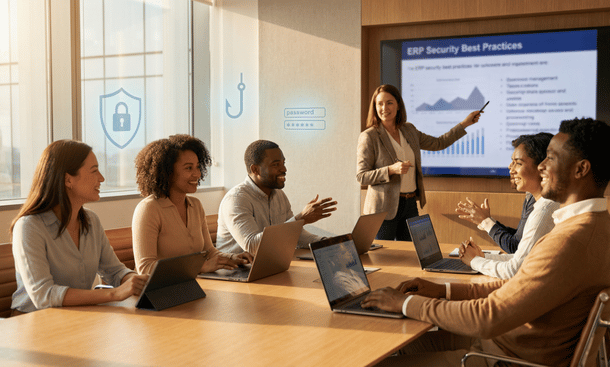
I’m Mike, 40, and I’ve spent years helping California businesses scale SaaS systems without compromising security. Even with strong access controls, encryption, monitoring, and audits, human behavior remains a major factor in ERP security. Employees who understand risks and best practices are your first line of defense.
ERP user training is not about scaring staff. It’s about building awareness, fostering responsibility, and equipping teams to handle sensitive data correctly. Security-aware employees reduce mistakes, prevent breaches, and support a culture of accountability that complements all other ERP security measures.
Why training is critical
Most ERP security incidents aren’t due to sophisticated hackers. They stem from human error: sharing credentials, falling for phishing attacks, misconfiguring systems, or misusing data. Proper training ensures employees understand their responsibilities and the impact of their actions.
Training is especially important in California, where privacy regulations like CCPA mandate that personal data be protected. Employees who understand these obligations act as an extension of your technical controls.
Core training topics
Effective ERP security training should cover:
-
Access control awareness – Understanding roles, permissions, and the principle of least privilege.
-
Password hygiene and authentication – Using strong, unique passwords and multi-factor authentication.
-
Data handling and encryption – Recognizing sensitive information and following storage and sharing protocols.
-
Phishing and social engineering – Identifying suspicious emails or messages that could compromise ERP access.
-
Incident reporting – Knowing how and when to report potential security issues.
These topics provide a foundation that aligns closely with other ERP security best practices, making employees active participants in protection rather than passive users.
Delivering engaging training
Training doesn’t have to be boring or one-size-fits-all. Effective programs include interactive elements:
-
Short scenario-based exercises.
-
Video demonstrations of common risks.
-
Quizzes to reinforce knowledge.
-
Role-specific modules tailored to finance, HR, operations, or admin users.
Interactive, relevant training keeps employees engaged and helps them retain critical information.
Frequency and reinforcement
Security awareness is not a one-time event. Repetition and reinforcement are key. Schedule training at onboarding, and follow up with quarterly refreshers, updated scenarios, or alerts about emerging threats.
Regular communication through newsletters, internal dashboards, or quick reminders ensures ERP security stays top of mind without overwhelming staff.
Creating a security-conscious culture
Employee behavior improves when security is seen as part of the company culture. Recognize and reward employees who follow protocols or report risks. Leadership should model good practices.
A culture of awareness reinforces technical controls and reduces the likelihood of human error compromising your ERP system.
Measuring effectiveness
Track training completion, quiz results, and incident reports to evaluate effectiveness. Metrics allow continuous improvement and help identify areas where employees need more guidance.
Feedback loops from monitoring, audits, and risk assessments can inform training content and ensure it remains relevant to real-world scenarios.
ERP user training and security awareness are essential complements to access control, encryption, monitoring, and audits. Employees who understand risks and responsibilities reduce errors, enhance compliance, and strengthen overall ERP security.
With all ERP security pillars in place—access control, cloud security, encryption, monitoring, audits, and user training—California businesses can confidently scale operations while protecting sensitive data.
To further enhance security, review practical implementation steps in the ERP implementation steps: a practical small business guide, which helps align security measures with smooth deployment and daily operations.
About the Author

mike
Mike is a tech enthusiast passionate about SaaS innovation and digital growth. He explores emerging technologies and helps businesses scale through smart software solutions.
Did you find this helpful?
Your feedback helps us curate better content for the community.