
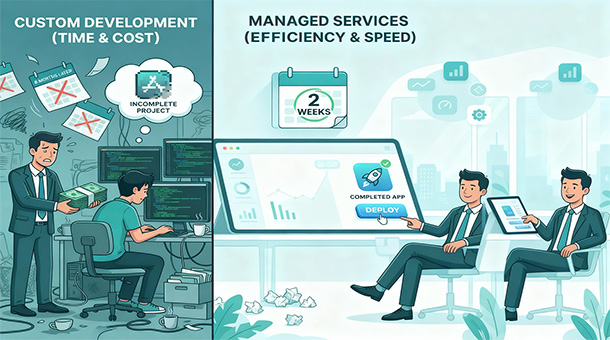
A developer quotes you $60,000 and four months to build a custom backend. It sounds professional and tailored to your exact needs. Six months later, you’re $90,000 in, the developer quit, and nobody else understands the code. Custom backends make sense for Netflix and Uber, not for your first product with 200 users.
The real cost of custom development
Developers quote projects based on best-case scenarios where requirements don’t change, nothing goes wrong, and every integration works perfectly the first time. Reality adds 50% to 200% to initial estimates because building backends is harder than it looks from the outside.
Your $60,000 quote assumes the developer knows exactly what you need, builds it correctly the first time, and delivers on schedule. What actually happens is you discover missing features after development starts, the developer hits unexpected technical challenges, and deadlines slip while costs accumulate.
The invoice shows development hours, but the real cost includes your time managing the project, explaining requirements, reviewing progress, and testing features. A four-month project consumes 20 to 40 hours of your time weekly, time you could spend talking to customers, refining your product, or generating revenue.
Ongoing maintenance isn’t included in the initial quote. The developer builds your backend and hands it over, but servers need updates, security patches need applying, and bugs need fixing. You’re either paying the original developer for maintenance or finding someone new who needs weeks to understand code they didn’t write.
Understanding what custom actually means
Custom doesn’t mean better, it means built specifically for you instead of using existing solutions. Sometimes that’s necessary because your requirements are truly unique. Most of the time, it’s expensive over-engineering solving problems that don’t exist yet.
A custom backend for a task management app might include features like real-time collaboration, file attachments, team permissions, and notification systems. A managed backend service includes all of these features already built, tested, and maintained by a team of engineers. You’re choosing between paying one developer to rebuild what already exists or using tools designed by specialists.
The argument for custom is that it’s tailored to your exact needs without paying for features you don’t use. The reality is that generic platforms are generic because they solve common problems efficiently. Unless your needs are genuinely unusual, the overlap between what you need and what platforms offer is 90% or higher.
Learning how Supabase becomes your startup’s toolbox means recognizing that most “custom” requirements are actually standard features packaged differently. You don’t need a custom authentication system, you need the standard one configured for your specific use case. You don’t need a custom database, you need a standard database with your schema.
The hidden talent problem
Finding a good backend developer is hard. Finding one available for a four-month project at reasonable rates is harder. Finding one who communicates clearly, estimates accurately, and delivers quality code is nearly impossible for first-time founders who can’t evaluate technical skills.
You post a job, receive 50 applications, and have no reliable way to separate competent developers from those who exaggerate their skills. You can’t review their code critically because you’re not a developer. You can’t verify their estimates because you don’t know how long things should take. You’re making a $60,000 decision based on interviews and portfolios you can’t properly evaluate.
Even if you hire well, you’re dependent on one person. They get sick, take another job, or burn out, and your project stops. There’s no team to pick up the work, no institutional knowledge to fall back on, just you scrambling to find a replacement who needs weeks to understand what the first developer built.
Managed platforms eliminate this dependency. You’re not relying on one developer’s availability, skills, or motivation. You’re using infrastructure maintained by a team of specialists who handle updates, fix bugs, and keep systems running regardless of individual availability.
Comparing timelines realistically
A custom backend quoted at four months typically takes six to eight months when you account for requirement changes, testing, bug fixes, and deployment. The developer builds features sequentially, discovering problems that require rework, and each iteration adds time.
A managed backend takes days to weeks for initial setup and configuration. You create a database, define your schema, set up authentication, and configure storage in hours, not months. The infrastructure exists, you’re just adapting it to your needs rather than building from nothing.
The time difference matters enormously for startups. Four months of development means four months before you can launch, four months without user feedback, and four months of runway consumed before generating revenue. Two weeks means you’re in market quickly, learning from real users, and iterating based on actual data instead of assumptions.
Speed to market often matters more than custom features. A product that’s 80% of your vision but available now beats a product that’s 100% perfect but won’t launch for six months. Users don’t care whether your backend is custom, they care whether your app solves their problem reliably.
The maintenance nightmare nobody mentions
Backend code requires constant attention even after the initial build. Security vulnerabilities are discovered in libraries and frameworks, requiring updates and patches. Server software needs upgrading to stay compatible with dependencies. Database performance degrades over time and needs optimization.
Your developer builds the backend, declares it done, and moves on to other projects. Three months later, a critical security vulnerability is announced in a library your backend uses. You need to patch it immediately, but the developer is unavailable or quotes hourly rates for what should be routine maintenance.
Managed platforms handle this automatically. Security patches are applied by the platform team without you knowing they were needed.
The security implications of custom versus managed backends are just as significant as the cost difference. Custom backends put the entire burden of encryption, access controls, patching, and incident response on you and your developer — and most developers aren’t security specialists. The Entrepreneur’s Guide to App Security and Data Safety explains what proper security actually requires so you can evaluate whether the developer you’re hiring is equipped to deliver it.
Performance optimization happens continuously in the background. Updates are tested and deployed without interrupting your service. You’re not managing infrastructure, you’re using infrastructure that manages itself.
The cost difference is dramatic. Hiring a developer for ongoing maintenance might cost $2,000 to $5,000 monthly for part-time availability. A managed platform costs $25 to $100 monthly for similar reliability and much faster response to critical issues. Avoiding “bill shock” by predicting your monthly tech costs includes factoring maintenance into total cost of ownership, not just initial development.
Understanding when custom actually makes sense
Custom backends are justified when your requirements genuinely can’t be met by existing platforms. You’re building something with extreme performance needs, unique regulatory requirements, or integration demands that standard tools can’t handle.
A real-time multiplayer game with thousands of concurrent users might need custom infrastructure optimized for low latency and high throughput. A healthcare platform with strict HIPAA requirements and legacy system integrations might need custom architecture. A fintech app processing millions of transactions daily might need purpose-built databases and caching layers.
These are exceptions, not rules. If you’re not certain your case is exceptional, it’s probably not. First-time founders often overestimate how unique their needs are because they’re too close to their own product to see that most apps share common patterns.
The right approach is starting with managed platforms and custom-building only the specific components that genuinely can’t be handled otherwise. Use Supabase for your database, authentication, and storage, then write custom code only for the unique business logic that differentiates your product. This gives you 90% of what you need immediately while focusing development effort on the 10% that actually matters.
Evaluating the “we can change anything” myth
The appeal of custom development is flexibility. If you want a feature changed, you just tell the developer and they change it. With a platform, you’re constrained by what the platform offers. This sounds compelling until you realize how rarely unlimited flexibility actually helps.
Your developer can change anything, but every change takes time and costs money. Want to add two-factor authentication? That’s three days of development and $2,400. Want to implement rate limiting? Two days and $1,600. Features that platforms include by default become expensive line items in custom development.
Platform constraints are often features disguised as limitations. You can’t structure your database in wildly inefficient ways because the platform enforces good practices. You can’t skip security features because they’re built in and enabled by default. The constraints guide you toward solutions that work reliably instead of leaving you to discover best practices through expensive mistakes.
Protecting your assets by controlling who sees what in your database is built into modern platforms through row-level security and access controls. Building equivalent security yourself means weeks of development, extensive testing, and ongoing auditing. The constraint that you use the platform’s security model saves you from under-securing your data through inexperience.
The scalability argument falls apart
Developers pitch custom backends by arguing that platforms won’t scale with your growth. This argument worked in 2010 but falls apart in 2026 when managed platforms routinely handle applications with millions of users.
Supabase runs on PostgreSQL, the same database powering Instagram, Netflix, and Spotify at massive scale. The platform handles scaling infrastructure automatically, adding resources as your usage grows. You’re not limited by the platform’s capabilities, you’re leveraging the same technology that powers the largest apps in the world.
The real scalability challenge isn’t whether the platform can handle growth, it’s whether you’ve designed your application efficiently. A poorly designed app will struggle at scale regardless of whether it’s custom-built or platform-based. An efficiently designed app will scale smoothly on managed infrastructure without custom development.
If you actually reach the scale where platform limitations become real constraints, you have revenue and users justifying the investment in custom infrastructure. At that point, you can migrate specific bottlenecks to custom solutions while keeping everything else on managed platforms. This gradual transition is smarter than starting with expensive custom development before you’ve validated product-market fit.
Calculating the true breakeven point
Custom development might cost $60,000 upfront versus $25 monthly for a managed platform. Simple math suggests breakeven at 200 months, or nearly 17 years. This calculation is wrong because it ignores ongoing maintenance and opportunity cost.
Add $3,000 monthly for part-time developer maintenance to the custom backend. Now you’re paying $3,000 monthly versus $25 monthly for the platform, a difference of $2,975 monthly. The custom backend never breaks even, it’s permanently more expensive while delivering the same functionality.
Include opportunity cost and the gap widens further. The four months you spent managing custom development could have been spent acquiring customers, refining features, or generating revenue. If that time is worth $10,000 monthly in business development, the real cost of custom development is $100,000, not $60,000.
The only scenario where custom development costs less is when you need extremely high transaction volumes where usage-based pricing becomes expensive. At millions of database queries daily, a dedicated server might be cheaper than platform pricing. But if you’re processing millions of queries daily, you have revenue justifying the complexity of custom infrastructure.
Recognizing the sunk cost trap
Founders who’ve already paid for custom development feel compelled to use it even when it’s not working. You’ve invested $80,000 and six months, and switching to a platform means “wasting” that investment. This is textbook sunk cost fallacy.
The $80,000 is gone regardless of what you do next. The question is whether continuing with the custom backend or switching to a platform gives you better outcomes going forward. If the custom backend is buggy, expensive to maintain, and slowing down development, switching saves you money long-term even though it means abandoning the initial investment.
Knowing why being open source means you’ll never be locked in applies here. Platforms built on open standards let you export your data and migrate if needed. Custom backends lock you in through code that only one developer understands. The supposed flexibility of custom development becomes a trap when you can’t easily move away from it.
Most founders who switch from custom to managed platforms report that they should have made the switch sooner. The short-term pain of migration is overwhelmed by the long-term relief of not managing infrastructure, not debugging production issues at midnight, and not coordinating with developers for routine maintenance.
Starting with platforms and customizing later
The smartest path is starting with managed platforms and adding custom components only when you’ve validated they’re necessary. Build your first version entirely on Supabase, launch quickly, and learn from real users. If you discover specific needs the platform can’t handle, address them individually rather than rebuilding everything.
This approach minimizes risk and maximizes learning. You’re not betting $60,000 on assumptions about what users need. You’re spending $25 monthly to test those assumptions with real people, then investing in custom development only for proven requirements.
Most startups discover that 95% of what they thought required custom development actually works fine on platforms. The 5% that genuinely needs custom work can be built as focused additions to your platform-based foundation, costing $5,000 instead of $60,000 and delivering faster because you’re building less.
Understanding how to keep your monthly software bill under $50 becomes possible when you’re using platforms efficiently instead of paying developers to reinvent standard functionality. Save custom development for when you’ve proven you need it, not as a default assumption before you’ve launched.
Whether you go custom or managed, the questions you ask your developer before signing anything will determine whether you end up with a solid foundation or an expensive rebuild six months later. The Technical Interview gives you the exact questions to ask so you can evaluate technical decisions confidently without needing a computer science degree.
About the Author

AISalah
Bridges linguistics and technology at PointOfSaaS, exploring AI applications in business software. English Studies BA with hands-on back-end and ERP development experience.
Did you find this helpful?
Your feedback helps us curate better content for the community.