
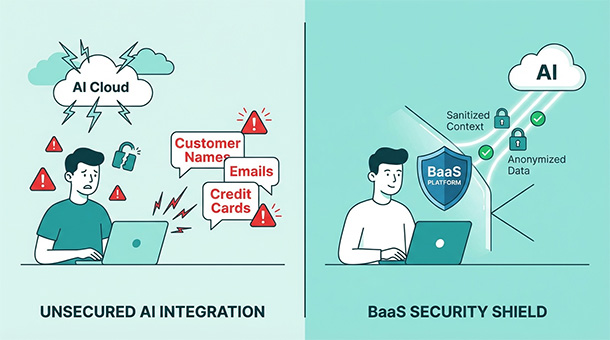
You want AI to summarize customer feedback, analyze sales patterns, or generate personalized recommendations. The problem is your data contains real names, email addresses, payment info, and private conversations. Uploading that to a public AI service feels reckless, but building a secure AI pipeline from scratch requires engineers you don’t have. BaaS platforms act as the middleman, sending only necessary context to AI models while keeping sensitive details locked in your database. Your AI gets smarter without your customers’ data ending up in training datasets.
The data exposure risk nobody talks about
You paste customer support tickets into ChatGPT to generate summary reports. Each ticket contains usernames, email addresses, sometimes phone numbers or account IDs. OpenAI’s terms state they don’t train on API data, but you’re still sending identifying information to external servers where you have zero control over storage, logging, or access.
Regulatory frameworks like GDPR and CCPA require you to protect personal data and limit third-party exposure. Even if you trust your AI provider’s privacy policy today, compliance means ensuring data handling meets legal standards regardless of which vendor you use. Sending raw customer records to any external service creates liability you can’t easily defend.
The risk multiplies when non-technical team members use AI tools directly. Your marketing person copies a customer list into an AI prompt to segment audiences. Your support lead feeds entire conversation transcripts into a chatbot for analysis. Each action potentially exposes data that should stay internal.
Building walls around data while still using AI seems contradictory. AI needs context to be useful, but context includes the exact information you’re trying to protect. The solution isn’t blocking AI entirely, it’s controlling what data leaves your infrastructure and in what form.
How BaaS platforms create data isolation layers
Your database holds everything: user profiles, transactions, messages, behavioral logs. Instead of sending that data directly to AI providers, your BaaS platform acts as a processing layer that extracts, sanitizes, and contextualizes information before external APIs see anything.
An edge function receives a request to analyze customer sentiment. Instead of dumping raw conversation text to an AI, the function strips identifying details first. Names become “User A,” email addresses get removed entirely, and account numbers transform into generic placeholders. The AI processes anonymous content and returns insights without ever seeing who said what.
Supabase edge functions run in isolated environments with defined permissions. You explicitly grant each function access to specific database tables and columns. A sentiment analysis function might read message content but lack permission to access user emails or payment methods. Even if the function code gets compromised, it can’t leak data it never had access to.
API keys and credentials stay encrypted in your BaaS platform’s secret storage, never exposed in frontend code or visible to users. When your edge function calls OpenAI or Anthropic, it uses server-side keys that stay locked in the backend environment. Users can’t intercept those keys through browser tools or network inspection.
Data processing happens on servers you configure, following rules you define. You decide what gets sent externally, what stays internal, and how information gets transformed in between. The AI provider sees only what you deliberately share, not your entire database.
Practical patterns for context without exposure
You want AI to generate personalized email recommendations based on user behavior. Instead of sending entire user profiles, extract only relevant signals. Purchase history becomes “bought 3 items in category X,” not “John Smith bought Product A, B, C on these dates.” The AI generates suggestions based on patterns, not identities.
Customer support summaries need conversation context but not personally identifiable information. Replace names with roles like “customer” and “agent.” Redact email addresses, phone numbers, and account IDs. The AI still understands the support issue and provides useful summaries without knowing who was involved.
Sales forecasting requires transaction data but not individual customer details. Aggregate numbers before sending anything external. “50 purchases totaling $5000 in the midwest region” gives AI enough information to identify trends without exposing specific buyers or order details.
Content recommendations benefit from understanding user preferences without tracking individuals. Hash user IDs into anonymous tokens before logging behavior. The AI sees “user token ABC123 likes technical content and ignores marketing posts,” which enables personalization without revealing that ABC123 maps to a real person in your system.
Document analysis can happen entirely within your BaaS environment if you use AI models you host yourself. Supabase supports running models locally through extensions or containers, meaning sensitive documents never leave your infrastructure. This costs more than API calls but eliminates data transmission entirely.
Building retrieval workflows that protect privacy
Retrieval augmented generation, pulling relevant context from your database before sending prompts to AI, powers most useful business applications. A user asks your chatbot about their account status, and the bot needs access to their data to respond accurately.
The naive approach queries your database, grabs the user’s full record, and includes everything in the AI prompt. Email, password hash, payment methods, activity logs, all sent to OpenAI along with the question “when does my subscription renew?”
The secure approach queries selectively based on what the question actually needs. The renewal question requires subscription start date and billing cycle, nothing else. Your edge function fetches only those two fields, formats them into context like “subscription started January 2024, billed monthly,” and sends that minimal snippet to the AI.
Role-based access control determines what data each function can retrieve. Customer-facing chatbots get read access to public profile fields and subscription status, but not internal notes, support flags, or payment methods. Admin-facing AI tools might access more, but only when authenticated users with proper permissions trigger them.
Audit logs track what data gets sent where and when. Every edge function execution records which database fields were accessed, what got sent to external APIs, and who initiated the request. If a compliance question arises later, you have evidence showing exactly what information left your control and under what circumstances.
When to use AI providers versus self-hosted models
OpenAI, Anthropic, Google, and other API providers offer convenience and performance. Their models are state-of-the-art, their APIs are reliable, and you pay only for what you use. The tradeoff is data leaves your infrastructure even when sanitized.
Self-hosting open source models like Llama, Mistral, or Falcon keeps everything internal. You run the model on your own servers or within your BaaS platform’s compute environment. Data never touches external services, which satisfies even the strictest compliance requirements.
The downside is complexity and cost. Self-hosted models require GPU compute, ongoing maintenance, and more technical expertise than making API calls. Performance typically lags behind commercial providers unless you invest heavily in infrastructure.
Hybrid approaches balance security and practicality. Use external APIs for non-sensitive tasks like content generation or public data analysis. Self-host models for processing sensitive information like medical records, financial data, or internal communications. Your architecture treats different data categories appropriately based on actual risk.
Supabase extensions can run smaller models directly in your database for simple tasks. Sentiment analysis, text classification, and basic summarization work with lightweight models that don’t require external servers. This middle ground handles moderate AI workloads without exposing data or managing separate infrastructure.
Securing how data flows to AI is critical, but it’s just one layer of building responsible, intelligent features. Cost management, ethical guardrails, and choosing the right providers all matter equally when you’re building AI products that scale. The founder’s guide to AI: how to give your app “brains” using BaaS covers the complete architecture, from data security to budget planning to automation, giving you a roadmap for building AI features that work without creating new problems.
Compliance frameworks that actually matter
GDPR requires that personal data processing has legal basis, users can access or delete their data, and third-party data sharing gets explicitly disclosed. Sending customer information to AI providers counts as third-party sharing even if the provider claims not to train on it.
Document your data flows clearly. What personal data gets processed, where it goes, how long it stays there, and who has access. This documentation proves compliance during audits and helps users understand how their information gets used.
CCPA gives California residents rights to know what data you collect and opt out of its sale. Using customer data to train AI models could qualify as “selling” under broad interpretations. Keeping data internal or using providers with explicit no-training policies reduces this risk.
HIPAA applies if you handle health information, requiring strict controls over who accesses data and how it gets transmitted. Sending patient records to standard AI APIs likely violates HIPAA unless you have a business associate agreement and the provider offers HIPAA-compliant infrastructure.
SOC 2 compliance, common in B2B SaaS, audits your security controls around data access, processing, and transmission. Using BaaS platforms that already have SOC 2 certification simplifies your own compliance because their controls become part of your control environment.
Setting up data governance policies before problems arise
Create explicit rules about what data can be sent to AI providers and what must stay internal. Email addresses, phone numbers, payment details, and government IDs stay locked down always. Behavioral data and anonymized content can be processed externally with proper sanitization.
Implement automated checks that enforce policies technically, not just in documentation. Edge functions should validate that outbound data meets sanitization rules before making external API calls. If a function tries to send an email address to OpenAI, the system blocks it and logs the violation.
Train your team on data handling practices specific to AI usage. Marketing wants to use AI for campaign personalization, but they need to understand they can’t copy customer lists into public tools. Provide approved workflows that accomplish their goals safely instead of just saying no.
Regular audits catch drift where initial policies get ignored over time. Review which edge functions access sensitive data, what they do with it, and whether usage patterns match documented purposes. New functions added quickly during feature development might bypass governance rules unless you check actively.
Incident response plans should cover AI-specific scenarios. What happens if an edge function accidentally sends unredacted data to an external API? Who gets notified, how do you assess impact, and what disclosure obligations trigger? Having answers ready prevents panic-driven mistakes during actual incidents.
Monitoring and alerts for data exposure risks
Log every external API call your BaaS platform makes on behalf of AI features. Timestamps, payload sizes, destination services, and triggering functions. This creates an audit trail showing data movement patterns and helps identify unusual activity.
Set up alerts for sensitive data patterns in outbound requests. If an edge function payload contains strings matching email formats, credit card numbers, or social security numbers, flag it immediately for review. False positives are better than unnoticed data leaks.
Rate limiting prevents data exfiltration through repeated small requests. If someone compromises an edge function and tries to dump your database through thousands of AI calls, rate limits stop the attack after a defined threshold. You investigate the spike instead of discovering it months later in your bill.
Cost monitoring doubles as security monitoring for AI usage. Unexpected spending spikes often indicate either attacks or misconfigured functions processing far more data than intended. A $500 monthly AI bill jumping to $5000 suggests something wrong beyond just budget concerns.
Balancing utility and privacy in AI features
Users want personalized experiences powered by AI, but they also want privacy. The balance comes from being transparent about what data you use and giving users control over AI features.
Let users opt out of AI processing entirely if they prefer. Some people don’t want their data analyzed by algorithms regardless of security measures. Offer a setting that disables AI features and processes their information only through traditional logic.
Explain what your AI does in plain language, not legal jargon. “We use AI to suggest relevant help articles based on your previous searches” tells users exactly what’s happening without making them read a 50-page privacy policy.
Minimize data retention for AI contexts. Once an AI generates a response, delete the context data used to create it. Storing conversation history makes sense, but keeping the entire database snapshot included in each prompt doesn’t serve any purpose beyond increasing risk.
Default to more privacy, not less. Make users opt into AI features that process sensitive data rather than opting out. If someone never activates AI-powered insights, their data never gets processed by those systems.
You’ve secured how data flows to AI, but now you want to expand beyond text into visual and audio capabilities. How to let your app see and hear users: image and voice AI shows you how to add multimodal features like photo recognition, voice commands, and speech synthesis through BaaS integrations without becoming a computer vision expert or training audio models from scratch.
About the Author

AISalah
Bridges linguistics and technology at PointOfSaaS, exploring AI applications in business software. English Studies BA with hands-on back-end and ERP development experience.
Did you find this helpful?
Your feedback helps us curate better content for the community.