
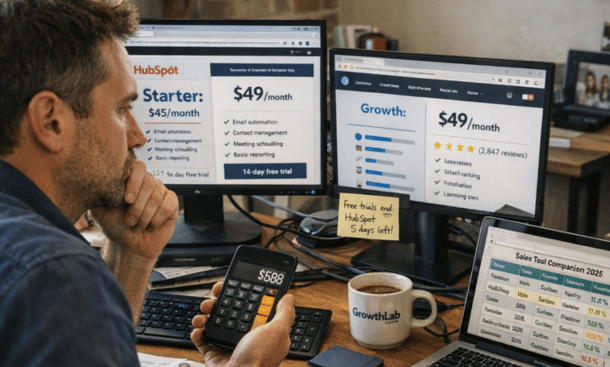
Selecting the right sales automation platform determines whether you’ll actually see ROI or just add another underutilized subscription to your tech stack. The market offers everything from $29 monthly tools with basic email sequences to enterprise platforms costing thousands that require dedicated administrators. Most entrepreneurs need something in between: powerful enough to handle real automation but simple enough to implement without a technical team. The right choice depends on your current sales volume, team size, and how complex your sales process actually is. Before diving into specific platforms, understanding how to automate your entire sales process with AI provides context for which features actually matter.
What separates basic tools from actual AI platforms
Marketing teams love slapping “AI-powered” labels on anything that sends automated emails. Real AI sales automation goes deeper than scheduled message sequences. The platform should make decisions based on prospect behavior, not just execute predetermined workflows.
True AI platforms analyze engagement patterns and adjust outreach timing automatically. If prospects from a specific industry tend to open emails on Tuesday mornings, the system learns this and schedules accordingly. Basic tools send messages at whatever time you specify regardless of whether anyone’s actually reading them.
Predictive capabilities distinguish AI from simple automation. The platform should forecast deal closure probability, identify at-risk opportunities, and surface patterns in what’s working. If you’re just getting email automation and calendar scheduling, you’re not getting AI, you’re getting workflow automation that’s existed for a decade.
Integration depth matters more than integration quantity. A platform might claim to integrate with 500 tools, but if those integrations only sync basic contact data, they’re not useful. You need two-way data flow where the AI can pull information from multiple sources to make smarter decisions and push updates back to keep everything synchronized.
Platform options by business size and complexity
For solo founders and very small teams
Close and Pipedrive serve businesses just starting to formalize their sales process. Close focuses on outbound sales with built-in calling, email sequences, and basic automation. It’s designed for teams making high volumes of calls and emails to cold prospects. Pricing starts around $49 per user monthly.
Pipedrive emphasizes visual pipeline management with straightforward deal tracking and simple automation workflows. The interface feels less overwhelming than enterprise CRM platforms. You can set up lead routing, task creation, and follow-up reminders without technical knowledge. Plans begin at $14 per user monthly for basics, with AI features starting at $49.
These platforms work well when you’re handling fewer than 100 active opportunities and don’t need sophisticated forecasting or advanced integrations. The learning curve stays manageable and you can implement within days rather than weeks.
For growing sales teams with moderate complexity
HubSpot Sales Hub and Salesforce Sales Cloud dominate the mid-market. HubSpot combines CRM, marketing automation, and sales tools in one ecosystem. The AI features include lead scoring, email automation, meeting scheduling, and conversation intelligence. Free tier exists for basic CRM, but real automation starts at $90 monthly.
Salesforce offers more customization and scales further but requires more setup expertise. Einstein AI provides forecasting, opportunity scoring, and automated data entry. Pricing gets complicated fast, starting around $165 per user monthly for AI capabilities, with implementation often requiring consultants.
HubSpot makes more sense when you want tight integration between marketing and sales without extensive customization needs. Salesforce wins when you need highly specific workflows or operate in industries requiring specialized functionality.
For teams needing advanced AI capabilities
Gong and Chorus focus specifically on conversation intelligence. They record and analyze sales calls to extract insights about what messaging works, which objections arise frequently, and how top performers differ from average reps. Gong pricing isn’t published but typically starts around $1,200 annually per user.
These platforms justify their cost when you’re running a team of five or more reps and conversation quality directly impacts deal outcomes. The AI identifies coaching opportunities and helps newer reps learn faster by surfacing examples from successful calls.
Outreach and SalesLoft specialize in sales engagement, orchestrating multi-channel campaigns across email, phone, social media, and other touchpoints. They’re built for teams running structured, high-volume outbound campaigns. Pricing starts around $100 per user monthly.
Features that actually matter vs marketing fluff
Every platform claims to have AI, but specific capabilities determine whether you’ll see real value. Prioritize these features over generic “AI-powered” promises.
Automated lead enrichment pulls data from public sources to build complete prospect profiles without manual research. When a new lead enters your system, the platform should automatically append firmographic data, technographic information, and contact details for other stakeholders at the company.
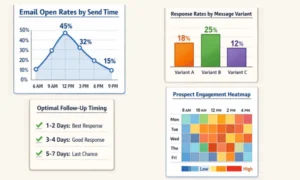
Sequence intelligence goes beyond basic email automation. The AI should analyze which message variants get responses, optimal send times for different segments, and when to pause sequences based on engagement signals. If someone visited your pricing page after getting your second email, the system should recognize that buying signal and adjust follow-up accordingly.
Meeting scheduling with AI coordination handles back-and-forth calendar coordination automatically. Advanced versions can even qualify prospects during the scheduling conversation, asking relevant questions before booking time with your sales team.
Revenue forecasting uses historical patterns to predict pipeline outcomes with surprising accuracy. Basic CRM tools show you current pipeline value. AI platforms tell you which deals will likely close this quarter and what revenue you’ll probably hit based on current trends.
Hidden costs nobody mentions upfront
Platform subscription fees represent just part of your total investment. Implementation time affects how quickly you see value and how much productivity you lose during transition. Enterprise platforms like Salesforce might take two to three months to implement properly with consultant help running $10,000 to $50,000.
Data migration from your existing CRM or spreadsheets takes longer than vendors estimate. Plan for 20 to 40 hours of cleaning data, mapping fields, and testing imports. If historical data quality is poor, you’ll spend even more time fixing issues.
Training your team on new platforms requires dedicated time that could otherwise go toward selling. Budget 10 to 15 hours per rep for initial training, plus ongoing learning as you discover advanced features. Some platforms offer better training resources than others, which impacts this investment.
Integration costs emerge when you need custom connections between tools. Standard integrations might be free, but building custom workflows or connecting to proprietary systems requires developer time or third-party tools like Zapier that add monthly costs.
Making your final decision
Start by documenting your current sales process in detail. Map out every step from lead entry through closed deal. Identify which steps consume the most time and which ones involve repetitive work that could be automated. This audit reveals which features you actually need versus nice-to-haves.
Request demos from your top three platform choices and bring specific scenarios from your business. Don’t accept generic demonstrations. Ask vendors to show exactly how their platform would handle your particular use cases. Can it automatically route leads from different sources to appropriate reps? Does it handle your specific integration requirements?
Run a pilot with a small team segment before full rollout. Pick two or three reps to test the platform for 30 days with real prospects. Gather feedback on what works smoothly and what creates friction. This limited test reveals implementation issues before they affect your entire sales operation.
Calculate your break-even point before committing. If the platform costs $500 monthly and saves each rep 10 hours per month, that’s measurable ROI. But if those saved hours don’t translate to more closed deals or faster sales cycles, the math doesn’t work regardless of time savings.
Choosing the right platform gives you the foundation for effective sales automation, but the tool alone won’t generate results. What matters more is how you deploy it to actually engage prospects and move them through your pipeline. Our guide to automating sales outreach shows you exactly how to build email sequences and follow-up campaigns that convert without feeling robotic or impersonal.
About the Author

Mateo
I’m Mateo, a SaaS blogger and digital strategist dedicated to helping startups accelerate growth through automation, data-driven decision-making, and performance-focused marketing systems. Over the past few years, I’ve worked with early-stage software companies to refine their go-to-market strategies, optimize conversion funnels, and implement scalable automation frameworks that drive measurable revenue growth. On my blog, I share proven insights from real-world SaaS cases, including actionable frameworks for churn reduction, onboarding optimization, and lead-to-customer conversion. My mission is simple: to empower founders and marketers with practical strategies that turn innovative software into sustainable, profitable success.
Did you find this helpful?
Your feedback helps us curate better content for the community.