
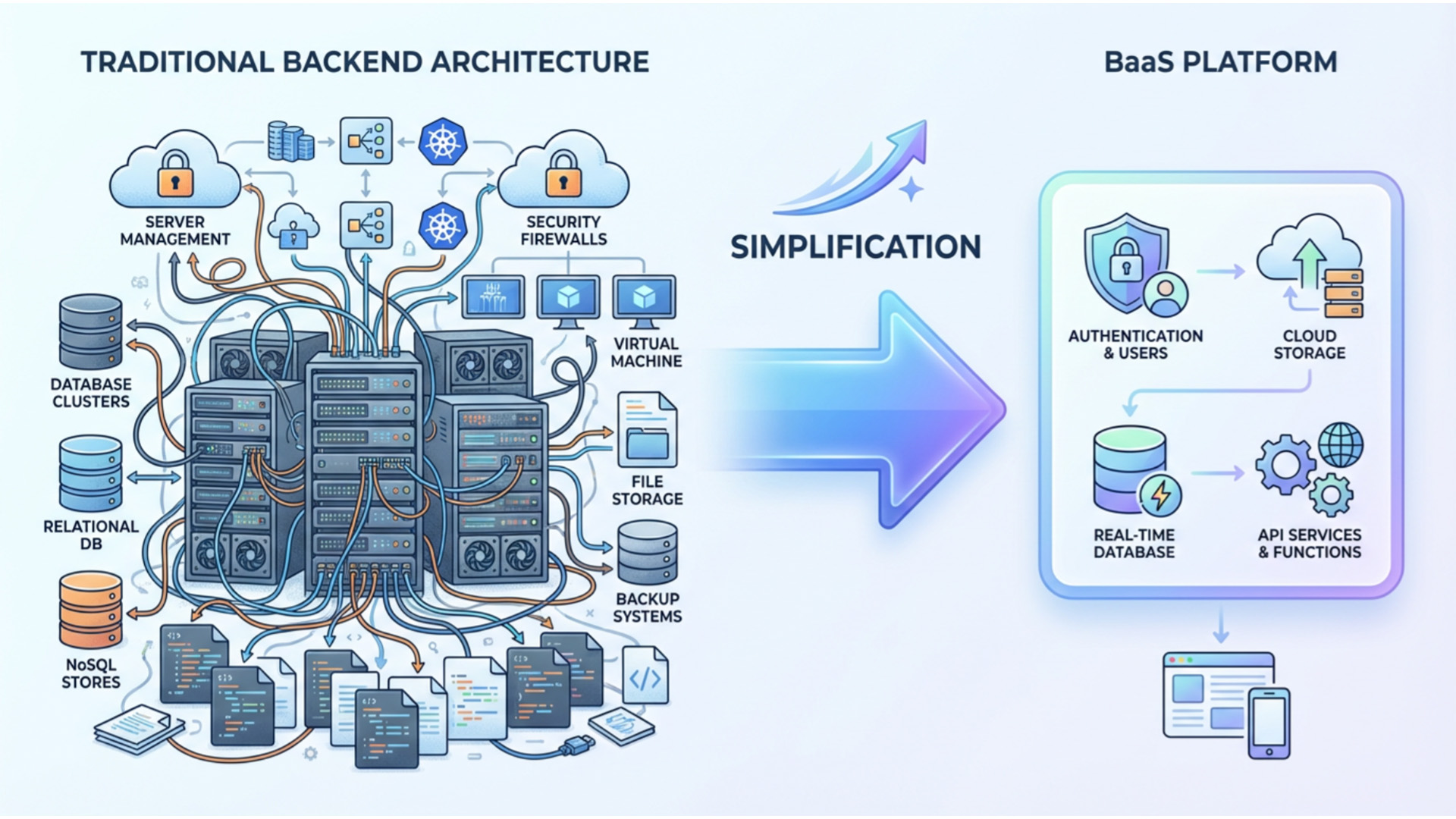
Backend as a Service (BaaS) represents a cloud computing model that provides developers with pre-built backend infrastructure, eliminating the need to build and maintain server-side components from scratch. Instead of configuring databases, authentication systems, and APIs manually, development teams can leverage ready-made backend functionality through a unified platform. This architectural approach has transformed how applications are built, particularly for teams seeking faster time-to-market. Understanding this foundational concept is essential before exploring what Backend as a Service offers in practice, including its technical components, trade-offs, and ideal use cases.
What exactly is backend as a service?
Think of Backend as a Service as the cloud-based equivalent of hiring an experienced backend team without actually hiring anyone. When you build an application, the frontend is what users see and interact with—the buttons, forms, and visual design. The backend is everything that happens behind the scenes: storing user data, processing payments, sending notifications, and managing who can access what.
Traditionally, creating this backend meant setting up servers, configuring databases, writing authentication code, building APIs, and maintaining all of it as your application grows. BaaS platforms handle all of this for you. They provide ready-to-use backend services that you connect to your application through simple code snippets or SDKs.
Instead of spending weeks or months building a user authentication system, you integrate a BaaS platform and have secure login, password reset, and session management working in hours. The same applies to databases, file storage, push notifications, and dozens of other backend features that most applications need.
The core concept behind BaaS platforms
The fundamental principle driving Backend as a Service is abstraction. Just as you don’t need to understand how electricity is generated to use a light switch, you don’t need to be a backend infrastructure expert to build a functioning application backend.
BaaS providers maintain the physical servers, handle security patches, optimize database performance, and ensure everything runs smoothly 24/7. You interact with these services through APIs and dashboards that hide the complexity underneath. This abstraction allows entrepreneurs and small teams to build sophisticated applications that would traditionally require multiple specialized developers.
Consider what happens when a user signs up for your app. With traditional backend development, you’d need to hash passwords securely, store user information in a database, send verification emails, create session tokens, and handle edge cases like duplicate accounts. With BaaS, you call a single function like auth.signup(email, password) and the platform handles everything else according to industry best practices.
This doesn’t mean BaaS platforms are magic black boxes. They’re built on the same fundamental technologies as traditional backends—databases like PostgreSQL, authentication protocols like OAuth, storage systems like S3. The difference is that someone else has already assembled these pieces into a cohesive, maintained system that you can use immediately.
How BaaS differs from traditional backend development
The distinction between BaaS and traditional backend development comes down to control versus convenience. When you build a custom backend, you make every decision: which database to use, how to structure your API endpoints, where to deploy your servers, how to handle scaling. This gives you maximum flexibility but requires significant time and expertise.
With BaaS, many of these decisions are made for you. The platform provides a database—often with a specific structure or query language. Authentication works in a particular way. APIs follow the platform’s conventions. You’re trading some control for dramatically faster implementation and reduced maintenance burden.
For entrepreneurs testing a business idea, this trade-off often makes perfect sense. Getting your MVP to market quickly matters more than having complete architectural control. If your business validates and grows, you can always migrate to a custom backend later, or use BaaS platforms in hybrid configurations alongside custom code.
The cost structure also differs significantly. Traditional backends often involve fixed costs—you’re paying for servers whether anyone uses your app or not. BaaS platforms typically charge based on usage: number of database reads, API calls, or storage consumed. For new projects with uncertain traffic, this usage-based pricing reduces financial risk.
Common misconceptions about BaaS
One frequent misunderstanding is that BaaS platforms are only suitable for simple applications or prototypes. While they excel at rapid MVP development, many production applications serving millions of users run on BaaS infrastructure. Instagram was built on AWS backend services before being acquired by Facebook. Modern BaaS platforms can scale to handle substantial traffic when configured correctly.
Another misconception is that using BaaS means you’re not a “real” developer. This outdated thinking ignores that all professional development involves leveraging existing tools and services. No one writes their own operating system or programming language from scratch. BaaS is simply another layer of abstraction that lets you focus on what makes your application unique rather than rebuilding common functionality.
Some entrepreneurs worry that BaaS creates vendor lock-in, making it impossible to switch platforms later. While migration does involve work, modern BaaS platforms increasingly support standard protocols and open-source technologies that make transitions smoother. The risk of being “locked in” to a problematic platform should be weighed against the very real risk of spending months building custom backend infrastructure for an idea that might not succeed.
Who benefits most from Backend as a Service?
BaaS platforms particularly benefit solo entrepreneurs, small teams, and anyone building their first application. If you’re strong at frontend development but less experienced with backend infrastructure, BaaS lets you build complete applications without hiring backend developers or spending months learning server administration.
Startups testing business hypotheses benefit from the speed advantage. Launching quickly and iterating based on real user feedback matters more than perfect architecture. Many successful companies started on BaaS platforms and only migrated to custom backends after proving their business model and securing funding.
Mobile app developers find particular value in BaaS platforms because mobile apps almost always require cloud backend functionality for user data, synchronization, and features like push notifications. BaaS platforms provide mobile SDKs that make backend integration straightforward, often with offline data synchronization built in.
Even experienced developers use BaaS for side projects or client work where budget and timeline constraints make custom backend development impractical. The ability to deliver working applications in days rather than weeks changes the economics of small projects.
Making sense of the BaaS landscape
Understanding what Backend as a Service means is just the first step. The practical question becomes how these platforms actually work under the hood, which components they provide, and how to evaluate whether they’re right for your specific project.
The technical architecture of BaaS platforms determines what you can build, how your application performs, and what limitations you might encounter. If you’re considering BaaS for your next project, learning how these systems function internally helps you make informed decisions about which features matter most and which platform aligns with your needs.
For a deeper look at the databases, authentication systems, APIs, and real-time capabilities that power BaaS platforms, explore how Backend as a Service works at the component level. Understanding these building blocks clarifies both the possibilities and constraints of the BaaS approach, helping you determine if it’s the right architectural choice for your entrepreneurial journey.
About the Author

AISalah
AISalah bridges linguistics and technology at PointOfSaaS, exploring AI applications in business software. English Studies BA with hands-on back-end and ERP development experience.
Did you find this helpful?
Your feedback helps us curate better content for the community.