
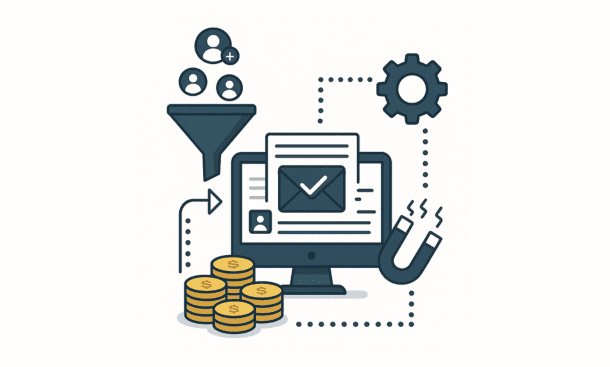
Lead generation becomes fragile when it depends on manual actions. Forms need follow-ups, ads need filtering, and prospects expect fast responses. Without structure, opportunities are missed and teams lose momentum. Lead generation automation creates stability. It turns acquisition into a predictable system instead of a daily struggle.
Automated acquisition is not about flooding your pipeline with contacts. It is about attracting the right people, capturing intent, and qualifying interest before human intervention. When done correctly, it lowers acquisition costs and improves conversion quality. This approach supports the broader framework described in marketing automation strategies for predictable business growth, where consistency matters more than volume.
A reliable lead generation system follows clear principles. It focuses on intent, timing, and relevance rather than isolated campaigns.
Understanding automated lead acquisition
Automated lead acquisition connects discovery with qualification. It captures interest at the moment it appears and responds without delay. The system works continuously, even when your team is offline.
At its core, automated lead generation combines three elements:
- traffic sources that attract attention;
- conversion points that collect contact data;
- workflows that respond instantly and consistently.
Each element must align with the same objective. When one part is weak, the entire system underperforms.
Automation allows entrepreneurs to scale without adding operational pressure. It also protects lead quality by filtering casual interest from real intent.
Building high-intent entry points
The first step in any automated system is creating entry points that attract qualified prospects. These entry points should solve a specific problem or answer a clear question. Generic offers attract weak leads. Focused offers attract people ready to engage.
Lead magnets with a clear outcome
Strong lead magnets promise clarity, not volume. They help prospects move one step forward. Examples include:
- step-by-step guides;
- templates and checklists;
- calculators or assessments;
- short educational resources.
Automation ensures that once someone requests the resource, delivery and follow-up happen instantly. This speed builds trust and reinforces credibility.
Forms that reduce friction
Long forms reduce conversion rates. Automated lead capture works best when forms are simple and intentional. Only ask for information you actually use. Every extra field reduces completion.
Smart systems enrich profiles later through behavior rather than demanding everything upfront.
Traffic sources that support automation
Automation works best when traffic is intentional. Random visitors rarely convert. High-performing systems rely on sources aligned with the offer.
Common traffic sources include:
- paid search for high-intent queries;
- paid social for problem-aware audiences;
- organic content for long-term acquisition;
- referral partnerships;
- community-driven platforms.
Automation connects these sources to the same backend logic. Regardless of where the lead comes from, the system treats them consistently while adapting to their behavior.
Immediate follow-up and qualification
Speed matters. The moment a lead enters your system is when attention is highest. Automated follow-ups protect that momentum.
Instant confirmation messages
Confirmation emails or messages reassure the prospect that their action worked. They also establish expectations. Clear language and simple instructions improve engagement.
Early qualification sequences
Not every lead should go directly to sales. Automated qualification filters contacts based on behavior and responses. This prevents wasted time and protects your sales pipeline.
Qualification can include:
- follow-up questions;
- content engagement tracking;
- page visit monitoring;
- short surveys.
Each interaction adds clarity to the lead profile.
Using lead scoring to prioritize action
Lead scoring assigns value to behavior. It helps teams understand who is ready for deeper engagement and who still needs education.
A simple scoring model may include:
- content downloads;
- repeated visits;
- email engagement;
- interaction with pricing pages.
Automation updates scores continuously. When a threshold is reached, the system triggers the next action, such as a sales notification or a personalized sequence.
This structure ensures that effort is spent where it produces the highest return.
Avoiding common lead generation mistakes
Many automated systems fail due to avoidable errors.
Chasing volume instead of intent
Large lists with low engagement create noise. Focus on relevance, not size.
Over-automating early interactions
Too many messages too quickly reduce trust. Automation should support the conversation, not overwhelm it.
Ignoring data hygiene
Poor tagging and inconsistent segmentation weaken workflows. Clean data keeps automation reliable.
Disconnecting sales from marketing
When sales teams do not trust the leads, automation loses value. Shared definitions and feedback loops keep both sides aligned.
Connecting acquisition to nurturing
Lead generation does not end with capture. It flows naturally into communication sequences. Once a contact enters the system, they need guidance. Education and trust-building follow acquisition.
This transition is where email and messaging workflows become critical. Well-designed communication systems ensure leads stay engaged until they are ready to move forward.
For deeper insight into this stage, explore email automation strategies, which explains how to structure follow-ups that convert interest into action.
Lead generation automation creates stability in growth. It captures intent, responds instantly, and qualifies prospects without manual pressure. When built around clarity and relevance, it transforms acquisition into a reliable engine rather than a daily challenge. A strong system does not chase every visitor. It focuses on the right ones and guides them forward with purpose.
About the Author

Mateo
I’m Mateo, a SaaS blogger and digital strategist dedicated to helping startups accelerate growth through automation, data-driven decision-making, and performance-focused marketing systems. Over the past few years, I’ve worked with early-stage software companies to refine their go-to-market strategies, optimize conversion funnels, and implement scalable automation frameworks that drive measurable revenue growth. On my blog, I share proven insights from real-world SaaS cases, including actionable frameworks for churn reduction, onboarding optimization, and lead-to-customer conversion. My mission is simple: to empower founders and marketers with practical strategies that turn innovative software into sustainable, profitable success.
Did you find this helpful?
Your feedback helps us curate better content for the community.