
I’m Pamela, 35, splitting my time between writing sessions and short trips that reset my head. I’ve seen startups grow fast, stall, then grow again once structure finally caught up with ambition. Tools alone never create success. The right system at the right moment does.
Project management tools have become central for entrepreneurs and early-stage startups because growth without structure rarely holds. When teams are small, everything feels manageable. Tasks float in conversations. Decisions live in memory. That works until it doesn’t. As soon as the pace increases, clarity becomes the real competitive advantage.
Asana stands out because it supports execution without turning work into bureaucracy. It adapts to fast-moving teams while offering enough depth to scale. This guide is built to show how project management tools fit into startup reality, from early traction to structured growth, with Asana as the backbone.
Why project management tools matter for startups

Startups are built on speed, but speed without coordination creates friction. Many founders underestimate how early this problem starts. Even with two or three people, misalignment shows up quietly. Tasks get duplicated. Deadlines slide. Important follow-ups vanish.
Project management tools solve this by creating shared clarity. They turn intentions into visible work. Everyone knows what matters today and what can wait.
Growth exposes weak structure
In the beginning, founders carry most of the context. They know priorities instinctively. Team members rely on quick messages and informal updates. This works when volume is low.
As soon as projects overlap, that informal system breaks. People hesitate because ownership is unclear. Work slows not because of lack of effort but because of uncertainty.
Project management tools give structure without killing flexibility. They define who owns what, by when, and why it matters. That clarity allows teams to move faster with less stress.
A deeper look at this shift is covered in this guide on why project management software matters for startups:
Focus becomes a shared asset
Founders often feel like they are juggling ten priorities at once. Without a system, that pressure spreads to the team. Everything feels urgent. Nothing feels finished.
Project management tools force prioritization in a healthy way. Tasks are visible. Limits appear naturally. Teams focus on what moves the business forward instead of reacting all day.
This shared focus reduces burnout. People know what success looks like for the week, not just for the quarter.
Accountability without micromanagement
One fear founders have is losing control as the team grows. The irony is that lack of structure creates more control issues, not fewer.
Project management tools create accountability through visibility, not pressure. Progress is easy to see. Blockers surface early. Conversations become constructive instead of corrective.
Founders stop chasing updates. Teams stop guessing expectations. Trust grows because work is transparent.
Remote and hybrid work demand clarity
Many startups operate remotely or in hybrid setups. Time zones vary. Schedules overlap imperfectly.
In this environment, relying on memory and meetings fails quickly. Project management tools replace hallway conversations with documented context. Tasks carry history. Decisions stay attached to execution.
This makes asynchronous work smoother and more reliable. People contribute when they are most productive instead of waiting for availability.
One source of truth saves time
When information lives everywhere, progress slows. Files, comments, and decisions scatter across tools.
Project management tools centralize work. Tasks, discussions, and assets stay connected. Teams stop searching and start executing.
This single source of truth becomes more valuable as the startup grows. Onboarding speeds up. Mistakes decrease. Momentum holds.
Startups scale habits before headcount
Hiring more people does not fix broken workflows. It often amplifies them.
Project management tools help startups scale habits early. Clear task definition. Consistent follow-up. Realistic planning.
These habits compound over time. When growth accelerates, the foundation already exists.
That is why the best time to adopt structure is before chaos forces it.
Asana basics: tasks, boards, timelines, and workflows
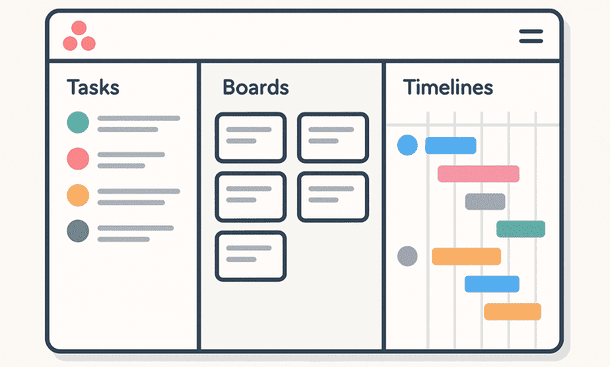
Asana works because it mirrors how work actually happens. Ideas turn into tasks. Tasks move through stages. Projects unfold over time. Nothing feels forced. The structure adapts to the team, not the other way around.
For startups, this balance matters. You get clarity without complexity and visibility without constant meetings.
Tasks turn intentions into commitments
Every action in Asana starts with a task. That simplicity is its strength.
A task is not a note. It is a clear commitment with an owner and a due date. When tasks are defined properly, confusion disappears. People know exactly what they are responsible for and when it matters.
Founders benefit immediately. Mental load drops because work lives in the system, not in their head. Teams move with more confidence because expectations are explicit.
Breaking large goals into smaller tasks also changes how progress feels. Work becomes approachable instead of overwhelming.
A practical walkthrough of task structure and daily use is detailed in this guide to the Asana project management tool basics:
Boards visualize flow
Boards show work as it moves through stages. To do. In progress. Review. Done.
This visual flow creates instant clarity. At a glance, teams see where work is stuck and where momentum is strong. Bottlenecks surface without a single question being asked.
Boards work especially well for marketing, content, sales, and operations. Any process with repeatable stages benefits from this layout.
For founders, boards replace status meetings. Progress is visible. Conversations focus on solving problems, not reporting them.
List view supports daily focus
While boards show flow, list view supports focus.
List view presents tasks in a clean, structured format. Priorities, due dates, and owners are easy to scan. This makes it ideal for daily planning and execution.
Many teams switch between views depending on the moment. Visual when coordinating. Structured when executing.
This flexibility allows individuals to work in the way that suits them best without fragmenting the system.
Timelines connect strategy to execution
Timelines show how tasks unfold over time and how they depend on each other.
For startups running multiple projects, this view is essential. It highlights sequencing and prevents unrealistic planning. Design must finish before development starts. Content must be ready before launch.
When dates shift, the impact becomes visible instantly. Teams adjust early instead of scrambling late.
Timelines give founders confidence when committing to deadlines because they see the full picture, not just isolated tasks.
Dependencies reduce hidden delays
Dependencies clarify what is waiting on what.
Instead of assuming work will magically align, dependencies make relationships explicit. Teams know when to act and when to wait.
This reduces frustration and prevents premature work. It also surfaces blockers early, when they are easier to resolve.
As startups scale, dependencies become one of the most valuable features for maintaining realistic momentum.
Projects organize work around goals
Tasks live inside projects. Projects represent outcomes.
This structure keeps work aligned with purpose. Instead of a long list of disconnected tasks, teams see how daily actions support larger goals.
Projects also make progress review easier. Founders can assess status by initiative instead of chasing individual updates.
Clear project structure turns activity into progress.
Workflows grow with the team
Asana workflows start simple and evolve naturally.
Early-stage teams may only need basic tasks and boards. As complexity increases, timelines, dependencies, and templates come into play.
This gradual evolution prevents overwhelm. Teams adopt structure at the pace of their growth.
That adaptability is why Asana fits startups so well. It supports both speed and scale.
Integrations and automation: connecting Asana to your stack

As startups grow, tools multiply. Communication platforms, file storage, CRMs, analytics, and support systems all become part of daily operations. Without integration, teams spend more time switching tools than doing real work.
Asana becomes powerful when it acts as the hub. Instead of replacing everything, it connects what you already use into one coherent flow.
Why disconnected tools slow teams down
When tools do not talk to each other, information gets copied manually. Updates are repeated. Details get lost.
This creates invisible work. It feels busy but adds no value. Founders notice it when teams look overloaded yet progress feels slow.
Integrations remove this friction. Information moves automatically. Context follows the work. People stay focused on execution instead of coordination.
Asana as the central workspace
High-performing startups usually treat their project management tool as the center of operations.
Sales updates trigger delivery tasks. Marketing assets attach directly to campaigns. Support issues become visible projects.
Instead of checking five tools, teams rely on one main space where work is organized and visible. Asana fits this role naturally because it connects easily with the tools startups already depend on.
A detailed breakdown of common setups and best practices is available in this guide on project management tools integrations:
Communication stays tied to execution
Messaging tools move fast. Important decisions disappear quickly.
Integrating communication platforms with Asana keeps conversations connected to tasks. Key messages become actions. Updates reach the right people without flooding everyone.
This reduces noise and keeps discussions outcome-focused. Teams stop asking for status updates because progress is already visible.
Files stay where the work is
Files scattered across folders create confusion. Teams waste time searching for the right version.
When file storage tools connect to Asana, assets live alongside tasks. Designs, documents, and spreadsheets stay attached to the work they support.
This saves time and prevents errors. Everyone works from the same source without guessing.
Automation removes repetitive steps
Automation handles predictable actions. Task creation from forms. Notifications when status changes. Follow-ups triggered by completion.
These small automations add up quickly. They reduce manual effort and protect teams from forgetting routine steps.
For startups with limited headcount, automation creates leverage. The team focuses on thinking and building, not managing checklists.
Sales and operations alignment
When sales and delivery tools integrate with Asana, handoffs become smoother.
New deals automatically generate onboarding tasks. Client details travel with the project. Delivery teams start with full context.
This alignment improves customer experience and reduces internal friction as deal volume increases.
Choosing integrations intentionally
Not every integration is useful.
The goal is not to connect everything. The goal is to fix the most painful handoffs first.
Founders should look for points where work slows down or information gets lost. Those are the best candidates for integration.
As the business evolves, integrations should evolve too. Regular cleanup keeps systems simple and effective.
Automation without overload
Too much automation creates noise. Notifications lose meaning. Teams stop paying attention.
The best setups stay minimal. Only automate what saves real time or prevents real errors.
Clean systems outperform complex ones every time.
Pricing and plans: choosing the right Asana level as you grow

Pricing decisions shape how tools are adopted. For startups, the goal is not to get the most features. It is to get just enough structure to support growth without adding friction.
Asana pricing works well for this because it scales gradually. Teams can start simple and upgrade only when complexity demands it.
Starting lean with the free plan
Many founders begin with the free plan and stay there longer than expected.
It covers core task management, basic projects, and collaboration for small teams. This is enough to build habits and test whether Asana fits the way your team works.
For solo founders or early collaborators, the free plan keeps things light. No financial pressure. No forced complexity.
What matters most at this stage is consistency, not sophistication.
Signals that it is time to upgrade
Upgrading rarely happens because of feature envy. It usually happens because friction appears.
Founders want to see timelines instead of guessing dates. Teams need clearer dependencies. Managers want visibility without constant check-ins.
These signals indicate growth, not failure. They show that the startup has outgrown simple coordination.
Understanding these transition points is explained in more detail in this guide on Asana pricing and plans for growing teams:
Premium plan supports coordination
Premium introduces timelines, dependencies, and custom fields.
For teams managing multiple projects, these features bring order. Planning becomes realistic. Workflows feel smoother.
Premium works well for startups entering their first real growth phase, where coordination matters as much as speed.
It adds structure without overwhelming the team.
Business plan brings visibility
As the team grows, leadership needs insight.
The Business plan adds reporting, workload management, and more automation options. Founders see capacity and bottlenecks before they turn into problems.
This level supports strategic planning. Decisions become proactive instead of reactive.
Business suits startups with several teams or managers who need shared oversight.
Enterprise fits specific constraints
Enterprise is designed for organizations with advanced security and compliance needs.
Most early-stage startups do not need it. Choosing it too early often adds complexity without real benefit.
Enterprise becomes relevant later, usually when scale or regulation demands it.
Pricing as an investment decision
The real question is not how much Asana costs. It is how much time and stress it saves.
If a plan reduces missed deadlines, improves focus, or saves hours each week, it pays for itself quickly.
Founders who see pricing through this lens make better long-term choices.
Advanced workflows: scaling your startup without losing momentum

Startups grow quickly, but processes often lag behind. Early on, simple task lists suffice. Soon, projects overlap, teams specialize, and informal habits no longer hold. Advanced workflows bridge this gap, keeping execution smooth while complexity increases.
Designing workflows around outcomes
Strong workflows start with the result, not the tool.
Instead of asking how to use Asana, ask what the team needs to accomplish. Faster launches, consistent client onboarding, or predictable marketing cycles.
Tasks, dependencies, and templates then align naturally around outcomes. Work becomes structured without feeling forced.
A practical example of setting up daily execution with tasks and boards is explored in this satellite on Asana project management tool basics:
Dependencies and sequencing
Dependencies reveal the true flow of work.
When one task must finish before another begins, the relationship is visible. Teams stop guessing and start planning realistically.
Dependencies prevent last-minute surprises and make timelines reliable. This is critical for multi-step projects with several owners.
Templates capture repeatable success
Scaling startups repeat similar work constantly—product launches, content campaigns, or onboarding sequences.
Templates capture what works and turn it into a reusable system. New projects start with proven steps instead of guesswork.
Teams move faster, make fewer mistakes, and maintain quality as they grow.
Custom fields and prioritization
Basic task names rarely capture all necessary information. Custom fields track priority, status, category, or effort.
This adds clarity for the team without overcomplicating workflows. Everyone understands what matters most and what can wait.
Custom fields become especially valuable as projects become larger and more interdependent.
Workload management
Uneven workload is a hidden risk. Some team members burn out while others have capacity.
Advanced workflows include workload views. Founders can redistribute tasks before bottlenecks appear.
This reduces stress, keeps morale high, and ensures consistent output during growth phases.
Automation for consistency
Automation reduces repetitive steps without replacing people.
Notifications, status updates, and task creation follow predefined triggers. This ensures processes are followed even under pressure.
Consistency allows startups to scale faster and maintain reliability.
Cross-team coordination
As teams specialize, workflows maintain alignment. Marketing, product, sales, and operations can see dependencies and shared milestones.
This reduces friction and ensures smooth execution across functions. Everyone understands how their work connects to the broader goals.
Reporting and insight
Advanced workflows generate actionable data naturally. Completion rates, bottlenecks, and cycle times reveal trends.
Founders use these insights to improve processes and make informed decisions. Execution becomes measurable, predictable, and adaptable.
Evolving workflows
Workflows are not static. As startups grow, regular reviews keep systems aligned with reality.
What worked at ten people may not work at thirty. Flexibility allows processes to evolve without creating chaos.
Human-centered design
Tools support people, not the other way around. Workflows should clarify, not control. Teams perform best when structure empowers autonomy.
Project management tools are more than apps; they are the foundation for scaling startups without losing clarity or speed. Asana combines tasks, boards, timelines, integrations, pricing flexibility, and advanced workflows into a cohesive system that adapts as teams grow.
Startups that adopt structured execution early gain focus, reduce friction, and improve accountability. Visibility into tasks and dependencies prevents bottlenecks. Integrations and automation reduce repetitive work, while templates and custom fields maintain consistency as complexity rises. Pricing choices ensure the tool grows with the business, not against it.
For founders ready to translate strategy into daily execution, exploring Asana tasks, boards, and timelines shows how to turn structure into momentum:
With this foundation, teams can scale confidently, knowing that work flows predictably and growth is sustainable.
About the Author

Pamela
Pamela is a dynamic professional with a deep passion for SaaS and emerging technologies. She provides valuable insights into software trends, digital innovation, and cutting-edge tools that empower businesses to thrive and expand.
Did you find this helpful?
Your feedback helps us curate better content for the community.