
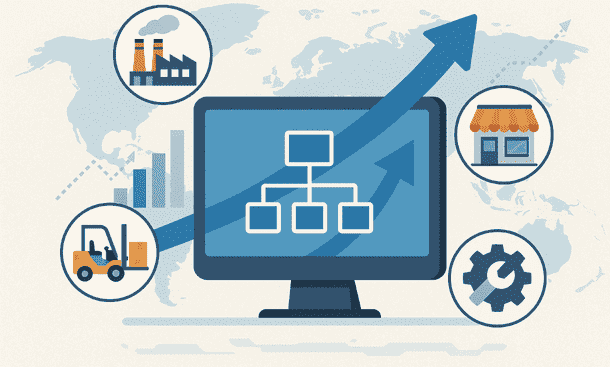
ERP is no longer one-size-fits-all. As small businesses diversify, they increasingly seek solutions tailored to their industry. A boutique manufacturer has different needs than a retail chain or a professional service firm. The rise of industry-specific ERP systems reflects this reality. These platforms are pre-configured to handle sector-specific workflows, regulatory requirements, and reporting needs, which makes them faster to deploy and easier to adopt.
Over the last few years, I’ve observed more entrepreneurs in the US turn to specialized ERPs because their generic systems slow them down. They face workarounds, manual adjustments, and duplicated processes that eat up time. Industry-specific solutions solve that problem by embedding best practices into the software. They align the system with how the business actually operates, instead of forcing teams to adapt to generic templates.
This trend ties directly to the broader ERP landscape for 2025. Business owners are seeking speed, accuracy, and operational clarity, and industry-focused solutions provide that in a practical, ready-to-use format.
Why Industry-Specific ERP Matters
Generic ERP systems are versatile but require heavy customization to match unique operational models. Small businesses often struggle with lengthy setups, expensive consulting, and ongoing maintenance. Industry-specific ERPs reduce that friction by offering pre-built modules, templates, and workflows designed around a sector’s needs.
For example, a food processing company needs batch tracking, expiration management, and compliance with FDA regulations. A construction firm prioritizes project costing, resource allocation, and subcontractor tracking. Without an industry-specific ERP, these companies must manually adapt a generic system, creating inefficiencies and risks.
These tailored platforms also support faster onboarding. Teams encounter familiar terminology and workflows. Employees spend less time learning the system and more time applying it to core tasks.
Key Sectors Adopting Specialized ERPs
Industry-specific ERP solutions are growing rapidly in sectors where process complexity, regulation, and growth velocity are high. Some of the main adopters include:
Manufacturing
Manufacturers face challenges like production scheduling, inventory optimization, and compliance reporting. Industry-focused ERPs integrate production planning with sales, procurement, and quality management. Real-time dashboards help managers see bottlenecks and streamline operations without relying on spreadsheets.
Retail and e-commerce
Retailers benefit from point-of-sale integration, customer behavior analytics, and omnichannel inventory tracking. Industry-specific ERPs link online and offline sales channels seamlessly. This improves order accuracy, forecasting, and customer satisfaction.
Professional services
Firms such as accounting, consulting, or engineering often focus on project management, resource allocation, and time tracking. Tailored ERP systems allow precise billing, accurate project costing, and workforce optimization.
Healthcare and life sciences
Compliance is critical here. Specialized ERPs manage patient records, regulatory reporting, and inventory tracking for medical supplies. Automation reduces administrative overhead while maintaining strict control over sensitive data.
Advantages of Adopting Industry-Specific ERP
The benefits are tangible and immediate for small businesses. They include:
Faster implementation
Pre-built workflows and templates reduce setup time. Companies can start using the system sooner, with less disruption to daily operations.
Lower customization costs
Industry-specific ERP reduces the need for expensive consulting or coding adjustments. The core system already reflects industry best practices.
Better reporting and analytics
Reports are tailored to sector-specific KPIs. Managers see insights that matter most, such as project margins, batch quality, or sales per channel, without building reports from scratch.
Compliance support
Regulations are often baked into the software, helping businesses stay up-to-date with industry standards. This reduces risk and frees teams from constant manual checks.
Improved employee adoption
Familiar workflows and terminology make it easier for teams to learn and embrace the system. Training time drops, and adoption accelerates.
These advantages explain why more small businesses are considering specialized ERP as their first or next system. The efficiency gains often outweigh the cost premium compared to generic alternatives.
Choosing the Right Industry-Specific ERP
Even with specialized systems, selection requires care. Key factors include:
Fit with business processes
The ERP should match your core workflows. Avoid software that requires significant process changes unless you are ready to adapt operations.
Vendor reliability
Check for proven implementations in your sector. Support quality, update frequency, and system stability matter for long-term success.
Integration capability
Your ERP should connect smoothly with other tools, including accounting, CRM, e-commerce, or payroll systems. Open APIs and standardized data exchange simplify integration.
Scalability
Ensure the platform can handle growth. Industry-specific systems must adapt to more users, higher transaction volumes, or new locations as your business expands.
Cost and total value
Balance subscription or licensing fees against potential gains in efficiency, compliance, and speed to market. In many cases, faster deployment and lower maintenance offset higher upfront costs.
Selecting the right solution requires research, trial periods, and input from the team. Many entrepreneurs start by focusing on the module that delivers the most immediate value.
Future Outlook for Industry-Specific ERP
As 2025 unfolds, industry-specific ERPs continue to gain traction among small businesses seeking speed, efficiency, and sector alignment. Vendors increasingly combine modular architectures with AI and cloud deployment, offering flexible, scalable solutions. Automation, real-time analytics, and mobile accessibility are becoming standard.
Small companies are increasingly realizing that a tailored approach is not a luxury but a necessity. Generic ERPs are evolving, but industry-specific systems offer a faster, more practical path to operational excellence. Business owners who adopt these tools early often gain a competitive edge by responding faster to market demands and improving internal efficiency.
Industry-specific ERP systems are transforming the way small businesses operate. They provide ready-made workflows, compliance support, and faster deployment while reducing customization headaches. Small teams can focus on growth instead of wrestling with generic software that doesn’t fit. The modular and flexible nature of these solutions also positions companies for ongoing innovation.
For practical guidance on adopting flexible ERP workflows that maximize efficiency, explore the satellite article on composable ERP and modular architectures, which highlights how small businesses can build systems that evolve with their growth.
About the Author

mike
Mike is a tech enthusiast passionate about SaaS innovation and digital growth. He explores emerging technologies and helps businesses scale through smart software solutions.
Did you find this helpful?
Your feedback helps us curate better content for the community.