
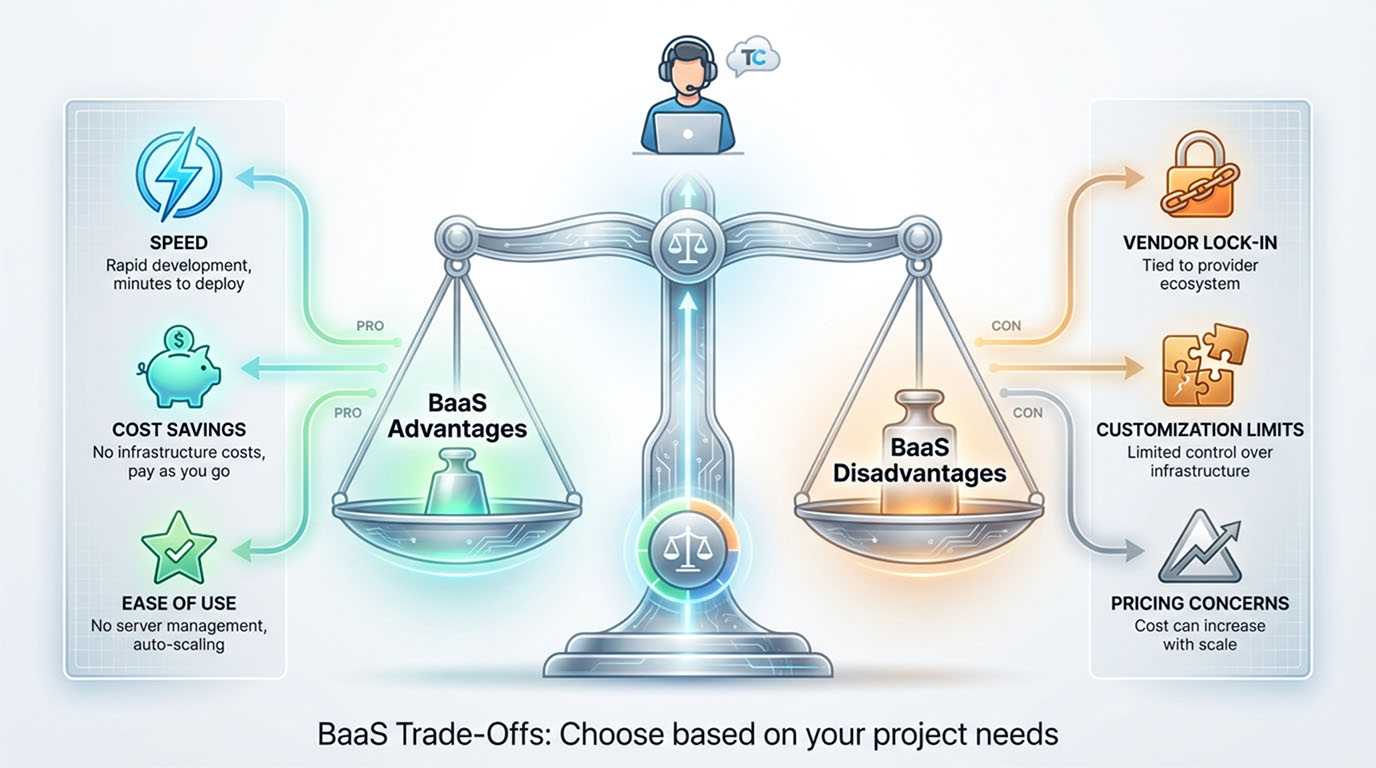
Every technology choice involves trade-offs, and Backend as a Service is no exception. While BaaS platforms promise accelerated development cycles, reduced infrastructure costs, and simplified maintenance, they also introduce considerations around vendor dependency, pricing scalability, and customization boundaries. Some organizations thrive with BaaS solutions, launching products in weeks rather than months, while others find themselves constrained by platform limitations or surprised by scaling costs. Making an informed decision requires understanding both sides of the equation. This balanced analysis expands on principles introduced in our complete Backend as a Service overview, providing the realistic perspective you need to evaluate whether BaaS aligns with your technical requirements and business goals.
The advantages: why entrepreneurs choose BaaS
Dramatically reduced development time
The single most compelling advantage of BaaS platforms is how quickly you can go from concept to working application. Features that would take weeks to implement from scratch—user authentication, database operations, file uploads, push notifications—work within hours or days using BaaS platforms.
This speed advantage compounds throughout your project. You’re not just saving time on initial development. You’re eliminating entire categories of work: server configuration, database optimization, security hardening, scaling preparation, monitoring setup, and backup implementation. Each of these tasks disappears from your project timeline, letting you focus exclusively on what makes your application unique.
For solopreneurs testing business ideas, this time compression changes the game entirely. You can validate product concepts in weeks rather than months, iterate based on user feedback quickly, and pivot without throwing away months of infrastructure work. The opportunity cost of slow development often exceeds any technical trade-offs BaaS platforms introduce.
Lower initial investment and predictable costs
BaaS platforms eliminate the upfront infrastructure investment traditional backends require. You don’t provision servers, pay for hosting before you have users, or commit to fixed monthly costs while your business model remains unproven. Most BaaS platforms offer generous free tiers that let you build and launch without spending anything on backend infrastructure.
As your application gains users, costs scale with usage. You pay for database operations actually performed, API calls actually made, and storage actually consumed. This usage-based model aligns costs with value—you’re only paying when your application is serving real users who hopefully represent revenue potential.
For bootstrapped entrepreneurs, this cost structure reduces financial risk significantly. You’re not betting hundreds or thousands of dollars monthly on infrastructure before knowing whether your business will work. The capital you save on infrastructure can fund marketing, user acquisition, or simply extend your runway while you find product-market fit.
Built-in security and compliance
Security represents one of the most challenging aspects of backend development. Implementing authentication securely requires expertise in cryptography, session management, and attack prevention. BaaS platforms provide security features built by teams who specialize in this domain, tested across thousands of applications, and maintained as new vulnerabilities emerge.
Password hashing uses industry-standard algorithms. Session tokens generate with appropriate randomness. API endpoints include built-in protection against common attacks like SQL injection and cross-site scripting. SSL certificates configure automatically. These security measures come configured correctly from day one, eliminating vulnerabilities that plague custom implementations.
Many BaaS platforms also maintain compliance certifications—SOC 2, GDPR, HIPAA—that would cost significant time and money to achieve independently. If your application serves European users or handles sensitive data, starting with a compliant platform saves months of compliance work and legal consultation.
Automatic scaling and reliability
Traditional backends require careful planning for scale. You monitor server capacity, configure load balancers, implement caching strategies, optimize database queries, and prepare infrastructure to handle traffic spikes. Get it wrong, and your application crashes during your biggest product launch or marketing campaign.
BaaS platforms handle scaling automatically. Infrastructure allocates resources based on demand. Databases distribute load across servers. CDNs cache content globally. The platform provider monitors performance 24/7 and addresses infrastructure issues before they impact your application. This automatic scaling eliminates a major operational burden and expertise requirement.
Reliability benefits from the platform provider’s scale and expertise. Major BaaS platforms maintain 99.9% uptime or better, backed by redundant infrastructure across multiple data centers. Achieving similar reliability with custom infrastructure requires significant investment in redundant servers, monitoring systems, and on-call engineering—resources most early-stage ventures can’t justify.
Simplified maintenance and operations
After launching your application, traditional backends demand ongoing maintenance. Operating system updates, security patches, database optimization, backup verification, monitoring configuration, and performance tuning all require regular attention. This operational work never ends, competing with product development for your limited time and energy.
BaaS platforms eliminate most operational work. The provider handles infrastructure maintenance, applies security updates, optimizes database performance, manages backups, and monitors system health. You receive the benefits of professional operations teams without hiring anyone or spending time on infrastructure concerns.
For solopreneurs especially, this operational simplification often represents BaaS platforms’ most valuable benefit. Your time focuses entirely on building features users want, improving user experience, and growing your business rather than wrestling with server configuration and database optimization.
The disadvantages: real limitations to consider
Vendor lock-in and platform dependency
The most frequently cited concern about BaaS platforms is vendor lock-in. Once you’ve built your application around a specific platform’s APIs, database structure, and authentication system, migrating to a different solution requires significant engineering work. Your application becomes dependent on the platform’s continued existence, pricing stability, and feature roadmap alignment with your needs.
This dependency introduces real risks. The platform could raise prices substantially, making your application economics unsustainable. They could discontinue features you depend on or sunset the entire platform. They could be acquired by a competitor or change their terms of service in ways that conflict with your business model. While catastrophic scenarios are unlikely with major platforms, the possibility exists.
The lock-in concern is somewhat overstated, however. Modern BaaS platforms increasingly use standard technologies—PostgreSQL databases, standard authentication protocols, REST APIs—that make migration more feasible. Open-source BaaS solutions let you self-host if necessary. Many companies successfully migrate from BaaS to custom backends after reaching scale and securing resources to justify the transition.
Customization constraints and platform limitations
BaaS platforms make architectural decisions for you. This works perfectly when your requirements align with the platform’s assumptions but becomes problematic when you need something the platform doesn’t support well. Complex business logic, unusual data relationships, specific performance optimizations, or integration with legacy systems may not fit naturally into a BaaS model.
You might find yourself implementing workarounds to achieve functionality that would be straightforward with a custom backend. These workarounds add complexity, reduce performance, and create technical debt. In extreme cases, platform limitations might make certain features impossible or prohibitively difficult to implement.
The flexibility of serverless functions mitigates this concern somewhat. Most BaaS platforms let you write custom code for complex logic. But there’s still a ceiling—truly unusual requirements may simply not work within BaaS constraints. Understanding your application’s unique needs and evaluating whether BaaS platforms can accommodate them is essential before committing.
Unpredictable scaling costs
While BaaS platforms offer attractive pricing for early-stage applications, costs can increase dramatically with scale. Usage-based pricing means your infrastructure costs grow with your user base. Applications with heavy database usage, frequent API calls, or significant file storage may find BaaS costs exceeding custom infrastructure costs at scale.
The unpredictability concerns some entrepreneurs. With traditional backends, you know your monthly server costs fairly precisely. With BaaS, usage spikes from viral growth or unexpected traffic patterns can generate surprise bills. Some platforms charge separately for various features—database operations, bandwidth, storage, function executions—making total cost projection difficult.
Most BaaS providers offer pricing calculators and spending alerts to help manage this concern. Understanding your application’s usage patterns and calculating projected costs at different scale levels provides reasonable predictability. Many companies find BaaS costs acceptable even at significant scale when factoring in the operational overhead eliminated.
Performance limitations and optimization constraints
BaaS platforms optimize for general use cases rather than specific application requirements. While performance is generally excellent, you have less control over optimization than with custom backends. You can’t restructure infrastructure for your specific traffic patterns, implement custom caching strategies, or optimize database queries at the server level.
For most applications, BaaS performance is more than adequate. But certain use cases have specific performance requirements that BaaS platforms struggle to meet. Applications requiring extremely low latency, high-frequency trading systems, or real-time processing of massive data streams may find BaaS platforms insufficient.
Database query performance depends on how well you model your data for the platform’s approach. Poor data modeling in a BaaS platform often causes performance problems that would be solvable with custom database optimization. Understanding the platform’s performance characteristics and designing accordingly is crucial.
Reduced infrastructure visibility and control
When issues occur with BaaS platforms, you’re dependent on the provider’s support and resolution timeline. You can’t access server logs, investigate infrastructure problems directly, or implement fixes yourself. This reduced visibility can be frustrating when trying to diagnose problems or optimize performance.
The platform’s status and support quality becomes critical. If the platform experiences an outage, your application goes down regardless of what you do. If you encounter a platform bug, you’re dependent on the provider fixing it. For applications requiring maximum control and reliability guarantees, this dependency may be unacceptable.
Most major BaaS platforms provide excellent uptime and responsive support. But the fundamental trade-off remains—you exchange control for convenience. Evaluating whether this trade-off works for your specific situation requires honest assessment of your technical capabilities, resources, and risk tolerance.
Learning curve and platform-specific knowledge
While BaaS platforms simplify backend development overall, they introduce their own learning curves. Each platform has specific conventions, APIs, and best practices you need to learn. This knowledge is somewhat platform-specific—expertise in Firebase doesn’t transfer completely to Supabase or AWS Amplify.
Time invested learning a BaaS platform represents an opportunity cost. You could spend that time learning foundational backend concepts that apply across any technology. If you later need to migrate to a different platform or custom backend, some BaaS-specific knowledge becomes less valuable.
The counterargument is that BaaS platforms teach many backend concepts through practical application. You learn about databases, authentication, APIs, and scaling by using them in real projects rather than abstract study. The knowledge is practical and immediately applicable, even if somewhat platform-specific.
Weighing the trade-offs for your situation
The pros and cons of BaaS platforms aren’t absolute—their importance varies based on your specific circumstances. A solopreneur testing a business idea faces different constraints than a well-funded startup building a complex application. A mobile app with straightforward requirements differs from an enterprise system with strict compliance needs.
For entrepreneurs in early stages, the advantages typically outweigh the disadvantages. Speed to market matters more than perfect architecture. Reduced costs and operational burden let small teams accomplish what would traditionally require larger organizations. The risk of vendor lock-in is manageable when balanced against the very real risk of spending months building infrastructure for an unproven business model.
These trade-offs don’t exist in isolation — they connect directly to how BaaS is structured as a model, what components it relies on, and how it compares to building a backend from scratch. The complete Backend as a Service guide puts all of this in context, covering the architecture, core components, and provider landscape so you can weigh the pros and cons against a full picture rather than evaluating them in a vacuum.
As applications mature and scale, the calculus can shift. Companies with product-market fit, significant revenue, and larger teams often have resources to justify custom infrastructure. At that point, the flexibility, control, and potentially lower costs of traditional backends become more attractive. Many successful companies follow this progression—start with BaaS, validate the business, then migrate to custom infrastructure.
The key is honest self-assessment. What are your technical skills? What resources do you have available? How quickly do you need to launch? What are your scaling expectations? How important is architectural flexibility? Understanding your priorities helps determine whether BaaS advantages align with your needs and whether BaaS disadvantages represent acceptable trade-offs.
Making this decision also requires understanding the specific scenarios where BaaS platforms excel versus situations where traditional backends make more sense. The abstract pros and cons become concrete when applied to actual use cases and project types. Examining when to use Backend as a Service provides practical guidance for evaluating whether this architectural approach fits your particular project’s requirements and constraints.
About the Author

AISalah
Bridges linguistics and technology at PointOfSaaS, exploring AI applications in business software. English Studies BA with hands-on back-end and ERP development experience.
Did you find this helpful?
Your feedback helps us curate better content for the community.