
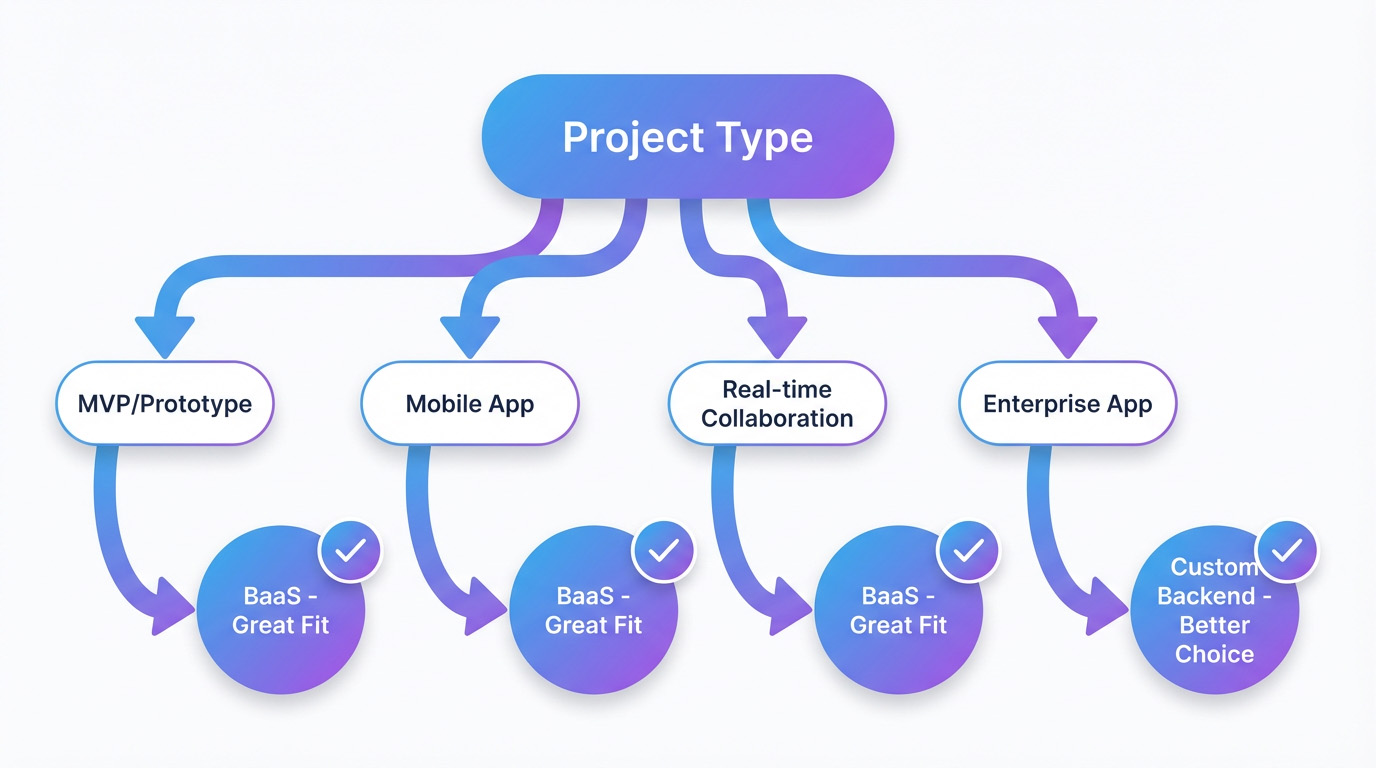
Not every project benefits equally from Backend as a Service—success depends on aligning platform capabilities with your specific requirements and constraints. BaaS platforms excel in scenarios like rapid MVP development, mobile-first applications, real-time collaborative tools, and projects with lean development teams. However, they may prove less suitable for applications requiring deep backend customization, complex business logic, or strict data residency requirements. Identifying where your project falls on this spectrum is crucial for making the right architectural choice.
MVP development and business validation
Backend as a Service truly shines when you’re testing a business idea and need to validate product-market fit quickly. MVPs prioritize speed and learning over perfect architecture. You want real users interacting with your product as soon as possible, providing feedback that shapes your direction before you invest heavily in development.
BaaS platforms let you launch functional products in days or weeks rather than months. You can test your core value proposition without building authentication systems, configuring databases, or setting up server infrastructure. If your business hypothesis proves wrong, you’ve invested minimal time and money. If it proves right, you have a working foundation to build upon.
Consider a solopreneur with an idea for a productivity tool. Using a BaaS platform, they can build a working prototype with user accounts, data storage, and basic features in a week. They launch to a small group of beta users, gather feedback, and iterate quickly. If the concept gains traction, they can expand features. If it doesn’t resonate, they’ve lost a week instead of three months building custom infrastructure.
This approach aligns perfectly with lean startup methodology. You’re minimizing waste, maximizing learning, and preserving capital for validated opportunities. BaaS platforms remove backend development as a bottleneck in the validation cycle, letting you test more ideas and pivot faster based on real market feedback.
Mobile application development
Mobile apps represent one of the strongest use cases for BaaS platforms. Nearly every mobile application requires backend functionality—user authentication, data synchronization across devices, push notifications, file storage, and offline capability. Building this infrastructure from scratch consumes significant development time and introduces complexity.
BaaS platforms provide mobile SDKs designed specifically for iOS and Android development. These SDKs handle network requests, data caching, offline synchronization, and background updates automatically. Your mobile code becomes simpler and more maintainable because the SDK abstracts away backend complexity.
Offline functionality particularly benefits from BaaS platforms. Users expect mobile apps to work without constant internet connectivity. Implementing offline data storage, conflict resolution, and background synchronization manually requires sophisticated engineering. BaaS platforms provide these capabilities out of the box, with the SDK automatically syncing local changes when connectivity restores.
Push notifications, essential for user engagement in mobile apps, integrate seamlessly with BaaS platforms. Rather than managing connections to Apple’s APNS and Google’s FCM separately, you send notifications through the BaaS platform, which handles delivery across platforms. This simplification alone saves significant development effort.
Mobile apps also benefit from BaaS pricing models. Many mobile apps start with small user bases and uncertain revenue. Usage-based pricing means you’re not paying for servers while building your audience. As downloads and engagement grow, backend costs scale proportionally with your ability to monetize.
Real-time collaborative applications
Applications requiring real-time updates—chat systems, collaborative editing tools, live dashboards, multiplayer games—align naturally with BaaS platforms. Building real-time functionality from scratch requires websocket implementation, connection management, message broadcasting, and handling network interruptions gracefully.
BaaS platforms provide real-time synchronization as a core feature. When data changes in your database, all connected clients receive updates instantly. This real-time capability works across devices and handles scaling automatically. A collaborative document editor, for instance, can have dozens of simultaneous editors with real-time cursor positions and text updates without custom websocket infrastructure.
The development experience for real-time features with BaaS is remarkably straightforward. You subscribe to data queries, and your application receives automatic updates when that data changes. The platform handles all the complex networking, reconnection logic, and efficient data transfer. You focus on the user experience rather than real-time infrastructure.
Consider a team project management tool where multiple team members view and update shared task boards. With BaaS, when someone moves a task from “In Progress” to “Done,” every team member sees the update instantly without refreshing. Building this experience with traditional backends requires significant engineering effort. With BaaS, it’s a core feature you leverage immediately.
Real-time applications also typically require offline resilience. Team members might work on tasks without internet connectivity. BaaS platforms handle offline data changes and synchronization automatically, resolving conflicts when connectivity restores. This offline-first capability is crucial for real-time applications but difficult to implement reliably from scratch.
Content management and publishing platforms
Applications focused on content creation, curation, and publishing work well with BaaS platforms. Blogs, media galleries, portfolio sites, news platforms, and content communities all require similar backend functionality—content storage, media management, user permissions, and content delivery.
BaaS platforms provide the essential components these applications need. Database storage for content with flexible schemas that adapt as your content model evolves. File storage with automatic image optimization, video transcoding, and CDN delivery for fast global access. Authentication with role-based permissions to control who can create, edit, or publish content.
The administrative overhead of content platforms also decreases with BaaS. You don’t manage media servers, configure CDNs, optimize image delivery, or worry about content backup and recovery. The platform handles infrastructure while you focus on content workflows, user experience, and community features.
Small publishing operations and individual creators particularly benefit from BaaS economics. You’re not paying for servers to host content that might not yet have significant traffic. As your audience grows and content library expands, costs scale with consumption. This usage-based model makes launching content platforms accessible to creators without significant capital.
E-commerce and marketplace applications
E-commerce applications have specific backend requirements—product catalogs, inventory management, shopping cart functionality, order processing, and payment integration. While complex e-commerce systems might justify custom backends, many successful online stores operate on BaaS platforms, especially in early stages.
BaaS platforms provide the data infrastructure e-commerce requires. Product information stores in the database with flexible schemas that accommodate varying product attributes. Image storage handles product photos with automatic optimization and responsive delivery. User authentication manages customer accounts and order history. Real-time inventory updates prevent overselling.
Payment processing integration works well with BaaS serverless functions. When a customer completes checkout, a function processes the payment through Stripe or similar services, creates the order record, updates inventory, and triggers confirmation emails. This workflow implementation takes hours with BaaS compared to days building custom backend logic.
For entrepreneurs testing product-market fit or launching niche products, BaaS platforms remove technical barriers to launching online stores. You can validate demand, process real orders, and build customer relationships without months of backend development or hiring developers. If your products succeed, the technical foundation exists to grow.
Marketplace applications connecting buyers and sellers similarly benefit from BaaS platforms. The real-time capabilities enable instant messaging between parties. Authentication handles user verification and trust systems. File storage manages product photos and documents. The infrastructure complexity of marketplace platforms becomes manageable for small teams.
Internal tools and business applications
Companies building internal tools—dashboards, admin panels, workflow automation, data management interfaces—often find BaaS platforms ideal. These applications prioritize functionality and rapid development over cutting-edge performance or complex customization.
Internal tools typically serve limited users with predictable usage patterns. BaaS pricing at these scales is negligible while development speed provides immediate business value. Building a customer service dashboard, sales pipeline tracker, or inventory management system in days versus weeks means faster ROI and happier internal users.
The authentication and permission systems BaaS platforms provide work naturally for internal tools. You can restrict access to employees, define roles for different departments, and integrate with existing identity providers. This security and access control comes configured rather than requiring custom implementation.
Internal tools also benefit from BaaS platforms’ simplicity when developers supporting these tools may not be backend specialists. A frontend developer can build functional internal applications using BaaS without deep backend expertise. This democratization of development capability lets more team members contribute to internal tooling.
When BaaS might not be the right choice
Understanding where BaaS excels is incomplete without acknowledging scenarios where traditional backends make more sense. Applications with extremely complex business logic that doesn’t map to standard database operations may struggle with BaaS platforms. The workarounds required to fit unusual requirements into BaaS constraints can introduce more complexity than building custom solutions.
Applications with strict data residency requirements or regulatory constraints may find BaaS platforms limiting. While major platforms offer regional data storage, applications requiring data to stay on specific servers in specific locations might need custom infrastructure. Healthcare, government, and financial applications often have these specialized requirements.
Systems requiring integration with complex legacy infrastructure or unusual databases may not work well with BaaS platforms designed for modern cloud-native applications. The integration overhead might exceed the benefits BaaS platforms provide.
Applications with massive scale from day one—think viral social networks or high-traffic media platforms—might justify custom infrastructure immediately. While BaaS platforms can scale significantly, applications expecting millions of users quickly may benefit from custom optimization from the start.
Making the decision for your specific project
Evaluating whether BaaS fits your project requires honest assessment across multiple dimensions. Consider your timeline—how quickly do you need to launch? Evaluate your team—what backend expertise exists? Assess your requirements—how much customization do you need? Examine your resources—what budget do you have for development and infrastructure?
Projects scoring high on speed requirements, low on backend expertise, standard on feature requirements, and limited on resources represent ideal BaaS candidates.
Choosing the right scenario for BaaS becomes much clearer when you understand the full architectural picture behind it. The decisions around databases, authentication, real-time features, and serverless functions — all covered in the complete Backend as a Service guide — directly shape which use cases a BaaS platform can handle well and where it will fall short.
Projects with opposite characteristics—flexible timelines, strong backend teams, unusual requirements, and abundant resources—might justify traditional backends.
Many successful applications start with BaaS and migrate later only if necessary. This staged approach lets you validate your business quickly, then invest in custom infrastructure only after proving the concept and securing resources. The migration path exists if needed, but many applications never need it.
The question isn’t whether BaaS is universally better or worse than traditional backends, but whether its capabilities align with your specific situation. By understanding the concrete use cases and decision-making criteria, you can determine this with confidence. And once you’re clear on when BaaS makes sense, the next step is identifying which platform is the best fit. With these scenarios in mind, you can move on to comparing the top BaaS providers and evaluating how their individual strengths, limitations, and ecosystems match your unique development needs.
About the Author

AISalah
Bridges linguistics and technology at PointOfSaaS, exploring AI applications in business software. English Studies BA with hands-on back-end and ERP development experience.
Did you find this helpful?
Your feedback helps us curate better content for the community.