
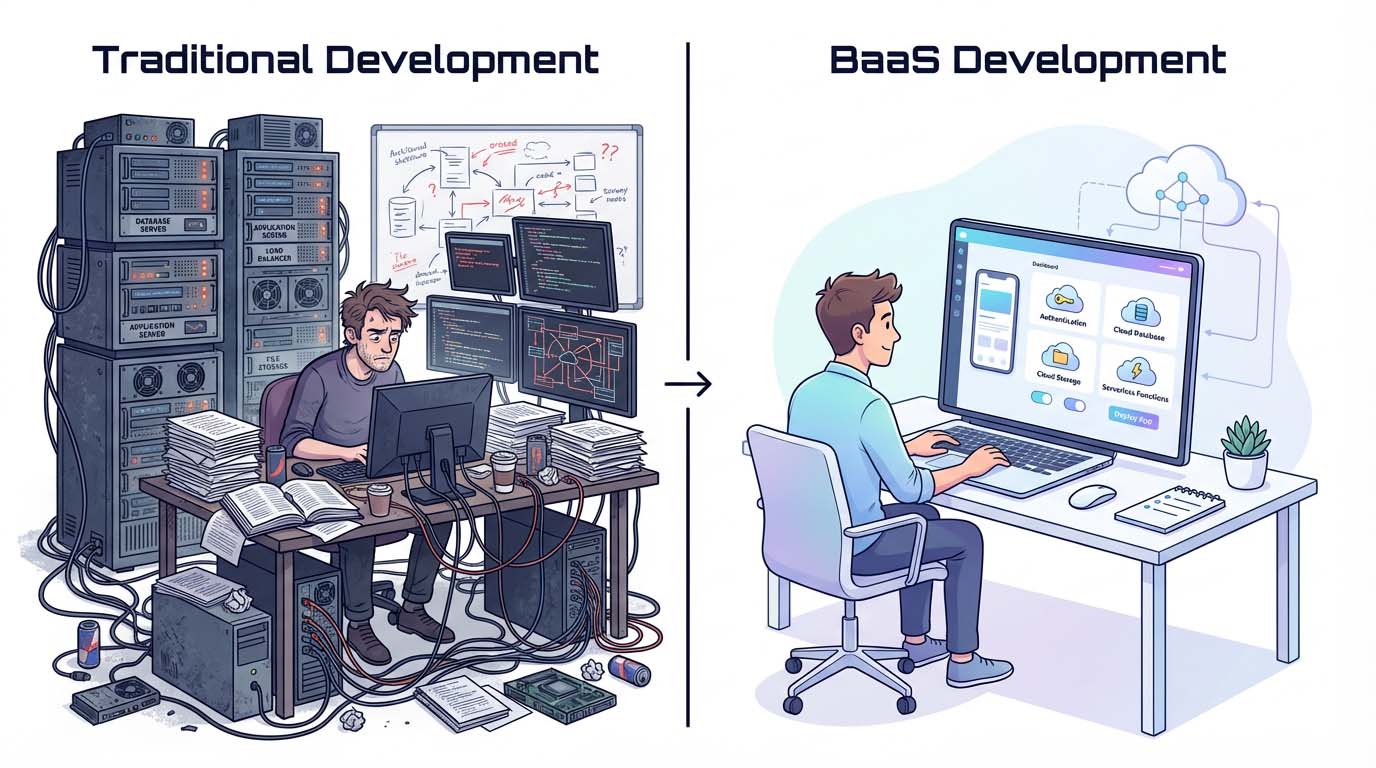
Choosing between Backend as a Service and traditional backend development represents one of the most significant architectural decisions in modern software projects. Traditional backends offer maximum control and customization, requiring developers to provision servers, configure databases, and build APIs from the ground up. BaaS platforms, conversely, provide pre-configured infrastructure that dramatically reduces development time but introduces certain trade-offs around flexibility and vendor dependency. The decision impacts everything from your development timeline and budget to long-term scalability and team requirements. This comparison builds upon the foundational concepts covered in our Backend as a Service guide, helping you weigh these approaches against your specific project constraints and business objectives.
Development speed and time to market
The most immediate difference between BaaS and traditional backend development shows up in your project timeline. With traditional backend development, you start from a blank canvas. You select a programming language, choose a web framework, set up a development environment, configure a database, implement authentication from scratch, build API endpoints, write tests, and deploy everything to servers you’ve provisioned.
This process typically takes weeks or months, even for experienced developers building relatively straightforward applications. Each component requires research, implementation, testing, and debugging. Authentication alone can consume a week of development time when you factor in password hashing, session management, password reset flows, and email verification.
BaaS platforms compress this timeline dramatically. The authentication system exists already, tested by thousands of applications. The database is configured and ready to use. APIs generate automatically based on your data structure. Many entrepreneurs launch functional MVPs within days using BaaS platforms—a timeline that would be impossible with traditional backend development.
This speed advantage matters particularly when you’re testing business ideas. The faster you can get your product in front of real users, the sooner you learn whether your concept has merit. Spending three months building a custom backend for an idea that fails market validation represents a significant opportunity cost. BaaS lets you validate quickly and iterate based on real feedback.
Cost structure and financial implications
Traditional backend development often involves significant upfront costs. You’re paying for server infrastructure whether anyone uses your application or not. A modest production setup might cost $100-200 monthly for hosting, plus database hosting, storage, and potentially additional services like email delivery or caching layers.
Beyond infrastructure, there’s the development cost. If you’re hiring developers, backend development represents months of salary. Even as a solopreneur building everything yourself, your time has value. The months spent building backend infrastructure are months not spent on marketing, customer development, or revenue generation.
BaaS platforms typically use usage-based pricing. You pay based on database operations, API calls, storage consumed, and bandwidth transferred. For new projects with low traffic, this often means starting at zero or near-zero monthly costs. As your application grows and generates revenue, your backend costs scale proportionally.
This pricing model reduces financial risk for bootstrapped entrepreneurs. You’re not committing to fixed monthly infrastructure costs before knowing whether your business will succeed. The trade-off is that heavy usage can become expensive on some BaaS platforms, making cost projection important as you scale.
There’s also the hidden cost of maintenance. Traditional backends require ongoing security patches, performance optimization, backup management, and infrastructure monitoring. BaaS platforms handle all of this, freeing your time for product development and business growth. For solopreneurs especially, this time savings often justifies BaaS costs even when absolute dollar amounts seem higher.
Flexibility and customization capabilities
Traditional backend development gives you complete architectural freedom. You can structure your database exactly how you want, implement any authentication scheme, build APIs that follow any convention, and integrate with any third-party service. If your application has unique requirements or complex business logic, this flexibility can be essential.
BaaS platforms make architectural decisions for you. The database works a certain way. Authentication follows specific patterns. APIs use the platform’s conventions. For most applications, these opinionated choices work perfectly fine—they’re based on industry best practices and battle-tested at scale. But edge cases exist where BaaS limitations become problematic.
To fully appreciate how these two approaches differ, it helps to first understand what BaaS actually is as a system — its layers, core components, and how it handles everything from authentication to real-time data. The complete Backend as a Service guide covers this foundation in detail, giving you a clearer lens through which to evaluate the practical differences between BaaS and building a backend the traditional way.
Consider a fintech application with complex transaction logic, or a healthcare platform with strict data residency requirements, or an enterprise system that needs to integrate with legacy databases. These scenarios often require customization that BaaS platforms don’t easily accommodate. You might find yourself working around platform limitations rather than building optimal solutions.
Most modern BaaS platforms recognize this and provide escape hatches. Serverless functions let you write custom backend logic. Some platforms support custom database schemas or let you bring your own database. Others offer self-hosted versions that give you BaaS convenience with traditional backend control. Understanding these options helps you evaluate whether a platform’s flexibility meets your specific needs.
Scalability and performance characteristics
Both BaaS and traditional backends can scale to handle significant traffic, but they scale differently. Traditional backends typically scale vertically (upgrading to more powerful servers) or horizontally (adding more servers). You control the scaling strategy, which means you can optimize for your specific traffic patterns and performance requirements.
BaaS platforms handle scaling automatically. As your traffic increases, the platform allocates more resources. This automatic scaling eliminates a major operational burden—you don’t need to monitor server capacity or wake up at 3 AM because traffic spiked and your server crashed. The platform manages all of that infrastructure complexity.
The downside is less control over performance optimization. With traditional backends, you can fine-tune database queries, implement sophisticated caching strategies, optimize specific API endpoints, and structure your infrastructure exactly for your traffic patterns. BaaS platforms provide less granular control, though most include built-in optimization features.
For most applications, BaaS performance is more than adequate. Platforms like Firebase serve applications with millions of users. Performance problems typically emerge from poor data modeling or inefficient queries rather than platform limitations. The key is understanding your performance requirements and whether a BaaS platform’s approach aligns with them.
Security and compliance considerations
Security represents a critical concern for any backend architecture. Traditional backends place security responsibility entirely on you. You implement authentication securely, protect against SQL injection, configure HTTPS properly, manage API keys, set up firewalls, and stay current on security patches. This control lets you implement exact security requirements, but also introduces risk if you lack security expertise.
BaaS platforms provide security features out of the box. Authentication systems use industry-standard encryption. Databases include built-in protection against common attacks. APIs enforce HTTPS automatically. The platform provider handles security patches and compliance certifications. For entrepreneurs without dedicated security expertise, this dramatically reduces risk.
However, compliance requirements sometimes necessitate specific security implementations. Healthcare applications need HIPAA compliance, financial applications require specific audit trails, European users demand GDPR-compliant data handling. While major BaaS platforms support these standards, you need to verify that your chosen platform meets your regulatory requirements. Traditional backends give you complete control to implement any compliance requirement, assuming you have the expertise.
Team skills and learning curve
Traditional backend development requires full-stack expertise or a dedicated backend developer. You need to understand server administration, database design, API architecture, security best practices, and deployment processes. For technical founders, this might be manageable. For entrepreneurs without programming backgrounds, it represents a significant barrier.
BaaS platforms lower the technical barrier considerably. If you can write basic JavaScript or Python, you can build functional backend-powered applications using BaaS. The platforms abstract away most complexity, providing SDKs that feel natural and documentation designed for developers at all skill levels. This accessibility enables solopreneurs to build applications they couldn’t create otherwise.
The learning curve exists either way. Traditional backend development requires learning multiple technologies and concepts. BaaS platforms require learning the platform’s specific approach and conventions. The difference is scope—BaaS knowledge is narrower and more focused, making it faster to reach productivity.
Long-term maintenance and operational overhead
Traditional backends require ongoing maintenance. Servers need updates, databases need optimization, monitoring systems need configuration, backups need management, and scaling requires planning. Even after your application launches, backend infrastructure demands regular attention. For solopreneurs, this operational burden competes with product development and business growth.
BaaS platforms eliminate most operational work. The provider handles infrastructure maintenance, security updates, performance optimization, and scaling. You focus on your application logic and user experience rather than infrastructure concerns. This reduction in operational overhead lets small teams accomplish what would traditionally require larger engineering organizations.
The trade-off is reduced visibility into infrastructure. When problems occur with BaaS platforms, you’re dependent on the provider’s support and resolution timeline. With traditional backends, you can investigate and fix issues directly. For most entrepreneurs, especially in early stages, the reduced operational burden outweighs this loss of control.
Making the right choice for your project
Neither approach is universally superior. Traditional backend development makes sense when you need maximum flexibility, have specific technical requirements that BaaS platforms don’t support, or possess the team and resources to build and maintain custom infrastructure effectively. It’s often the right choice for well-funded companies building complex, unique systems.
BaaS platforms excel when speed matters, when you’re testing business ideas, when your team is small or lacks backend expertise, or when you’d rather focus on product differentiation than infrastructure. They’re particularly compelling for solopreneurs and early-stage startups where time and resources are constrained.
Many successful companies start with BaaS and migrate to custom backends only after validating their business model and securing resources to support infrastructure complexity. Others use hybrid approaches, leveraging BaaS for standard features while building custom solutions for truly unique requirements.
Understanding both the benefits and limitations of each approach helps you make informed decisions aligned with your specific situation, skills, and business goals. The architectural choice you make today isn’t permanent—successful products evolve their technical infrastructure as their needs and resources change.
Now that you understand how these approaches differ in practice, evaluating the specific advantages and disadvantages of BaaS becomes essential. While the comparison reveals general trade-offs, examining the concrete benefits and potential drawbacks of Backend as a Service helps you assess whether this approach fits your particular circumstances and risk tolerance.
About the Author

AISalah
Bridges linguistics and technology at PointOfSaaS, exploring AI applications in business software. English Studies BA with hands-on back-end and ERP development experience.
Did you find this helpful?
Your feedback helps us curate better content for the community.