

ProofHub comes up a lot in conversations about project management tools for small businesses. It gets mentioned in founder Slack groups, in SaaS comparison threads, in discussions between entrepreneurs who are tired of paying for five different subscriptions that barely talk to each other.
The name circulates. But when I ask founders who bring it up what ProofHub actually does how it organizes work, what the daily experience inside it looks like, what kind of operation it was built for the answers get vague pretty quickly.
Most people know ProofHub exists. Far fewer have a clear picture of what it is.
That gap matters more than it might seem because ProofHub is not a neutral, flexible tool that adapts to every workflow and every team. It is a product with a specific design philosophy one that delivers genuine value for certain types of businesses and creates friction for others. Understanding which category your business falls into before you sign up for a trial saves weeks of evaluation time and one more abandoned subscription.
The one-line answer then the real one
The one-line answer is that ProofHub is an all-in-one project management and team collaboration platform that charges a flat monthly fee regardless of how many users are on the account.
That sentence is accurate. It is also not enough to make a useful evaluation decision.
The real answer requires understanding what “all-in-one” actually means in ProofHub’s case because the term gets used loosely in SaaS marketing to describe everything from a robust multi-function platform to a basic tool with a few extra tabs.
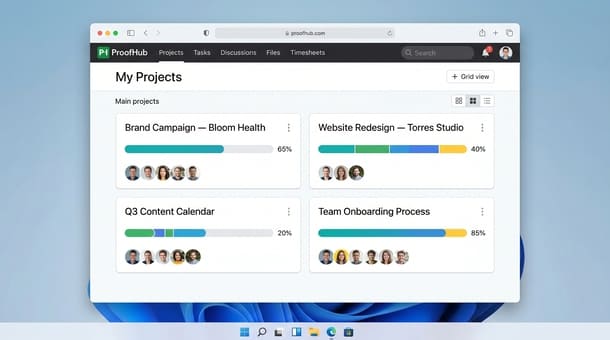
In ProofHub’s case all-in-one means six distinct functions in a single workspace. Task management with multiple views list, kanban, Gantt and table. Team communication through group discussions and one-to-one messaging organized by project. Time tracking connected directly to individual tasks rather than running as a parallel system. Client-facing proofing and approval workflows for creative deliverables. File storage organized within projects. And basic reporting on project progress and team time.
Those six functions are what ProofHub is used for. The question of whether they add up to the right tool for your business depends on which of those functions actually matter for your operation.
Who ProofHub was genuinely built for
ProofHub was designed for a specific type of small business operator and the product makes the most sense when you understand that design intent rather than evaluating it against a general purpose checklist.
The clearest fit is agencies. Design agencies, marketing agencies, content agencies, PR firms any business that manages multiple simultaneous client projects, moves creative deliverables through review and approval cycles and needs to track how team hours are allocated across different client engagements. ProofHub’s combination of project management, proofing tools and time tracking addresses the three core operational pain points of agency work in a single subscription.
Consultancies and professional service businesses are a strong second fit. When client delivery involves defined project phases, deliverables that need sign-off and billing tied to hours worked the three operational functions ProofHub consolidates project tracking, proofing and time tracking map directly to how that work flows.
Remote and distributed teams benefit from ProofHub’s communication layer being built directly into the project workspace rather than living in a separate tool. Discussions about a project happen inside the project rather than in a general Slack channel where they drift away from context. Files live alongside the tasks they support rather than in a separate Drive folder that requires a separate search.
Early-stage startups trying to avoid the tool fragmentation problem before it gets established are also a natural fit. Signing up for separate tools for project management, communication, time tracking and client collaboration before the team reaches five people means paying for and maintaining four subscriptions, four onboarding processes and four integrations that may or may not work cleanly together. ProofHub consolidates all of that from day one.
What ProofHub is not the honest part
Every honest product assessment requires naming what the tool is not built for as clearly as what it is.
ProofHub is not a task management specialist. If your primary need is highly granular task architecture nested subtasks, complex dependency chains, custom fields, conditional automation rules, detailed sprint planning ClickUp and Asana go deeper in that specific direction. ProofHub’s task management is solid for most small business workflows but it is not the most customizable option in the market.
ProofHub is not a communication replacement at the same depth as Slack. For teams that have built strong operational habits around Slack’s threading, channel structure and extensive integration library ProofHub’s discussion feature will feel more limited. It is functional and project-contextual but it does not replicate the full Slack experience. If Slack is deeply embedded in how your team communicates and collaborates ProofHub works alongside it rather than replacing it entirely.
ProofHub is not a field operations or construction management tool. The product was built for knowledge work digital deliverables, client communication, creative review rather than site-based or physical operations. Contractors managing crews, builders coordinating subcontractors and similar field-heavy businesses are better served by tools built specifically for that context.
ProofHub is not the cheapest option for very small teams. At three to five people the flat-fee pricing at $45 per month may be higher than what per-user alternatives cost at the same team size. The financial advantage of the flat-fee model only becomes meaningful somewhere between eight and twelve users where per-user pricing from competitors starts climbing past ProofHub’s fixed rate.
The flat fee model and what it actually means
Most project management tools charge per user. Every team member added to the account increases the monthly invoice. That model is straightforward and it works well for businesses with stable, small teams. It becomes punishing for businesses that are growing because every hire comes with a software cost attached.
ProofHub’s flat-fee model is the most distinctive thing about the product’s positioning in the market and it is worth understanding specifically rather than abstractly.
At $45 per month on the Essential plan the cost is identical whether you have three users or thirty. At $89 per month on the Ultimate Control plan the same principle applies. ProofHub’s cost does not grow with your headcount. That is genuinely unusual in the project management category and it is the primary reason the product gets recommended in conversations about scaling small businesses that want operational predictability.
The trade-off is that the flat fee requires a larger upfront commitment than paying $7 or $10 per user for a smaller team. A two-person operation paying $45 per month for ProofHub is paying more per user than they would on most alternatives. The break-even point where ProofHub becomes cheaper than per-user alternatives depends on the specific tool being compared but tends to arrive somewhere around eight to twelve users for most realistic comparisons.

The specific problems ProofHub is designed to solve
Beyond defining what the tool is it helps to name the specific operational problems it was built to address because that framing tells you more about fit than any feature list.
The fragmented tool stack problem. A small agency or consultancy managing client work through four separate tools a project manager, a communication platform, a time tracker and a review tool spends real time every week moving information between them, managing four separate subscriptions and maintaining four different onboarding processes for new team members. ProofHub was built to collapse that fragmentation into a single workspace.
The client review chaos problem. Creative businesses that deliver design, content or marketing work to clients almost universally struggle with the feedback process. Feedback arrives via email with descriptions like “the thing on the left should be bigger” attached to no specific reference point. Versions get confused. Approvals get missed. ProofHub’s proofing tool attaches feedback directly to the specific element being referenced and tracks approval status so nothing gets signed off accidentally or bypassed.
The invisible time problem. Service businesses that bill by the hour often discover at the end of a project that the hours they tracked do not add up to the hours they actually worked because time tracking was happening in a separate system that nobody logged into consistently. When time tracking lives in the same place as the task it relates to the habit of logging time forms more naturally.
The project visibility problem. Founders managing multiple concurrent projects often spend Friday afternoons mentally reconstructing where everything stands rather than reading it from a system that is current. ProofHub’s project dashboard and reporting give that consolidated view without requiring anyone to produce a status update on demand.
Before evaluating any specific feature or pricing tier understanding whether ProofHub is the right productivity tool for your specific type of small business operation changes how every subsequent comparison gets made because the right tool is the one that solves the problems your business actually has, not the one with the longest feature list.
ProofHub is used for project management, team collaboration, time tracking and client-facing file review in a single flat-fee workspace designed for small to mid-sized businesses that want to stop managing multiple separate tools for those functions.
It is a particularly strong fit for agencies, consultancies, remote teams and any small business moving creative work through client review and approval cycles. It is a less obvious fit for businesses with simple task-only needs, very small teams where per-user pricing remains competitive or technical teams requiring complex dependency management and sprint tracking.
The evaluation is not complicated once the design intent is clear. Does your business manage the types of projects ProofHub was built for? Does your team size make the flat-fee model financially sensible? And does the consolidation of project management, communication, time tracking and proofing into one workspace solve a real fragmentation problem your operation is currently experiencing?
If the answer to those three questions is yes ProofHub is worth a serious trial. If the answer to any of them is no the right starting point is a different evaluation entirely.
Once the fit is clear the natural next question is which specific ProofHub features deliver the most time savings in daily operation — and that breakdown, including the proofing workflow most evaluation articles underemphasize, is exactly what ProofHub features for small teams: what actually saves time in 2026 covers in full.
About the Author

Pamela
Pamela is a dynamic professional with a deep passion for SaaS and emerging technologies. She provides valuable insights into software trends, digital innovation, and cutting-edge tools that empower businesses to thrive and expand.
Did you find this helpful?
Your feedback helps us curate better content for the community.