
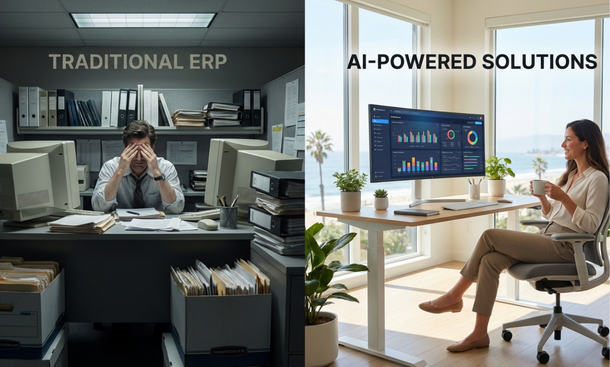
Why this comparison actually matters for your business
If you’ve been running your California business on a traditional ERP system — or you’re evaluating your first ERP purchase and feeling torn between legacy platforms and newer AI-powered ones — this comparison is going to save you a lot of time and second-guessing.
The ERP software market is packed with vendors, each claiming their platform is the most powerful, most intuitive, and best value for money. But most of the noise skips over the fundamental architectural difference between systems built before machine learning became practical and the ones built after.
That difference is not cosmetic. It changes how your business operates on a daily basis, how fast your team moves, and how clearly you can see what’s coming next.
How traditional ERP systems were built
Traditional ERP platforms were engineered around a straightforward principle — centralize your business data so every department works from the same source of truth. For the 1990s and early 2000s, this was genuinely revolutionary. Companies that had been running finance in one silo and operations in another suddenly had a connected system.
Platforms like SAP R/3, Oracle E-Business Suite, and Microsoft Dynamics dominated this era. They were powerful, comprehensive, and deeply customizable. They were also expensive, slow to implement, and built on the assumption that your business processes would stay relatively stable once the system was configured.
The typical implementation looked like this: a business would spend six to eighteen months working with a team of consultants to configure the software around their existing workflows. Once live, the system recorded transactions, stored data, and generated reports. If you wanted to change something — add a new workflow, modify a report, integrate a new tool — you called the consultant back.
The core limitation was not power. These systems had plenty of that. The limitation was responsiveness. Traditional ERP was built to record and report. It was not built to learn, adapt, or anticipate.
What changed when AI entered the ERP space
The shift started becoming commercially significant around 2018 and has accelerated sharply since. Modern AI ERP platforms introduced three capabilities that fundamentally change the user experience and business value of the software.
Predictive intelligence Instead of showing you historical data, the system analyzes patterns in your data and surfaces predictions. Your demand forecast updates automatically based on seasonality, market signals, and your own sales history. Your cash flow projection adjusts when it detects a pattern that historically precedes a slow payment cycle.
Automation that learns Traditional ERP automates rules you define manually — if inventory drops below 50 units, trigger a reorder. AI ERP refines those rules over time based on outcomes. It notices that your Thursday reorders consistently arrive late from one vendor and starts adjusting lead time calculations automatically.
Natural language and conversational interfaces Many modern AI ERP platforms now let team members query business data in plain language. Instead of navigating through five menu layers to pull a report, a team member types a question and the system surfaces the answer. This removes a significant training and adoption barrier for small teams.
Head-to-head: where the real differences show up
Let’s put both systems side by side across the areas that matter most to a California entrepreneur running a growing business.
Implementation speed Traditional ERP implementations average six to eighteen months for mid-size businesses. Cloud-based AI ERP platforms can go live in weeks for small businesses, with modular onboarding that lets you activate features as you need them.
Cost structure Legacy ERP carries heavy upfront licensing fees, infrastructure costs if hosted on-premise, and ongoing consultant fees for customization. AI ERP typically runs on a SaaS subscription model — monthly or annual per-user pricing — with no server infrastructure required.
Scalability Traditional ERP scales, but usually through expensive upgrade cycles. AI ERP is designed to scale dynamically. You add users, activate modules, and expand to new markets without rebuilding the foundation.
Data insights This is where the gap is widest. Traditional ERP gives you reports. AI ERP gives you forecasts, anomaly alerts, and optimization recommendations. One tells you what happened. The other tells you what to do next.
User adoption Traditional ERP has a notoriously steep learning curve. Studies have consistently shown user adoption as the top failure factor in legacy ERP implementations. Modern AI ERP platforms invest heavily in intuitive UX, role-based dashboards, and guided workflows that reduce onboarding friction significantly.
Integration with modern tools A California startup in 2025 is likely using Shopify, Stripe, Slack, a payroll platform, and possibly a custom CRM. AI ERP platforms are built with open APIs, meaning they connect to these tools natively. Traditional ERP often requires custom middleware — software that acts as a bridge between systems — to achieve the same result.
The hidden costs of staying on legacy ERP
This is the conversation most ERP vendors won’t have with you directly. If you’re currently on a traditional ERP platform, the visible cost is your annual license or maintenance fee. The hidden cost is harder to quantify but very real.
Manual workarounds accumulate. When your ERP can’t do something natively, your team builds a workaround. That workaround becomes a habit. That habit becomes a process no one fully understands when the person who built it leaves the company.
Reporting delays slow decisions. When your financial close takes two weeks because data has to be pulled and reconciled manually, you’re making growth decisions on stale information. In a fast-moving California market, that lag is a competitive disadvantage.
Integration debt grows. Every new tool your team adopts that doesn’t connect cleanly to your legacy ERP creates another data silo. Over time, you end up back where you started — multiple disconnected systems and no unified source of truth.
Talent friction is real. Younger operations and finance professionals expect modern tooling. If your internal systems feel dated, it affects hiring and retention in a state where talent competition is already fierce.
What California entrepreneurs are actually choosing in 2025
The trend is clear. Across California’s startup ecosystem — from pre-Series A SaaS companies in San Francisco to e-commerce brands scaling out of Los Angeles — founders are prioritizing AI-native ERP platforms over legacy systems at a rate that would have been surprising just three years ago.
The drivers are practical. Lower entry cost, faster implementation, and the operational leverage that intelligent automation provides make the business case straightforward for a founder managing a lean team with aggressive growth targets.
Platforms like NetSuite, Odoo, and Acumatica are seeing strong adoption across California’s small and mid-size business segment. Each takes a slightly different approach to AI integration, pricing, and industry focus — which is exactly why platform selection deserves its own dedicated evaluation.
That evaluation becomes significantly easier once you’ve moved past the foundational question of which type of system to pursue.
The choice between AI ERP and traditional ERP is not really a debate anymore for most California startups and growing small businesses. The architecture, the cost model, the implementation timeline, and the day-to-day usability all favor AI-native platforms for businesses operating at the speed and scale that California’s market demands.
Where the real decision-making work begins is in choosing the right AI ERP platform for your specific business — your industry, your team size, your integration needs, and your growth roadmap.
For the broader strategic context on why California entrepreneurs are accelerating adoption of these platforms, the complete guide to AI-driven ERP systems for California entrepreneurs ties the full picture together across platforms, costs, automation, and future trends.
When you are ready to move from understanding the difference to actually choosing a platform, the next step is Best AI ERP Platforms for Small Business in California.
About the Author

mike
Mike is a tech enthusiast passionate about SaaS innovation and digital growth. He explores emerging technologies and helps businesses scale through smart software solutions.
Did you find this helpful?
Your feedback helps us curate better content for the community.