
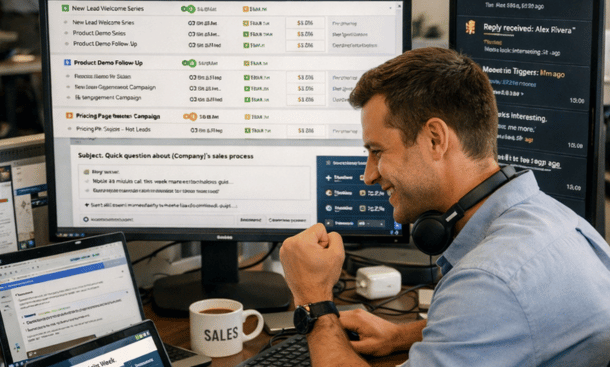
Sales outreach automation separates consistent revenue growth from the feast-or-famine cycle most entrepreneurs experience. Manual outreach doesn’t scale because there’s only so many personalized emails one person can write daily before quality drops off a cliff. AI changes the equation by generating personalized messages at scale, timing follow-ups based on engagement signals, and adapting sequences based on prospect behavior. The difference shows up in response rates that stay consistently above 20 percent instead of declining as you increase volume. To see how outreach automation fits into your broader sales strategy, our complete guide on automating sales processes with AI walks through the entire framework from prospecting through close.
Why manual outreach eventually fails everyone
The math problem with manual sales outreach becomes obvious once you do the calculation. A well-crafted personalized email takes 10 to 15 minutes when you research the prospect, identify relevant talking points, and write something that doesn’t sound templated. That means you can send maybe 20 to 25 quality emails in a four-hour prospecting block.
If you’re getting a 15 percent response rate, those 25 emails generate three to four conversations. To book one meeting, you need those responses plus two or three follow-ups per prospect over the next week. The follow-up sequences add another hour or two daily. You’re spending 20 to 25 hours weekly on outreach to book maybe four or five meetings.
The volume constraints force a choice between personalization and reach. You can send highly personalized emails to a small list, or you can blast generic templates to larger audiences. Both approaches have obvious problems. Small volume limits your pipeline. Generic templates get ignored or marked as spam.
Consistency becomes impossible to maintain manually. You have good weeks where you stay disciplined with outreach and follow-up. Then deals heat up, you’re in back-to-back meetings, and prospecting falls off for a week. Your pipeline empties and the cycle repeats. Most sales organizations never escape this pattern without automation.
How AI solves the personalization-at-scale problem
AI outreach platforms analyze prospect data to generate personalized messages that reference specific, relevant details about each recipient. The technology pulls information from LinkedIn profiles, company websites, recent news mentions, and other public sources to find hooks for your outreach.
Instead of writing “I noticed your company is growing” to everyone, the AI might reference a prospect’s recent LinkedIn post, a press release about their funding round, or a job opening that indicates expansion in a specific department. These specific references dramatically improve response rates because they prove you did actual research.
The personalization goes beyond just inserting custom fields. Advanced AI writes entire message variations based on different prospect attributes. Someone in healthcare gets messaging focused on compliance and security. A prospect in e-commerce sees examples relevant to online retail challenges. The tone and length adjust based on seniority level and industry norms.
This level of customization would be impossible manually at any meaningful scale. The AI handles hundreds or thousands of variations while you define the strategic framework once. You set the core value proposition, key talking points, and desired tone. The system adapts those elements for each individual prospect.
Building sequences that actually convert
Effective outreach sequences require multiple touchpoints across different channels over a defined period. Single emails rarely work anymore because busy prospects miss messages or forget to respond even when interested. A structured sequence increases the chances of catching someone at the right moment.
Start with a clear objective for your sequence. Are you trying to book discovery calls? Get prospects to attend a webinar? Have them download a resource? The sequence structure changes based on your goal. Discovery call sequences typically run seven to ten touches over two weeks. Content download sequences might be three to four touches over five days.
Your first message needs to accomplish three things in under 100 words: explain who you are, why you’re reaching out to them specifically, and what you want them to do. Skip the company history and feature lists. Lead with a specific problem you’ve seen similar companies facing and how you’ve helped solve it.
Structuring your follow-up cadence
Follow-ups can’t just say “bumping this to the top of your inbox.” Each message needs to provide new value or a different angle. Your second email might share a relevant case study. The third could ask a provocative question about their current approach. The fourth offers a specific insight you noticed about their business.
Timing matters more than most people realize. Don’t send all your follow-ups at the same time of day. If your first email goes out Tuesday at 10am and gets no response, try Thursday at 2pm for the follow-up. Different prospects check email at different times, and varying your send schedule increases the chance of catching them when they’re receptive.
Channel variation keeps your outreach from feeling overwhelming. Don’t send seven straight emails. Mix in LinkedIn connection requests, InMail messages, phone calls, and even video messages. Multi-channel sequences get higher response rates because you’re meeting prospects where they actually spend attention.
Break patterns with your last message in the sequence. Most people send a “should I take you off my list” breakup email that feels manipulative. Instead, offer something genuinely valuable with no strings attached. Share a relevant article, introduce them to someone useful in your network, or offer feedback on something you noticed about their website. This goodwill often generates responses even when previous messages didn’t.
Triggers that make sequences intelligent
Basic automation sends messages on fixed schedules regardless of what prospects do. AI-powered sequences adapt based on engagement signals and behavior changes. This intelligence dramatically improves relevance and conversion rates.
Engagement triggers adjust your sequence when prospects take actions that indicate interest. If someone opens your first three emails but doesn’t respond, that’s a signal of passive interest. The AI might pause the sequence and wait for stronger buying signals before resuming, or it might adjust to more direct calls-to-action since they’re clearly reading your messages.
Website visit triggers change everything. When a prospect visits your pricing page or product demo after receiving your email, they’ve moved into active evaluation mode. The sequence should recognize this immediately and accelerate follow-up timing while the interest is hot. Maybe send your next message within hours instead of waiting two days.
Negative signals matter too. If someone unsubscribes or marks your email as spam, obviously remove them immediately. But subtler signals also warrant attention. A prospect who previously opened every email but suddenly stops engaging for two weeks might need a longer pause before resuming outreach. The AI recognizes pattern changes and adjusts accordingly.
Job change triggers create new opportunities. When your prospect changes companies, that might end the current opportunity but create a fresh one at their new organization. AI monitors for these changes and can automatically update contact information and restart sequences with relevant messaging about their new role.
Writing templates that don’t sound like templates
The biggest giveaway that you’re using automation is language that sounds stiff, formal, or generic. Real emails between humans are conversational, occasionally imperfect, and specific to the context. Your automated templates need to maintain that natural quality.
Write the way you actually talk. Read your templates out loud. If you’d never say something in a real conversation, don’t put it in your email. Phrases like “I hope this email finds you well” or “I wanted to reach out” are dead giveaways of templated outreach. Just start with your actual point.
Use variable fields strategically, not excessively. Inserting someone’s first name seven times in a short email feels forced. Reference one or two specific details about them or their company that demonstrate research, then focus on the value you’re offering. The specificity should feel natural, not like you’re showing off how much data you collected.
Keep sentences short and punchy. Long, winding sentences full of subclauses and qualifiers make your email harder to read and easier to ignore. Get to your point quickly. Use line breaks generously. Make your email scannable because most prospects skim before deciding whether to actually read.
Embrace minor imperfections that make messages feel human. An email that’s too polished looks automated. Starting sentences with “and” or “but,” using contractions, and occasionally bending grammar rules makes your writing sound more natural. The goal is professional but conversational, not corporate and stiff.
Testing and optimizing for better results
Launch your sequences with small test groups before rolling out to your entire prospect list. Send your sequence to 50 to 100 prospects first and closely monitor results. Response rates, reply sentiment, and conversion metrics from these early tests show what’s working and what needs adjustment.
A/B test one variable at a time. Try different subject lines while keeping message content the same. Test varying message length. Experiment with different calls-to-action. Sequential testing reveals which elements actually impact response rates versus changes that make no difference.
Track metrics beyond just response rate. What percentage of responses are positive versus negative or dismissive? How many conversations turn into booked meetings? What does the path from first email to closed deal look like? These downstream metrics matter more than vanity numbers about opens and clicks.
Response time analysis shows when prospects are most receptive. If you’re getting significantly more responses to emails sent Tuesday and Thursday mornings versus Friday afternoons, adjust your sending schedule accordingly. The AI can learn these patterns automatically, but manual analysis in the early stages helps you understand your audience.
Refine your messaging based on common objections or questions that come up in responses. If multiple prospects ask about pricing before agreeing to a call, consider addressing pricing expectations earlier in your sequence. When you see patterns in the responses you’re getting, use that feedback to improve your templates.
Building effective automated outreach takes iteration and ongoing optimization, but the payoff in consistent pipeline generation makes it one of the most valuable automations you can implement. Once you’ve got prospects engaging with your outreach, the next challenge involves handling those initial conversations efficiently without overwhelming your calendar. Our guide on using AI sales assistants shows you how to automate qualification conversations and meeting scheduling so your team only talks to prospects who are actually ready to buy.
About the Author

Mateo
I’m Mateo, a SaaS blogger and digital strategist dedicated to helping startups accelerate growth through automation, data-driven decision-making, and performance-focused marketing systems. Over the past few years, I’ve worked with early-stage software companies to refine their go-to-market strategies, optimize conversion funnels, and implement scalable automation frameworks that drive measurable revenue growth. On my blog, I share proven insights from real-world SaaS cases, including actionable frameworks for churn reduction, onboarding optimization, and lead-to-customer conversion. My mission is simple: to empower founders and marketers with practical strategies that turn innovative software into sustainable, profitable success.
Did you find this helpful?
Your feedback helps us curate better content for the community.