
A founder lands their first corporate client. Then the second. Then the tenth.
Suddenly there are fifty different companies using the same app, each with their own users, permissions, billing cycles, and data privacy requirements.
This is where most early-stage SaaS products break down. The app was built for individual users, not for organizations with twenty employees who all need different access levels and separate data environments.
The technical solution is called multi-tenancy, the backend architecture that keeps each customer’s data completely isolated while running everything from a single codebase and infrastructure. Without it, serving multiple companies means spinning up separate versions of the app for every client, which would bankrupt most startups before they hit twenty customers.
Multi-tenancy is what makes B2B SaaS financially viable. It’s the difference between an app that can serve ten companies and an app that can serve ten thousand without multiplying infrastructure costs.
Choosing a backend that handles multi-tenancy cleanly is one of the most important architectural decisions a founder makes when building a subscription business designed to serve companies instead of individual consumers.
What multi-tenancy means for B2B SaaS
Multi-tenancy is the architectural pattern where a single application serves multiple customers, called tenants, while keeping their data completely separate.
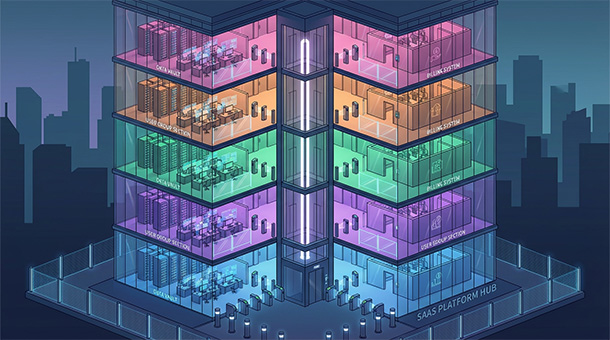
Think of it like an office building. One building. Multiple companies renting different floors. Each company has its own locked office space, its own files, its own employees. They share the elevator and the utilities, but they never see each other’s data or operations.
In software terms, this means one database serving multiple companies, with strict rules ensuring Company A can never access Company B’s information. One codebase powering everyone’s experience, but with data isolation enforced at the database level.
The alternative is single-tenancy, where each customer gets their own separate instance of the application with its own database and its own infrastructure. This sounds safer, but it’s financially unsustainable for most startups. If infrastructure costs $200 per month per customer, serving fifty customers means $10,000 in monthly hosting fees before making a single dollar in profit.
Multi-tenancy flips this equation. Fifty customers share the same infrastructure. Hosting costs might be $500 total. The gross margin goes from negative to 90%+.
This is why every major B2B SaaS platform from Salesforce to Slack to Notion runs on multi-tenant architecture. It’s not just a technical preference. It’s the economic foundation that makes SaaS business models work.
How data isolation prevents catastrophic security failures
The biggest concern founders have about multi-tenancy is security. If all customer data lives in the same database, what prevents one company from accidentally seeing another company’s information?
The answer is row-level security, a database feature that automatically filters every query to show only the data belonging to the tenant making the request.
When a user from Company A logs in and requests a list of projects, the database doesn’t just return all projects. It returns only the projects where tenant_id matches Company A’s unique identifier. The filtering happens automatically at the database level, not in application code where mistakes can happen.
Modern backends like Supabase enforce row-level security by default. Every database table can have security policies that define who can read, write, update, or delete specific rows. These policies are checked on every single database operation, regardless of what the application code tries to do.
This means even if application code has a bug that tries to fetch the wrong tenant’s data, the database blocks it. Security is enforced at the infrastructure level, not the application level.
This architectural approach is far more secure than trying to filter tenant data in application code, where a single missed check or typo in a query can expose sensitive information. Database-level isolation means security doesn’t rely on perfect code. It’s baked into the infrastructure.
Why multi-tenancy enables enterprise features without enterprise costs
Enterprise customers expect features that individual users don’t need. Team management. Role-based permissions. Audit logs. Single sign-on. Custom branding.
Building these features for a single-tenant architecture means implementing them separately for each customer, which is prohibitively expensive. Building them for a multi-tenant architecture means implementing them once and enabling them for all customers.
A founder adds role-based permissions to the app. Instantly, every tenant can assign their users as admins, editors, or viewers. The feature scales automatically because the architecture is designed for it.
The same pattern applies to usage analytics, billing management, and compliance features. Build once, deploy for all tenants. The development cost is fixed. The business value multiplies with every new customer.
Multi-tenancy also makes it easier to offer tiered pricing. A startup plan might limit a tenant to five users. An enterprise plan might allow unlimited users. The same codebase supports both. The backend just checks the tenant’s subscription level and enforces the appropriate limits.
Without multi-tenancy, offering multiple pricing tiers means maintaining multiple versions of the application, which quickly becomes a maintenance nightmare.
Multi-tenancy is a critical architectural decision, but it’s one of six interconnected factors that determine whether a subscription backend can grow with your revenue. The platform you choose to enforce tenant data isolation is the same one handling your API integrations, frontend communication, structured data, progressive web app performance, and social authentication. If you’re still evaluating which backend fits your overall business model, How to Pick a Backend That Grows With Your Revenue walks through all six of these factors together — so you can evaluate multi-tenant architecture alongside every other infrastructure decision your B2B subscription business depends on.
How poor tenant architecture kills growth opportunities
A SaaS product gains traction. A mid-sized company wants to sign up. They ask if the app supports team accounts with separate billing and user management.
The founder realizes the app was built for individual users, not organizations. Adding multi-tenancy after the fact means rewriting the entire data model, migrating existing users, and testing every feature to ensure data isolation works correctly.
The project takes six months. The deal falls through. The company goes with a competitor whose backend was designed for multi-tenancy from day one.
This scenario plays out constantly with early-stage startups that underestimate the importance of tenant architecture. The app works perfectly for solo users or small teams, but it can’t scale to serve the mid-market or enterprise customers that represent the majority of B2B revenue.
Retrofitting multi-tenancy is exponentially harder than building it correctly from the start. Every table needs a tenant_id column. Every query needs tenant filtering. Every feature needs to be tested across multiple tenants. Security policies need to be written and audited.
Founders who skip this early often spend their second year rewriting infrastructure instead of building features, while competitors with better architecture capture the market.
How to implement multi-tenancy without a database architect
Most first-time founders hear “multi-tenant architecture” and assume it requires deep database expertise. It used to. Modern backends have changed that equation.
Supabase, built on PostgreSQL, includes row-level security as a core feature. A founder creates a table for projects. They add a tenant_id column. They write a simple policy that says “users can only see rows where tenant_id matches their organization.” The database enforces this rule automatically on every query.
No custom middleware. No application-level filtering logic. No risk of accidentally exposing the wrong tenant’s data because someone forgot to add a WHERE clause.
The backend handles authentication, tenant identification, and security enforcement. The application code just makes normal database queries. The infrastructure ensures data isolation without the application needing to manage it explicitly.
This is the real advantage of building on a modern BaaS platform. Multi-tenancy goes from an architectural challenge requiring months of custom development to a configuration task that takes an afternoon.
The bottom line
Multi-tenancy is not optional for B2B SaaS. It’s the architectural foundation that determines whether a product can serve multiple companies efficiently or whether it collapses under the weight of duplicated infrastructure.
When tenant isolation is handled correctly at the database level, a single codebase can serve thousands of customers without multiplying costs or security risks. When it’s handled poorly or skipped entirely, growth becomes prohibitively expensive and enterprise deals become impossible to close.
Founders building subscription businesses aimed at companies need to implement multi-tenancy from day one, not as an afterthought when the first enterprise customer asks for it.
As your tenant count grows, the data model underneath needs to be just as organized as the isolation layer above it — here’s why structured data keeps your business operations clean at scale.
About the Author

AISalah
Bridges linguistics and technology at PointOfSaaS, exploring AI applications in business software. English Studies BA with hands-on back-end and ERP development experience.
Did you find this helpful?
Your feedback helps us curate better content for the community.