
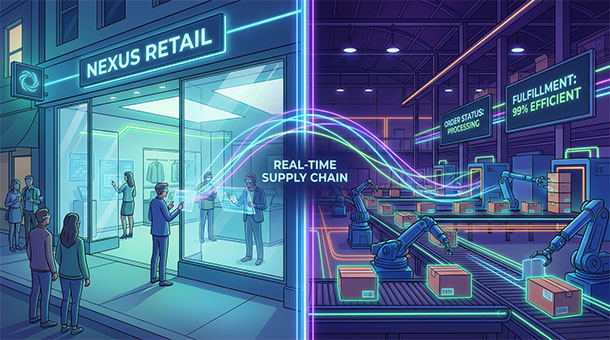
Your website looks perfect.
Clean design. Fast loading. Beautiful typography. Every button is exactly where it should be. You spent two weeks getting the landing page just right, and it shows.
Then someone clicks “sign up” and nothing happens.
Or the page loads for ten seconds and times out. Or they create an account but their information never saves. Or they pay for a subscription and the confirmation email never arrives.
This is what happens when your website and your backend don’t know how to talk to each other.
Your website is the menu. It shows people what’s available and makes everything look appetizing. Your backend is the kitchen, the accounting department, and the fulfillment center combined. It processes orders, stores customer data, handles payments, and sends confirmations.
When these two systems communicate properly, your business feels professional and reliable. When they don’t, your users see error messages, loading screens, and broken promises.
The connection between your frontend, the part of your app users see and interact with, and your backend, the server and database that store and process everything, is what transforms a pretty website into a functioning business.
Most first-time founders assume this connection “just works.” It doesn’t. The architecture you choose determines whether your app feels instant or frustrating, whether data syncs correctly or disappears into the void, and whether you can scale past your first hundred customers without everything breaking.
What it means when your website talks to your backend
Every time someone interacts with your website, dozens of conversations happen behind the scenes.
They click “save profile.” Their browser sends a message to your backend server saying “update this user’s information with these new values.” Your backend checks if they’re allowed to make that change, validates the data to make sure it’s formatted correctly, saves it to your database, and sends a confirmation back to the browser saying “done, here’s the updated profile.”
This entire conversation happens in under a second if your architecture is solid. It takes ten seconds or fails completely if your website and backend aren’t properly connected.
The technical term for this is an API, application programming interface, which is just a set of rules that lets your frontend and backend exchange information reliably. Your website asks questions. Your backend answers them. The API is the language they use to understand each other.
When this language is clear and consistent, your app works. When it’s messy or missing, users see the spinning wheel of death and assume your product is broken.
Why disconnected systems kill user experience
You’ve experienced this as a customer, even if you didn’t realize what was happening.
You fill out a long form on a website. You click submit. The page refreshes and all your information is gone. Or you update your payment method and it says “saved successfully” but next month you get a failed payment email because nothing actually updated.
These aren’t bugs in the traditional sense. They’re architecture problems. The website and the backend are technically connected, but they’re having two different conversations. The website thinks the data was saved. The backend never received it. Nobody catches the miscommunication until a user complains.
This happens constantly with poorly designed systems. The frontend developers build the website assuming the backend will handle things a certain way. The backend developers build the API assuming the frontend will send data in a specific format. Nobody documents the expectations. The two sides drift apart. Users suffer.
Modern backends like Supabase solve this by giving you a standardized API that works the same way every time. Your frontend knows exactly how to ask for data. Your backend knows exactly how to respond. The contract between them is clear, documented, and enforced automatically.
This is why choosing a backend that prioritizes clean API design is just as important as choosing one with a good database. If your website can’t communicate with your backend reliably, nothing else matters.
Real-time updates and why they require tight integration
The worst websites make you refresh the page to see new information. The best websites update instantly without you doing anything.
This difference comes down to how well your website and backend are integrated.
Let’s say you’re building a project management tool. A team member marks a task as complete. If your architecture is basic, other team members won’t see that update until they manually refresh their browsers. If your architecture is modern, the update appears on everyone’s screen instantly.
Real-time updates require your backend to push information to your frontend without being asked. This is called a WebSocket connection, a two-way communication channel that stays open so your backend can send updates the moment something changes.
Not every app needs real-time updates, but if you’re building anything collaborative, anything with live data, or anything where users expect to see changes immediately, your backend needs to support this kind of tight integration.
Supabase includes real-time features by default. When data changes in your database, your frontend is notified automatically. You don’t build the infrastructure yourself. You don’t manage servers or connections. The backend and frontend just stay in sync because the platform assumes that’s what modern apps require.
How poor integration creates hidden business costs
A slow or unreliable connection between your website and backend doesn’t just frustrate users. It costs you money in ways you won’t notice until it’s too late.
Every extra second of loading time reduces conversion rates. Studies show that a three-second delay can cut signups by 40%. If your website takes too long to talk to your backend, you’re literally losing customers before they even create an account.
Failed data syncs create support tickets. A customer updates their address but the backend never saves it. They contact support. You spend twenty minutes investigating. That’s twenty minutes you’re not spending on growth, plus the reputational damage of looking incompetent.
Poorly integrated systems also make it harder to add new features. Want to add a notification system? If your frontend and backend barely communicate now, building a whole new communication channel will take weeks. Want to integrate a third-party tool like Stripe or Twilio? If your backend API is a mess, every integration becomes a custom project instead of a simple connection.
This is why the quality of your website-backend connection matters just as much early on as it does at scale. You’re not just building for today’s ten users. You’re building the foundation that determines how expensive and painful every future feature will be.
How to ensure your website and backend stay connected
Most first-time founders don’t have the technical background to evaluate API quality or debug connection issues. That’s fine. You don’t need to.
What you need is a backend that makes reliable connections the default, not something you have to configure manually.
Modern BaaS platforms, backend as a service tools that give you a complete backend without custom development, handle this automatically. They provide client libraries, pre-written code packages that let your website talk to the backend using simple commands. You don’t write the connection logic. You don’t manage authentication tokens. You don’t debug CORS errors or HTTP status codes.
You just call a function that says “get this user’s profile” and the backend returns it. You call another function that says “update this record” and the backend handles it. The connection is stable, documented, and maintained by the platform.
This is the real advantage of using a service like Supabase instead of building a custom backend. The integration between frontend and backend is already solved. You’re not hiring a developer to spend two weeks setting up authentication and API routes. You’re using a system where these things already work.
The quality of your frontend-backend connection doesn’t just affect user experience — it reflects a much larger set of infrastructure decisions that determine whether your subscription business can scale. The backend you choose to power your API communication is the same one responsible for your data structure, payment integrations, multi-tenant security, and social authentication. If you’re still deciding which backend fits your overall revenue model, How to Pick a Backend That Grows With Your Revenue breaks down all six of these factors together — so you can evaluate frontend-backend communication alongside every other architectural decision your subscription business depends on.
The bottom line
Your website and your backend are not two separate projects. They’re two halves of the same system, and the quality of their connection determines whether your app works or whether it frustrates users into leaving.
A beautiful frontend with a broken backend is just an expensive brochure. A powerful backend with a disconnected frontend is invisible to users.
When these two sides communicate properly, your business feels fast, reliable, and professional. When they don’t, you spend your days debugging issues that should never have existed in the first place.
If you’re building a subscription business, the relationship between your website and backend is not optional infrastructure. It’s the nervous system of your entire operation.
For more on how your backend connects to the broader ecosystem of tools your business runs on, connecting your app to other platforms through APIs shows you how to unlock payments, emails, and analytics without writing custom code from scratch.
About the Author

AISalah
Bridges linguistics and technology at PointOfSaaS, exploring AI applications in business software. English Studies BA with hands-on back-end and ERP development experience.
Did you find this helpful?
Your feedback helps us curate better content for the community.