
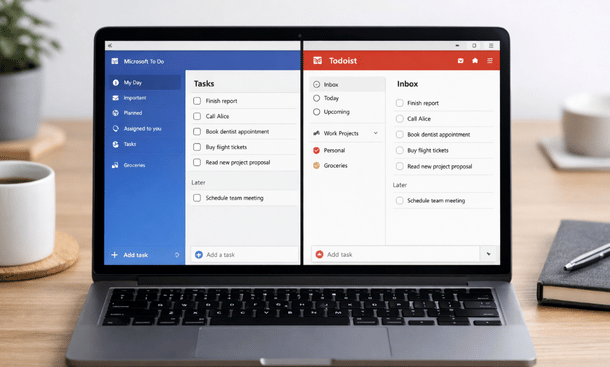
Choosing a task manager sounds simple until you actually need one that supports real startup life. I am Pamela, 35 years old, bac+3, and I spend a lot of time testing SaaS tools in real working conditions. Not demos. Not feature lists. Real days with pressure, deadlines, and limited focus. The comparison between Microsoft To Do vs Todoist comes up often among founders, and the answer is rarely about which tool is better in theory. It is about which one fits how you work today.
Both tools aim to help you get things done. They just take different paths. Understanding those differences helps entrepreneurs avoid friction early on. For a broader framework on how Microsoft To Do fits into a full productivity system, this Microsoft To Do guide for entrepreneurs gives the big picture.
Core philosophy: simplicity vs structure
Microsoft To Do is built around simplicity. The interface is calm. Options are limited on purpose. This helps founders who want clarity without thinking too much about configuration.
Todoist focuses on structure. Projects, labels, filters, priorities. It gives you many ways to organize work. For some people, this is powerful. For others, it becomes mental overhead.
Early stage startups often change direction fast. Simpler systems adapt more easily. Complex systems require maintenance.
This difference alone already guides many founders toward one tool or the other.
Task creation speed and daily use
Speed matters. When an idea pops up, you need to capture it fast.
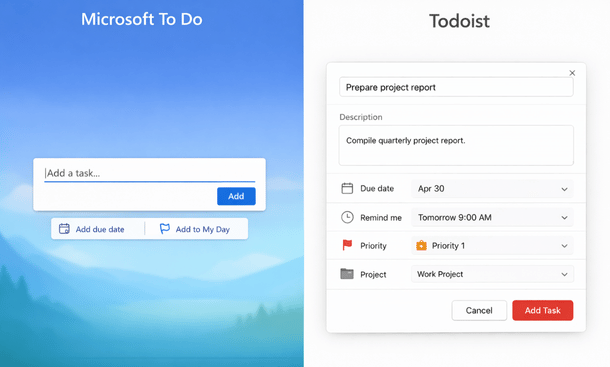
Microsoft To Do makes task creation quick and distraction free. Open the app. Add task. Done.
Todoist is still fast, but offers more fields. Priority levels. Labels. Projects. This can slow down capture when you are moving quickly.
Founders who live in reactive environments often prefer speed over precision. Tasks evolve anyway. You can refine later if needed.
Daily planning and focus
Microsoft To Do uses My Day as its central planning feature. Each day starts fresh. You choose what matters today.
Todoist relies more on filters and priorities. You can build powerful views, but they require setup and maintenance.
My Day works well for founders who prefer a daily reset. It creates a natural boundary between planning and doing.
Todoist works better for people who think in long term systems and predefined rules.
Neither approach is wrong. The question is which one matches your mental model.
Features and complexity trade off
Todoist offers advanced features like labels, advanced filters, and karma tracking. These appeal to users who enjoy optimization.
Microsoft To Do focuses on essentials. Lists. Due dates. Reminders. Steps. Notes.
For startups, complexity often becomes a hidden cost. Every feature requires decisions. Decisions consume energy.
Many founders start with Todoist, then simplify later. Others start simple and only add complexity when absolutely necessary.
Collaboration and team use
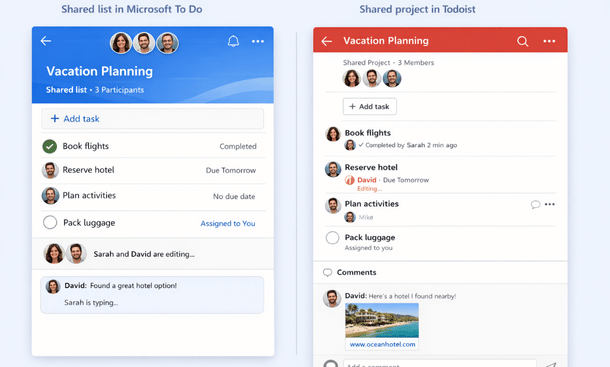
Todoist handles team collaboration more seriously. Shared projects, comments, and role management are stronger.
Microsoft To Do supports shared lists. This works well for small teams and simple coordination.
For early stage startups, shared lists are often enough. Content tasks. Admin work. Simple operations.
When teams grow, some founders keep Microsoft To Do for personal execution and use another tool for team projects.
Pricing and startup budgets
Microsoft To Do is free for most users. This lowers adoption friction.
Todoist has a free tier, but many useful features sit behind a paid plan.
For startups watching expenses closely, free matters. It removes hesitation. It encourages consistency.
When a tool is free and reliable, people stick with it longer.
Learning curve and habit formation
Habits matter more than features. A tool only works if you use it daily.
Microsoft To Do has almost no learning curve. You open it and start.
Todoist requires learning concepts like labels and filters to unlock its full power.
Founders under pressure often delay learning complex systems. Simple tools support habit formation faster.
Which tool fits which founder profile
Microsoft To Do fits founders who value simplicity, daily focus, and low maintenance systems.
Todoist fits founders who enjoy structuring work deeply and managing complex task ecosystems.
The mistake is choosing based on feature lists instead of work style.
Microsoft To Do vs Todoist is not about which tool wins. It is about which one fits your current stage and mindset.
For many early stage founders, simplicity supports execution better than structure. As startups evolve, needs may change.
Choosing the right tool is only half the equation. Real results come from how you use it every day. Learning how founders actually use Microsoft To Do for startup execution turns theory into action. For a complete view of how Microsoft To Do supports entrepreneurs beyond comparisons, this in depth Microsoft To Do guide for entrepreneurs brings everything together.
About the Author

Pamela
Pamela is a dynamic professional with a deep passion for SaaS and emerging technologies. She provides valuable insights into software trends, digital innovation, and cutting-edge tools that empower businesses to thrive and expand.
Did you find this helpful?
Your feedback helps us curate better content for the community.