
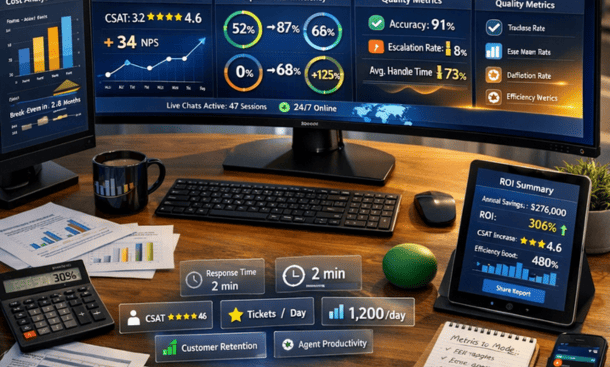
Implementing automation without tracking performance is like driving blindfolded. You need specific metrics to understand whether your chatbot actually reduces workload, improves customer satisfaction, or just creates new problems. The most valuable metrics include first contact resolution rate, average handling time, customer satisfaction scores, and cost per resolved ticket. These numbers tell you whether automation is working or where it needs adjustment. Tracking these metrics makes sense only after you’ve built a solid foundation, which we cover thoroughly in our guide on how to automate customer service with AI chatbots and agents from planning through execution.
Why most businesses track the wrong metrics
Entrepreneurs get excited about vanity metrics that sound impressive but don’t actually indicate business value. Total conversations handled by your bot seems meaningful until you realize many of those conversations failed to resolve the customer’s issue and required human follow-up.
Messages sent by your bot hits high numbers quickly but tells you nothing about effectiveness. A bot sending 10 messages to resolve a simple question isn’t performing better than one that resolves it in two messages. More messages often indicate confusion or poor conversation design.
User engagement with your bot sounds positive until you dig deeper. High engagement might mean customers are stuck in conversation loops, repeatedly asking variations of the same question because the bot doesn’t understand them. Low engagement might actually be good if it means customers find answers quickly and move on.
The metrics that matter are ones that directly connect to business outcomes: reduced support costs, improved customer retention, faster resolution times, and higher satisfaction scores. Everything else is noise that distracts from real performance evaluation.
First contact resolution rate tells the real story
First contact resolution measures what percentage of inquiries your automation completely resolves without requiring human intervention. This metric directly impacts your cost savings and customer satisfaction.
Calculate it by dividing the number of conversations your bot fully resolved by the total number of conversations it handled. If your bot engaged in 1,000 conversations last month and 700 of those never escalated to a human agent, your first contact resolution rate is 70 percent.
A well-trained bot targeting straightforward use cases should achieve 60-70 percent FCR within the first month. As you refine training and expand capabilities, this should climb toward 80 percent. Anything below 50 percent indicates serious problems with your bot’s design or training.
What good looks like across industries
E-commerce businesses typically see higher FCR rates because many inquiries involve straightforward information retrieval like order status or return policies. Well-implemented e-commerce bots achieve 75-85 percent FCR for their target use cases.
SaaS companies handle more complex technical questions, which naturally lowers FCR rates. A SaaS bot focused on account management and basic troubleshooting might achieve 60-70 percent FCR, with more technical issues requiring human expertise.
Service businesses like healthcare or professional services often see lower FCR rates around 50-60 percent because many inquiries require judgment calls or compliance considerations that shouldn’t be automated. The value still exists in triaging and gathering information before human agents get involved.
Track FCR by conversation type, not just overall. Your bot might achieve 90 percent FCR for password resets but only 40 percent for billing disputes. These category-specific metrics show where automation works and where it doesn’t.
Average handling time reveals efficiency gains
Average handling time measures how quickly your automation resolves customer inquiries compared to human agents. This metric directly translates to capacity improvements and cost savings.
Calculate AHT by measuring the time from when a customer initiates contact until the issue is resolved. For bot conversations, this includes the entire exchange until the customer receives a complete answer or escalates to a human. For human-handled tickets, measure from initial contact through resolution.
Automated responses should be significantly faster than human handling. A human agent might take 5-8 minutes to look up order status, verify customer identity, and provide tracking information. A bot should complete this in 30-60 seconds.
The time savings compound across volume. If your bot handles 500 order status inquiries monthly and saves 6 minutes per inquiry compared to human handling, that’s 3,000 minutes or 50 hours of agent time freed up. At $25 per hour, that’s $1,250 in monthly labor savings from a single use case.
Looking beyond simple time comparisons
Don’t just compare bot AHT to human AHT. Consider total resolution time including escalations. If your bot spends 3 minutes failing to help a customer before escalating to a human who then spends 8 minutes resolving the issue, your total handling time is 11 minutes. That’s worse than the human agent handling it from the start.
Track how AHT changes over time as your bot learns. Early implementations often have longer handling times as the bot asks more clarifying questions or provides overly detailed responses. As you optimize conversation flows based on real usage, AHT should decrease.
Monitor AHT by time of day and day of week. You might discover your bot performs better during business hours when customers are more focused and type clearer questions. Evening and weekend inquiries might have lower quality input that increases handling time.
Customer satisfaction scores measure real impact
CSAT scores tell you whether customers actually appreciate your automation or merely tolerate it. High resolution rates mean nothing if customers hate the experience and switch to competitors.
Send a simple satisfaction survey immediately after bot interactions: “Did this conversation resolve your issue?” with yes/no options, followed by “How satisfied were you with this experience?” rated on a 1-5 scale. Keep it short because survey fatigue is real.
Compare bot CSAT scores to human agent scores to understand relative performance. If your human agents average 4.2 out of 5 and your bot averages 3.8, that gap indicates opportunities for improvement. If your bot matches or exceeds human scores, you’ve successfully automated without sacrificing experience.
Track CSAT by conversation outcome. Successful resolutions should have high satisfaction scores around 4.5-5.0. Escalated conversations naturally score lower, but if customers rate the bot 1-2 before escalation, your bot is actively frustrating them rather than helping.
Reading between the ratings
Low CSAT scores with high resolution rates suggest a disconnect. Maybe your bot provides correct information but does so in a cold, robotic way that feels impersonal. Or perhaps it resolves issues but takes too long with unnecessary questions.
High CSAT scores with low resolution rates might indicate your bot does a good job triaging and setting expectations before escalating. Customers appreciate the quick initial response even when they ultimately need human help.
Look for patterns in negative feedback. If multiple customers mention “the bot didn’t understand me” or “I kept repeating myself,” you have a natural language processing problem. If complaints focus on “it couldn’t help with my specific issue,” you might be routing too many complex inquiries to the bot.
Cost per resolved ticket quantifies ROI
Cost per ticket shows exactly how much you spend resolving each customer inquiry through automation versus human agents. This metric makes ROI concrete and justifies continued investment in automation.
Calculate your human agent cost per ticket by dividing total support labor costs by tickets resolved. If you spend $10,000 monthly on support staff who handle 2,000 tickets, your cost per ticket is $5.
For automation, include your platform subscription cost, any integration or development expenses, and the time your team spends managing and optimizing the bot. If you pay $500 monthly for your platform and spend 10 hours monthly on bot management at $50 per hour, that’s $1,000 total monthly cost. If your bot resolves 1,000 tickets, your cost per automated ticket is $1.
The gap between human and automated cost per ticket represents your savings. In this example, you’re saving $4 per automated ticket. With 1,000 automated resolutions monthly, that’s $4,000 in savings, delivering a 4x return on your $1,000 automation investment.
Accounting for total costs accurately
Don’t forget hidden costs when calculating automation expenses. Implementation time, training data curation, ongoing optimization, and periodic retraining all require resources. The investment needed for effective AI agent training demands continuous attention, not just initial setup work.
Factor in escalation costs too. When your bot fails and escalates to a human, that ticket now costs more than if the human handled it initially. The customer spent time with the bot first, potentially getting frustrated, making the human agent’s job harder.
Calculate the break-even point where automation costs equal human handling costs. If your bot costs $1 per ticket and humans cost $5 per ticket, but your bot only resolves 30 percent of inquiries, you’re not breaking even. You need roughly 50 percent first contact resolution to justify the investment at those cost levels.
Response time metrics that actually matter
Speed matters to customers, but not all response time improvements create equal value. Responding in 5 seconds versus 30 seconds rarely impacts satisfaction, while responding in 5 minutes versus 2 hours dramatically changes the experience.
Track your first response time, which measures how long customers wait before receiving any acknowledgment. Automation should bring this to near-zero for bot-handled inquiries. Customers appreciate immediate engagement even if resolution takes a few exchanges.
Measure business hours versus after-hours response time separately. One of automation’s biggest values is 24/7 availability. Your bot might not perform any faster than human agents during business hours, but it dramatically reduces response time evenings and weekends when agents aren’t available.
Monitor response time by inquiry complexity. Simple questions should get instant responses. More complex issues requiring system lookups or data verification might take 30-60 seconds. If your bot takes 2-3 minutes to respond to straightforward questions, something is wrong with your conversation design or system performance.
Building dashboards that drive decisions
Tracking metrics is worthless if you don’t regularly review them and act on insights. Build a simple dashboard that shows your key metrics in one view.
Include week-over-week and month-over-month comparisons so you can spot trends. A 5 percent drop in first contact resolution might seem minor in isolation but signals a problem if it’s been declining for three consecutive weeks.
Set threshold alerts for critical metrics. If CSAT drops below 3.5 or first contact resolution falls under 60 percent, you should get notified immediately rather than discovering the problem in your monthly review.
Share metrics with your entire team, not just management. Support agents who see that automation is successfully deflecting 65 percent of tier-one inquiries understand they can focus on complex issues. They become advocates for automation rather than viewing it as a threat.
Creating a metrics-driven approach to customer service automation ensures you’re actually improving operations rather than just implementing technology for its own sake. These measurements guide decisions about where to expand automation, when to intervene with additional training, and how to demonstrate value to stakeholders. With solid metrics in place, you have everything needed to build and scale an effective automation program that delivers measurable business results. Understanding these fundamentals of automation gives you the foundation to make informed decisions about implementation. Learning what AI customer service automation is and why it matters helps you evaluate whether this technology aligns with your business goals and customer support strategy.
About the Author

Mateo
I’m Mateo, a SaaS blogger and digital strategist dedicated to helping startups accelerate growth through automation, data-driven decision-making, and performance-focused marketing systems. Over the past few years, I’ve worked with early-stage software companies to refine their go-to-market strategies, optimize conversion funnels, and implement scalable automation frameworks that drive measurable revenue growth. On my blog, I share proven insights from real-world SaaS cases, including actionable frameworks for churn reduction, onboarding optimization, and lead-to-customer conversion. My mission is simple: to empower founders and marketers with practical strategies that turn innovative software into sustainable, profitable success.
Did you find this helpful?
Your feedback helps us curate better content for the community.